

This article is taken from the October 2025 issue of The Critic. To get the full magazine why not subscribe? Get five issues for just £25.
Bank Holiday Saturday, North London. A city humming with the last relish of summer before holidays are over and nights start drawing in.
A close mate and I head up to the Emirates to watch Arsenal play Leeds. Over a leisurely lunch beforehand we share our news and thoughts: children growing up, parents growing old, mutual friends, work, politics, culture. Into the easy conversation of men who’ve known each other for 35 years come favourite stories, which still make us laugh just as much now as they did way back when.
The stadium fills like John Green described falling in love: slowly, then all at once. There’s a subtle but unmistakeable hierarchy amongst the thousands of replica shirts on display: the older the better, to show that the wearer was a Highbury habitué long before this shiny new spaceship landed in Ashburton Grove.

Eberechi Eze is introduced ten minutes before kick-off, and 60,000 people stand to him. Fourteen years ago, when Arsenal cut him from their academy, he wept uncontrollably, not just for the rejection but because this was the club he loved. Fulham took him on and discarded him: so too Reading and Millwall. So many kids chasing so few places. The odds against are high, the attrition rate higher still. This is the most ruthless meritocracy in sport.
Eze never gave up. QPR saw something, believed in him. Then, in the first pandemic summer, the eagles of Crystal Palace swooped. He was a Premier League player at last. For five years he illuminated Selhurst Park, becoming an England international along the way, and scoring the only goal in this year’s FA Cup Final: Palace’s first major trophy, and a moment which will bind him to the SE25 faithful forever.
Tottenham and Arsenal both wanted him. It wasn’t a choice. Some places have one’s heart; some things are meant to be. To paraphrase Jorge Luis Borges: a man travels the world, and when he returns home he discovers that the patient labyrinth of lines traces the lineaments of his own face.
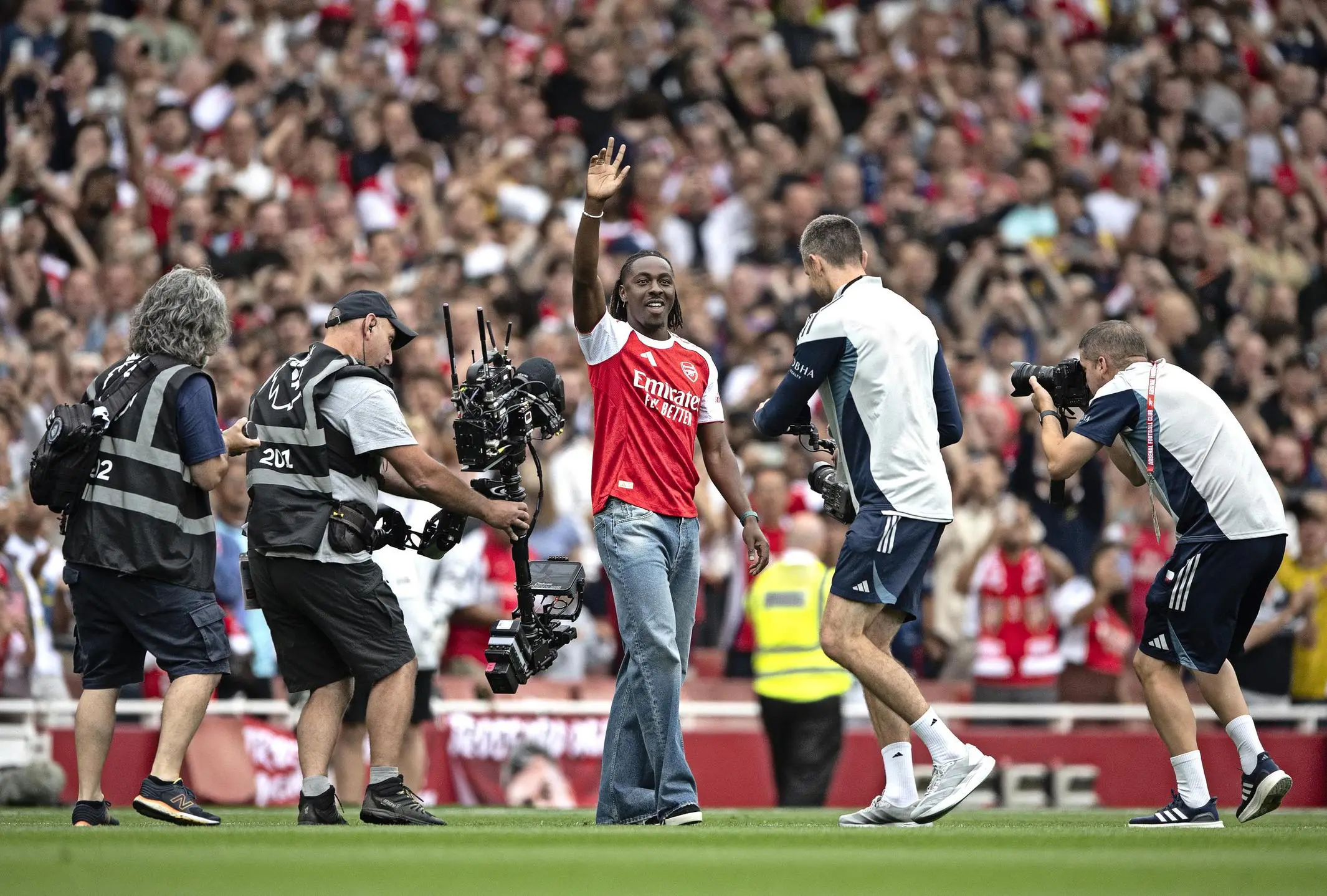
Now this particular man stands with his hand clasped to the badge on his chest, smiling and shaking his head in happy disbelief. He wears the number 10 shirt which Dennis Bergkamp once did, and just like Ian Wright, he’s come here from Palace aged 27. Big boots to fill; big childhood dreams to fulfil.
An hour and a half later, Arsenal are 4-0 up, there are 25 minutes left, and the game is safe. Max Dowman comes on, and the crowd rises to him as completely as it did to Eze. Dowman won’t be 16 until New Year’s Eve. He’s just about to start Year 11 at school: he is, absurd as it seems, still literally a kid on his summer holidays. He won’t even be allowed to share a dressing-room with his teammates until the last day of 2027.
But none of this fazes him. He kills driven passes stone dead, takes balls in full stride, goes hard at his markers. Mikel Arteta calls him “a kid that has zero hesitation and is so convinced that, at 15, he can go and deliver, which I have never witnessed in my life. For us, he brings joy, he brings emotion and something else that makes our jobs so great”.
That “something else” ripples round the stadium every time Dowman has the ball. It’s part excitement at seeing someone so young with such swagger and ability, part the sense that this is an “I was there” moment when a star is born. But most of all, it’s that he reflects something back at us, something precious, pure and innocent. Take away the stadium and the money, the fans and the tribalism, and the game is still the primal joy of controlling and propelling a sphere, of expressing one’s own skill and talent, of balancing the individual and the collective, of testing oneself.
Max Dowman, 15 years and 235 days old, is all of us, not because we have his skill but because we don’t. He holds our dreams, and if they were easy to achieve then they wouldn’t be dreams.
Pretty much everyone wants him to complete the fairytale by scoring: the crowd, his team-mates, perhaps even some of the Leeds fans. In stoppage time, he draws a penalty. The crowd clamour for him to take the kick, but it’s right that he doesn’t. His team are ruthless and respect the opposition, not just today but further down the line, too: who knows how narrow the margins will be at the top of the table come next May? So Arsenal entrust the penalty to Viktor Gyökeres, their designated taker, and he buries it with aplomb.
We file out of the stadium. A river of red and white begins as a torrent and gradually slows and thins into a delta of tributaries as fans peel off and head back to their homes and lives, to Saturday nights with friends or in front of the TV: the pilgrimage to a modern cathedral over, at least until next time.
The great Italian manager, Arrigo Sacchi, said that “football is the most important of the least important things in life”. It’s a nice quote, and true, but sometimes you only need its top and tail: football is life.


