


This article is taken from the June 2026 issue of The Critic. To get the full magazine why not subscribe? Find our subscription offers here.
Following the opening of the V&A’s East Storehouse last May, I thought the V&A might have set itself an insuperable challenge in opening a more conventional exhibition and display space only half a mile away on the opposite side of Olympic Park. How could it possibly match the scale, ambition and sense of open-ended exploration of its Storehouse in a much smaller, more bijou building?
The new V&A East Museum has been designed by Sheila O’Donnell and John Tuomey, a well-established Irish practice which has built up a good reputation in London ever since they designed a new building for the Photographer’s Gallery in Soho which opened in 2012. They were responsible for the beautiful and ingenious Glucksman Gallery, like a treehouse in parkland below the Victorian building of University College, Cork. They also designed the Saw Swee Hock Student Centre for the LSE which, like the V&A East Museum, is wilfully angular and they are soon to open a new building for the School of Architecture for the University of Liverpool.
In 2015, O’Donnell + Tuomey won an open competition jointly with Allies and Morrison to develop a set of new cultural buildings on a tributary of the River Lea next to the Queen Elizabeth Olympic Park. It was planned by Boris Johnson as Olympicopolis, an equivalent to Albertopolis in South Kensington: a series of cultural institutions, including Sadler’s Wells East, the London College of Fashion, new studios for the BBC, and a branch of the V&A originally intended to be done in partnership with the Smithsonian in Washington.
From the beginning, V&A East Museum was planned to appeal to younger and more diverse audiences than the V&A in South Kensington, based on a belief that school children in East London will only engage with museums if the displays are works of contemporary youth culture.
There have been times when I have been sceptical of this array of pepper pot designs which stand alongside one another, but not relating to each other, disguising the huge bulk of Westfield Stratford City, a monster shopping mall. But as they have opened over the last couple of years, I have been impressed by the ambition of the project, now called East Bank to match the post-war South Bank.
The London College of Fashion opened in autumn 2023, designed by Allies and Morrison. I find it a bit intimidating from outside — a mammoth industrial block towering over V&A East Museum, but with a daring Piranesian interior and the benefit of attracting huge numbers of fashion-oriented, international students to the area.
Sadler’s Wells Dance Theatre, also designed by O’Donnell + Tuomey, opened last March and is an exemplary building — calm, unpretentious, in a style which deliberately echoes the warehouse architecture of Hackney Wick, a rigorously utilitarian approach to the provision of cultural amenities.
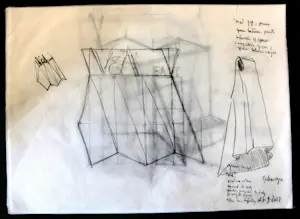
The building of V&A East Museum was apparently inspired by the logo of the V&A, designed by Alan Fletcher in 1989 and displayed on top of V&A East Museum. I think this was a naff idea and luckily, in all the years I have been looking at the building (the exterior was finished some time ago), I never realised that it was supposed to be a blown-up version of the V&A’s logo.
More recently, it has been said to have been inspired by an X-ray photograph of a taffeta evening dress. Again, I don’t see this, except in so far as the building is structurally complex, and based on the idea of overlapping layers, although the idea that the building should be based on a piece of haute couture is odd for an institution which is so determinedly demotic.

All the rhetoric surrounding the opening of V&A East Museum made me suspicious. So, I was unexpectedly surprised, and pleased, to find that inside it is a relatively conventional, well laid-out museum: two floors of works drawn from the V&A’s permanent collection organised thematically as a smorgasbord of mainly contemporary work; a huge and very generously proportioned exhibition space on the third floor; an event space on the top floor with a view out west towards the Olympic stadium and the City on the skyline; and a smart café down in the basement which opens up onto the area next door to the river.

Only Sadiq Khan has so far claimed credit for what has been achieved but if one looks back to how run-down Stratford used to be, then it is a massive, cross-party achievement, stretching back to the day when Michael Heseltine looked over a model of East London in the early days of the London Docklands Development Corporation and suggested the first phase of development should be the Isle of Dogs, the second Greenwich Peninsula, and the third, the area stretching up from the Thames on the far side of the River Lea.
Also, to give them their due, it was Boris Johnson who promoted the idea that a legacy of the 2012 Olympics should be a new cultural district; and the late Martin Roth who, when he was the V&A’s director, embarked on an expansionist policy which has given it three new institutions in East London in the last three years.


