

This article is taken from the April 2026 issue of The Critic. To get the full magazine why not subscribe? Get five issues for just £5.
The Flemish biographer Karel van Mander seems to have been the first to say it explicitly (in his Schilderboeck of 1604), but for centuries beforehand painters and sculptors knew it perfectly well: Ovid’s Metamorphoses, his great epic poem of transformations, has functioned as an alternative Bible for artists.
Both the Bible and the Metamorphoses are vast compendia of vivid, dramatic stories, or myths, which summon forth endless interpretations. The main difference is that Ovid offers very little in the way of overarching moral order, providence, consolation, redemption or salvation, to make sense of all the lust, envy, deceit and violence. He just presents, as he says in the opening line, physical change: the way bodies — through the agency of gods who behave no better than humans — are changed into new bodies.

The Rijksmuseum’s Metamorphoses exhibition, which runs until May before transferring to the Galleria Borghese in Rome, is the most ambitious and comprehensive exhibition ever to have been explicitly devoted to the influence on art of Ovid’s masterwork, starting in its own time and running through 20 centuries to the present. Here then is an enticing opportunity not only to view more or less the entire history of Western art (from Roman times) through this particular lens, but also to reflect on and reassess the continuing fecundity of Ovid’s epic of shape-changing via the astonishing creative energy it has unleashed.
The attractions of the Metamorphoses for painters and sculptors are fairly obvious: bodies are the most essential subject matter for artists, and the depiction of unashamed carnality — not always the hallmark of Christian art — was not an opportunity to be missed.
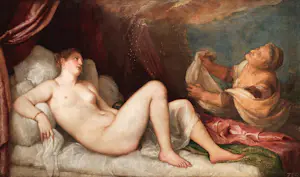
Frankly erotic images, of characters such as Danae, Leda and Io, all impregnated by the insatiable Jupiter, were probably intended to hang in bedchambers, far away from any disapproving clerical gaze. They are amongst the star attractions of the Rijksmuseum show. Of these, Correggio’s exquisite Io, apparently returning the embrace of Jupiter in the form of a cloud, stands out for its subtlety and delicacy, and its — perhaps subversive in the current climate — suggestion of reciprocated desire. That is more questionable in the case of Titian’s poesia of Danae from Apsley House apparently willingly receiving the divine shower of gold, though there is no more beautiful painting in the show.

Paul Delvaux
There are also major challenges for artists mining this rich material: Ovid’s subject is not just bodies, but the way bodies change or are transformed. How can artists making two-dimensional, or even three-dimensional, images capture the moment of, or the sense of, transformation?
The curator of the Rijksmuseum show, Frits Scholten, is the museum’s head of sculpture, so it is perhaps not surprising that the sculptural exhibits make an especially strong impression. Constant, often rapid, movement is a hallmark of Ovid’s poem; sculptures are as frozen in time as paintings, but the fact that the viewer needs to move around them to appreciate them fully makes them seem less static.
Here the first Ovidian tale which comes to mind (and one of the few not to end violently) is that of Pygmalion, the sculptor who fell in love with his own creation, a statue of a woman of perfect beauty, which the goddess Venus, taking pity on his infatuation, brought to life. Maybe the best-known version of this story is not a painting or a sculpture but George Bernard Shaw’s play, in which a crusty professor “corrects” the speech habits of a street girl, only for her to turn the tables on him and demand that he improve his own behaviour, shed his arrogance and sense of superiority and begin to respect others as equals.
The Metamorphoses show also features a subversive retelling of the Pygmalion myth by the Belgian surrealist painter Paul Delvaux, whose haunting, dream-like Pygmalion shows a naked woman embracing a limbless, stony-looking statue of a naked man. Is the frozen, abstracted male artist being brought back to life by his living, breathing, model-lover?

Rodin’s Pygmalion and Galatea subverts the myth in a different way: Pygmalion is changed from the rather peculiar, quasi-misogynist, dreamy, obsessive, image-haunted character in Ovid to a bearded, virile hunk with almost ape-like arms, grasping after a nubile young woman who seems, at least from her knees upward, quite unmarmoreal. This is more a self-portrait of the artist lusting after his model than falling in love with his creation.
Other sculptures command especial attention, including a wonderful first century AD Roman head and half-torso of a Minotaur. In Book VIII of the Metamorphoses, Ovid makes only passing mention of the Minotaur — the half-bull, half-man offspring of King Minos’ wife Pasiphae and a magnificent white bull, which the King out of shame hid in the labyrinth constructed by Daedalus. But the sculpture manages to convey the pathos of a creature doomed to eternal captivity, trapped in between identities, struggling to be free. A similar mystery and ambiguity is conveyed, in even more pared-down form, by Brancusi’s head of Prometheus from the Philadelphia Museum of Art.
The outstanding sculptural exhibit, however, is the Sleeping Hermaphroditus from the Louvre — a lifesize second century AD Roman sculpture of an unclothed sleeping figure for which Gian Lorenzo Bernini, in 1620, carved an extraordinarily lifelike marble mattress and pillow. This marvellous work has a room to itself, and the initial view is of what appears to be a young woman, seen from behind, before, in a beautifully orchestrated and lit theatrical trick, the visitor is drawn to see the sculpture from the other side, with its male genitalia coming as what Philip Larkin in another context called a “sharp tender shock”.

Here the Ovidian tale of the nymph Salmacis and the virginal Hermaphroditus — essentially a story of violent female lust and the virtual rape of an innocent — is transformed into an image of ambiguous repose, which, apart from its prefiguring of contemporary debates about gender fluidity, is also, and perhaps more fundamentally, a kind of answer to the enigma of unassuageable and incommensurable desire.
For the English poet Algernon Charles Swinburne, visiting the Louvre in 1863, the statue evoked feelings of both “strong desire” and “great despair” — a wish perhaps to awaken the sleeping figure from its erotic limbo, the “waste wedlock of a sterile kiss”. Perhaps the Rijksmuseum curators missed a trick by not including, as an optional soundtrack, the British prog rock band Genesis’ 1972 track “The Fountain of Salmacis”, which follows Ovid remarkably faithfully.

The Rijksmuseum show includes a number of tapestries, an art form often regarded as essentially decorative. But in this context, looking at tapestry versions of Ovidian tales prompts reflection on the importance, even centrality, of weaving both as subject-matter and metaphor in the Metamorphoses.
If the perpetuum carmen of Ovid’s Metamorphoses — its apparently endless tapestry of stories — has a centre, that might be the tale of Arachne, the brilliant weaver who dared to challenge Minerva to a contest, and who was punished for her artistic virtuosity — outshining Minerva’s own — by being turned into a spider. Arguably the greatest of all paintings inspired by the Metamorphoses, Velázquez’s Las Hilanderas (which never moves from the Prado in Madrid and so could not be included in the show) is also one of the most radical and multi-layered. By filling the entire foreground with a group of humble spinning-women, Velázquez implicitly comes down on the side of Arachne, the human artisan-artist, against the “high and mighty” goddess, who appears against a tapestry (apparently based on a Titian painting of another Ovidian tale) in the background.
Beyond the frame of art history, what reflections does this show inspire about the meaning and value of the Metamorphoses themselves? As the Bible itself recedes from knowledge, is this alternative “Bible for artists” faring any better? In a post-Nietzschean, post-Freudian age, we might say that the Metamorphoses are like the semi-repressed id of the culture, as opposed to its Christian superego and its Enlightenment ego. Here are all the lusts and desires, envies and hatreds, which Christianity tried to repress with its moral overlay. Of all Freud’s doctrines, the return of the repressed seems to be the one which has lasted best.

But, in a violent and disorderly world where, on the political level, “might” seems increasingly to be coterminous with “right”, do we need still more violence and cruelty? In what ways can the Metamorphoses continue to inspire us in a positive way? They will not provide us with any renewed moral code or compass, but they can help with something equally important: the re-enchantment of the world or what the psychologist James Hillman would call encouraging us to fall back in love with the world.
Western scientific thinking from Bacon and Descartes onwards led us to think of nature as dead matter or, at best, neutral raw material to be reshaped for human ends. In the Metamorphoses, nature is alive, ensouled; a dripping stone could house the spirit of a grieving woman (Niobe) or even become a living woman (Galatea); a laurel tree might be a transmutation of a fleeing girl (Daphne); a spider might be continuing the spinning work of a brilliant, proud human weaver (Arachne); a nest of snakes might represent (or so Freud argued in “Das Medusenhaupt”) the terror evoked by a woman’s pubic hair. The poem is a celebration of imagination, or the act of making images.

Beyond even that, and as declared at its outset, the Metamorphoses is about transformation, or as the Rijksmuseum’s director Taco Dibbits puts it “What happens if gods touch mortals”. That is, transformation of a different order from the human reordering of nature for human ends.
These transformations may often be shocking, apparently unjust, even outrageous, but they may reveal truths of which the conscious, rational mind is unaware. And if nature, including that of humans, is transformable, that means it is also endlessly full of possibility. Thus the story of the Metamorphoses’ relationship with art has no full stop and will continue to be written: Juul Kraijer’s Spawn (2019) is a 14-minute video installation of pythons crawling over a woman’s face. Neither she nor the viewer is turned to stone — rather the effect is of fear being assuaged and turned to beauty. Or, as the poet Louis MacNeice put it in “Snow”, “World is crazier and more of it than we think”.
Metamorphoses is at the Rijksmuseum, Amsterdam, until 25 May and at the Galleria Borghese, Rome, from 23 June to 20 September.


