

This article is taken from the February 2025 issue of The Critic. To get the full magazine why not subscribe? Right now we’re offering five issues for just £10.
At the start of the new year, we all might need a little cheering up, to drown out the suspicion that Albanian president Enver Hoxha had it right when he told the population on New Year’s Day 1967, “The bad news is that this year will be harder than last year. The good news is that it will be easier than next year.”
So what better way to achieve this than with books that make us laugh? The first is a novel that, like the god Janus who gives his name to January, looks both back and forward. It looks back because Allen Bratton’s Henry Henry was published in mid-2024, but attracted little attention at the time. Yet it is so impressive that it requires us to break with the publishers’ schedules and trumpet it now. And it looks forward because it is a debut novel that gives us high expectations of what its talented author will write next.
Henry Henry tells the story, as the title suggests, of two Henrys — a father and a son. The elder is 44 years old when the book is set, in 2014, and he is the 16th Duke of Lancaster, having taken the title when his cousin Richard died; the other is Henry’s 22-year-old son and heir, Hal. If bells are not yet ringing faintly, their chime may become clamorous if I add that Hal’s friends include characters named Jack Falstaff and Poins.
Yes, Henry Henry is a retelling of Shakespeare’s Henriad tetralogy, covering the rise of Prince Hal, lowered a few rungs — but only a few — down the social ladder. Hal Lancaster here is a gay man, a perpetually overdrawn trustafarian living within his expectations but beyond his family’s means (“We lost everything in the Reformation,” his father laments), with a surfeit of sex and drugs to distract him from the aimlessness of heirdom.

Hal does have a job, or at least an internship for now, at the British Policy Institute, but his main occupation — not unreasonably for his age — is socialising, and the book is structured around a series of Hal’s encounters. Always, these are exquisitely described by Bratton. Hal has sex with Jack Falstaff, an actor summarised thus: “Then he was in a string of flops, and his looks went, and he got fat, and younger, handsomer men took his place, and the world went on, leaving him living on bit parts, using his talents mostly in the service of getting other people to pay for his drinks.”
He visits his widowed father Henry, who has recently become engaged to a younger woman, and who rants eloquently about the late cousin Richard: “He made a league of painted narcissists, a private army of grasping aesthetes who dressed just like he did and spoke just like he did and for all that they’d contributed to the world would have been better off stillborn.”
Oh, and there’s a third Henry in this story: Henry Percy — Hotspur in this reading of Shakespeare — who is Hal’s peer and great frenemy. Successful where Hal is not, he greets our man with, “I hadn’t heard from you in so long I was worried you were finally making something of yourself.” (Hal, silently, concludes that Percy “would probably look like a stick of rhubarb when he was forty-five”.)
As these quotes suggest, this is a book driven by a certain caustic wit, and therein the pleasure lies. The model here, to an almost incestuous degree, is Edward St Aubyn when he was still good, i.e. in Patrick Melrose territory. Indeed, there are echoes of the Melrose novels in Hal and Henry’s father-son relationship and even in Hal’s helpless addiction to irony: “It’s totally fine, I’ve got a lot of brothers,” is Hal’s response when Percy accidentally shoots him during a hunting weekend.
And when Hal gazes out from the family seat of Monmouth House and reflects that “rich foreigners paid thousands of pounds to feel for a day what Hal had felt always: that he had a right to the land, to the things living on the land, including the people”, I was reminded of St Aubyn’s David Melrose, and how “the expression that men feel entitled to wear when they stare out of a cold English drawing room onto their own land had grown stubborn over five centuries and perfected itself in David’s face”. This comparison is not idle: St Aubyn’s Melrose books are one of the great fictional projects of the last 30 years, and Bratton, in his debut, is breathing down their necks already.
Is this, then, a perfect novel? No: Bratton’s desire both to pay tribute to Henry IV and its sequels and to depart from them leads to some forced plot points, as well as the need to switch narrative devices implausibly late in the game; and the central Henry-Hal relationship has some curious aspects. Nonetheless, this is a good novel, a very good debut novel, where there’s a pleasure in every paragraph and a tartness to the story to set off the sweetness of the prose.
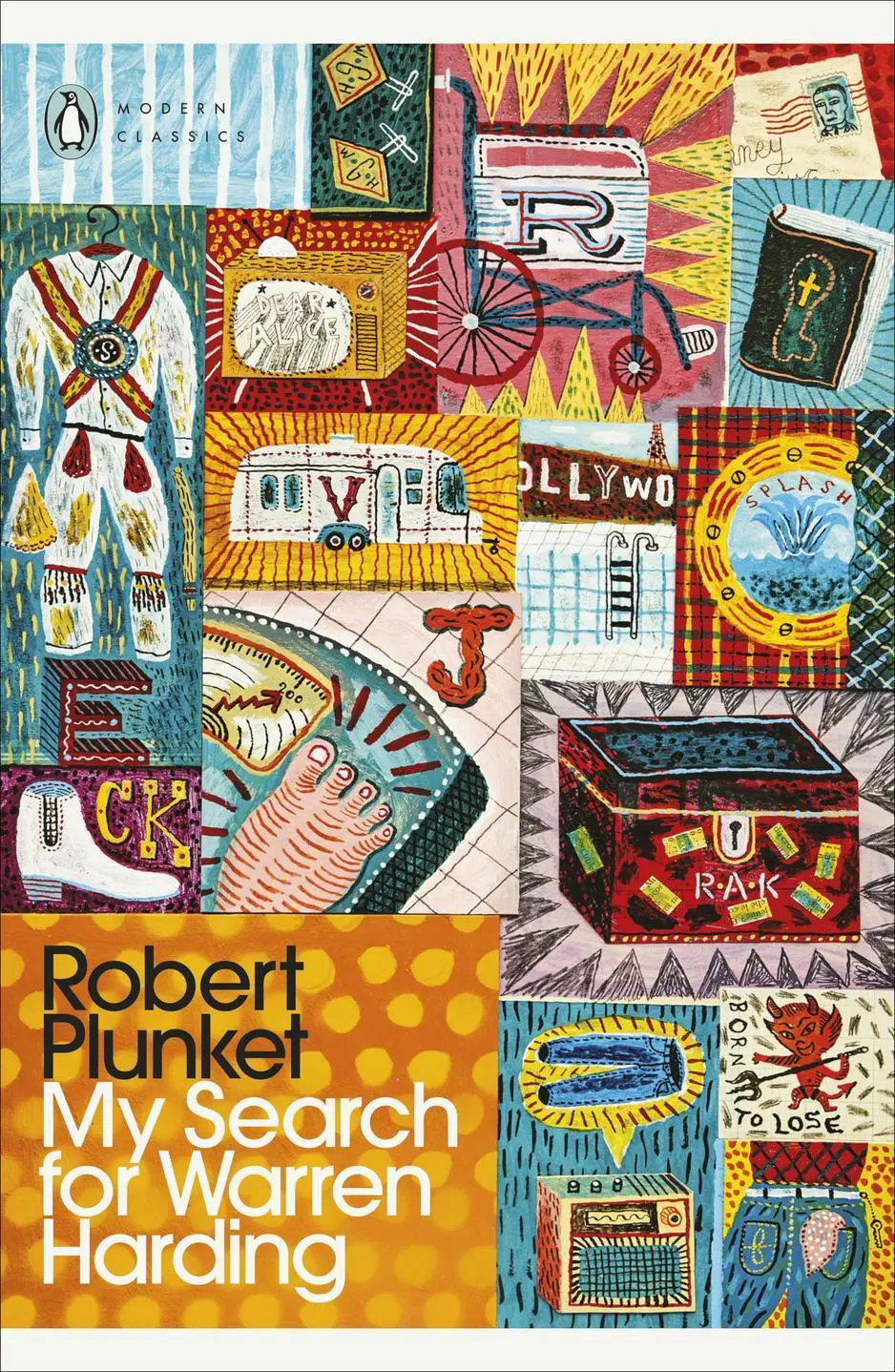
A more straightforward comedy, but no less achieved, is Robert Plunket’s My Search for Warren Harding, first published in 1983 and now reissued with a timing that says nothing of contemporary literary fashions but simply pays tribute to evergreen effervescence.
Like Henry Henry, it works as comedy on the line level, but also in its farcical set-up. The narrator is Eliot Weiner, a snobbish social climber in 1980s Los Angeles and Morris dancer (“rugby for the effete”) who takes an interest in Warren G. Harding, “the shallowest President in history”, who died in office in 1923 leaving behind him a string of extramarital affairs.
That much is on the historical record, but Weiner’s obsession is with a fictional mistress — Rebekah Kinney, who wrote a book about her affair with Harding and is now in her eighties.
To acquire a putative cache of Harding’s love letters, Weiner rents a room in the house where Kinney lives with her granddaughter Jonica, and the story cycles between his capers with the family and Kinney’s as told in her memoir. This provides Plunket with opportunities for comedy as broad as it is long, with quips about a character “who had survived Auschwitz. And not as an inmate, if you see what I mean”, or a fashion-conscious woman who appears at a party “not so much dressed as decorated”.
There’s physical comedy too, as Weiner’s willingness to do anything to worm his way into the family affections leads him to seduce Jonica. On their date he wears cut-up Pampers nappies under his armpits to control his noxious sweating — which makes things awkward when things go further than he expected on a first date. (“She had a lot of dimples. Everywhere.”)
But most of all what My Search for Warren Harding conveys is a devil-may-care, not-giving-a-damn energy that makes no concessions to taste, simply offers its manic vision to the reader and says “take it or leave it”. I’ll take it.
The Dutch author Toon Tellegen is perhaps not a name to conjure with in British literary circles, but I greatly admired Raptors, his 2006 poem sequence about a family and its father, so I was thrilled to see the first English translation of one of his novels. The Hedgehog’s Dilemma, translated by David Colmer, is described in its blurb as one of a series of “witty philosophical animal fables for adults”.

At the beginning of the book, the hedgehog in question is sitting alone in his home and thinking about how nobody ever visits him. This seems strange when the other animals nearby “were constantly visiting each other, sometimes for no reason at all”. And so he hits upon the bright idea of inviting all the other animals to his house.
“Dear animals,” he writes, “I hereby invite all of you to come and visit me.” Then he adds, “But if nobody comes, that’s okay too.” It is this addendum which reveals his character. The hedgehog is a hedger of his bets, and his specialist subject is overthinking. And so he decides not to send the letter just yet. “[He] thought about those two words. Not and Yet.”
Instead of doing, he doesn’t. He thinks about doing and imagines the consequences of his invitation, branches of possibilities splitting off into a speculative future, constructing complexities out of nothing but air. “There’s nothing my mind likes more than changing,” he observes. “I’m at its mercy.”
He pictures and enacts visits from the different animals — rhino, frog, bear — each expressing a different point and different aspect of the hedgehog’s own extrapolated character. “Help! Help! Who knows what’s wrong with me?” the hedgehog asks, midway through his dilemma. “But no answer came,” we’re told.
As far as philosophical fables go, this is more fable than philosophy, but there’s a gentle charm to the story, exemplified by the running joke of a snail and a tortoise, making a slow journey together to the hedgehog’s home and bickering all the way. The Hedgehog’s Dilemma isn’t as sharp or complex as Raptors, and it won’t change your life — but it might brighten up your new year and sometimes that’s enough.


