

This article is taken from the February 2025 issue of The Critic. To get the full magazine why not subscribe? Right now we’re offering five issues for just £10.
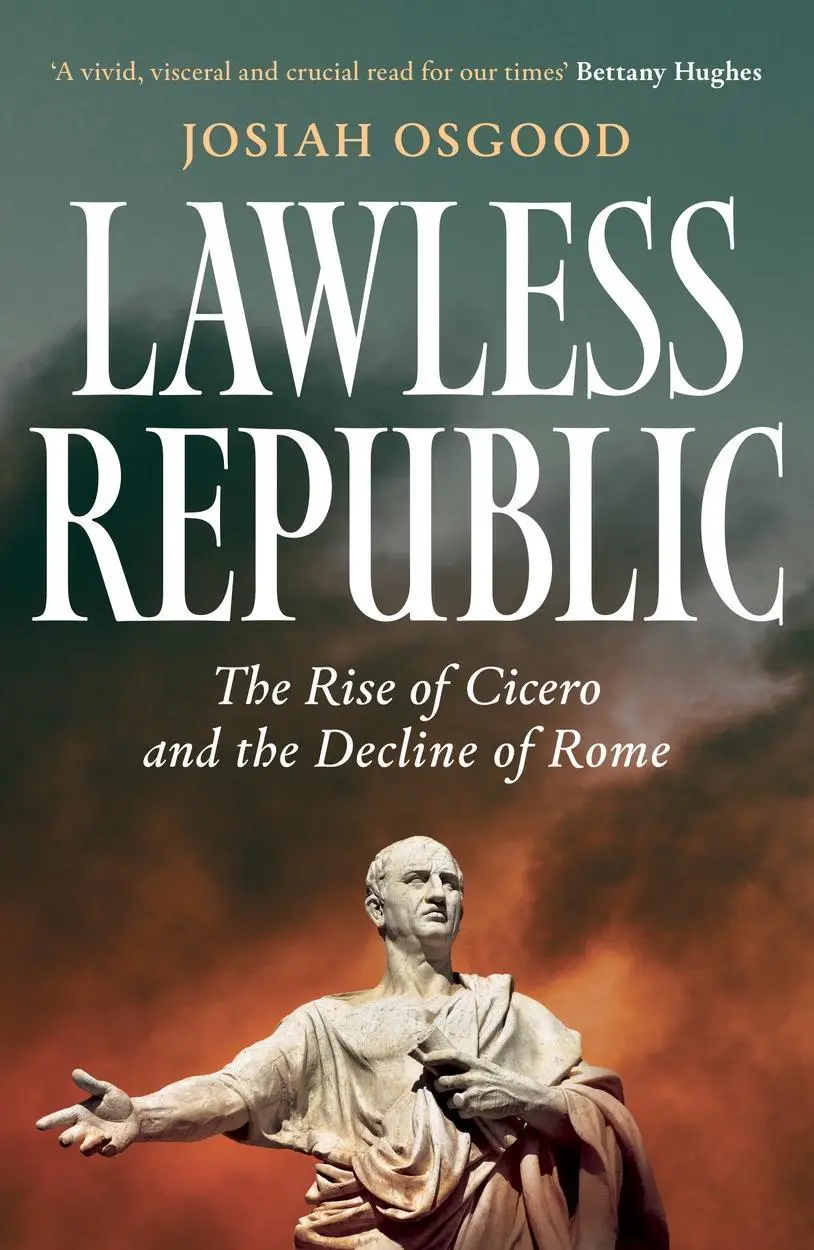
Josiah Osgood, professor of Classics at Georgetown University and author of the excellent history of the Roman civil war Caesar’s Legacy (2006), has turned the clock back to the decades preceding that conflict. Lawless Republic is the story of the Roman Republic’s fall, presented through the lens of a series of criminal trials involving the orator, statesman and philosopher Marcus Tullius Cicero.
Osgood charts the republic’s terminal descent into violence, anarchy, civil war and collapse via the activities of Rome’s standing courts, where the city’s wealthiest and most politically engaged citizens met to duel for justice. If these courts were founded with the noble goal of allowing aristocrats to settle disputes without recourse to violence, Osgood shows how, as the first century BC wheezed towards its conclusion, they became venues where the powerful met to flex their muscles. Inquests aimed at cooling tempers became trials of strength, fanning the flames of partisan politics.
It doesn’t require a great deal of imagination to see why Basic was so keen to publish such an account. An American audience that has seen its president-elect attend his own sentencing hearing might well be eager to hear how such a script might end.
Yet, to his immense credit, Osgood stoppered his ears to the siren song of facile domestic comparisons. Whilst this book muses at its beginning and end on how the judicial woes of the Late Republic might give us pause for thought today, it steers clear of drawing straight lines between Rome’s murder courts and modern examples of political lawfare.
What we have instead is a brisk narrative of the Roman Republic’s final years, from Sulla’s voluntary vacation of his dictatorship down to Julius Caesar’s rather more forcible exit from his. The thread we follow to guide us through this labyrinth (our cicerone, if you will) is Cicero’s booming legal practice.
Our vignettes to this collapse come in the form of trials for murder, extortion, incest and public violence. Connective tissue is provided by biographical material from Cicero’s life, recollections of moments in Roman legal history and analysis of Cicero’s rhetorical craft.
If that makes Lawless Republic sound a bit lumpy, I’m afraid that’s not an inaccurate description of the end product. Fundamentally, the book lacks a firm conception of what it wants to be. The text bobs uneasily on competing currents: now dragged in the direction of a narrative history, then pulled back by the riptide of biography; now hoist upwards on a wave of literary criticism, then caught in an eddy of political philosophy. This book contains interesting and important observations on all four of these topics, but none is given sufficient room to breathe.
This volume shines when it allows Osgood to do what he does best: slow the narrative down to a walking pace and luxuriate in the small details that bring these stories to life. His narrative of the playboy patrician Clodius’ trial for invading the rites of the Bona Dea (Good Goddess) whilst dressed as a serving girl is richly detailed, judicious in its analysis and offering a gripping narrative of a wounded beast, cornered by hypocritical forces, desperately seeking an escape. It is a crime to be reckoned alongside Verres’ ransacking of Sicily that the rest of the book is not allowed to follow this model.
Osgood hobbles his own account of this tumultuous period by his decision to structure the majority of the book’s chapters around the speech delivered at a Ciceronian trial. He is more than capable of building up a strong head of narrative steam when setting the scene for each trial — be that a throat slit in the middle of the night or the armed insurrection of an over-taxed populace.
Once the trial begins, however, that momentum collapses into simple paraphrase of Cicero’s oratory. In some cases, Osgood pulls it off: his summary of Cicero’s defence of Cluentius is masterful; more frequently, however, one comes to dread the appearance of the quotation mark.
Ultimately, this is a missed opportunity. For a work that has at its heart the ipsissima verba of the most eloquent son of Rome, Cicero the man has almost no presence on the page. One looks in vain for the personality that was just as enchanting and enraging to his contemporaries as it is to those who read him millennia later. By all means read Lawless Republic to ground yourself in this period of history, but do go on to treat yourself to the master’s own unmediated voice.


