


This article is taken from the June 2026 issue of The Critic. To get the full magazine why not subscribe? Find our subscription offers here.
I have measured out my life, not with coffee spoons, but with Madonnas. The eighties Boy Toy I knew from my first awareness of pop culture became the Sex Madonna of the nineties, and then — just as it seemed she’d run out of ways to shock — she transformed into the clean and spiritual Madonna of the millennium. Ray of Light came out in 1998 when she was nearly 40.
At the time, this seemed an impossible age. Aretha Franklin and Tina Turner had both carried their careers into middle age, but they were respectively the Queen of Soul and the Queen of Rock ’n’ Roll — genres that valued heritage.
Madonna was the Queen of Pop, and pop had an attitude to ageing that made Logan’s Run look friendly. Having scandalised the public in seemingly every possible way, Madonna was about to confront probably the greatest taboo in pop.
By the late nineties, there was a feeling that Madonna was past her prime. She hadn’t had a US number one in four years. She had also become a mother — another thing marking her as decisively past her youth.
Her most recent project had been starring in the film version of Andrew Lloyd Webber’s Evita. Moving into musical theatre was effectively a door slam on her provocative past and a move into age-appropriate safety.
It’s that context that makes Ray of Light more than a great pop album, or even a great Madonna metamorphosis. It’s also a revolution in what it meant to be a female pop star. Ray of Light caught the sixties influences that had swirled out of the Cool Britannia moment (Madonna worked with British producer William Orbit), melded them with electronica and trip-hop, and turned them into the setting for some of Madonna’s most searchingly personal lyrics.
From the goth-y drama of lead single “Frozen”, Ray of Light felt entirely Madonna but also entirely new. This wasn’t a kitschy reprise of her earlier success, and it wasn’t an escalation into further reaches of softcore (where did she have left to go?). It was just great music by someone clearly in her creative prime.
At the time, I was nearly 18, and I looked on the attainment of majority as a kind of threat. As I understood it, once the clock ticked over on my birthday, I would be facing a fixed store of years before the inevitable irrelevance of 40. Almost all the cultural messages I received assured me that, beyond the fourth decade, a female life could hardly be worth living.
And then came Madonna — the role model who assured me that being an adult woman was something to aspire to. It wasn’t just me. Madonna’s example of maternity seemed to open the door for pop stars such as Mel Blatt of All Saints and Natasha Hamilton of Atomic Kitten to insist on their right to motherhood without giving up their music careers, bumps proudly out on stage.
So I take Madonna’s evolutions personally, although I’ve found them less exciting as the 21st century has dragged on. I’d argue that her last true reinvention was in 2005, when the single “Hung Up” launched Confessions on a Dancefloor in a blaze of leotards and a throb of Abba samples.
This was a back-to-the-nightclub Madonna, and she stayed in that mode for the next 20 years, ratcheting up the filth quotient on the way.
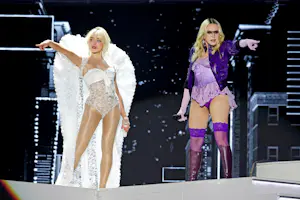
Then, this April, she swept her Instagram clean in preparation for an announcement: a new album, but also a return to a former self. Later this year Madonna, now 67, will release Confessions II, the sequel to Confessions on a Dancefloor.
Effectively, it’s hitting the reset button on the last two decades of her career, and my immediate reaction was as much relief as excitement.
If anything, her inter-Confessions period has been more artistically restless than ever before, as she’s hunted down new collaborators and experimented with different genres, from rap to hyperpop to Latin trap. But these experiments have felt vibe-chasing rather than zeitgeist-defining: less like an artist inventing the future as she goes along, and more like someone scared of being left behind.
Her appearance is part of it. At 40, Madonna looked 40: a very healthy 40, a probably botoxed 40, but a 40 whose skin and sinew had the texture of living tissue.
By the 2020s, her face had the swollen smoothness that suggests too many injectables, and her body the improbable curves of surgical sculpture. She became a testament to the denial of time. Instead of embracing change, Madonna now is a study in the struggle for inertia.
Madonna almost certainly doesn’t care what I think. As she sings (with Sabrina Carpenter) on “Bring Your Love”, the lead single of Confessions II: “Don’t comment on my ideas/I don’t want your judgement or your expectations”.
When they debuted the song at Coachella, both wore corsets, and Madonna — a bit less puffy these days — looked spectacularly age-defying. Only when she moved could you detect the tell-tale stiffness in her shoulders. Her voice feels limited, in a way that makes me suspect she’d rather inhabit what’s left of her previous range than embrace the one age has gifted her.
Confessions II feels like a retreat for Madonna — into her past, away from mortality, and away from humanness too. Madonna taught me how to grow up; I wish she’d teach me how to grow old, too.


