

This article is taken from the June 2026 issue of The Critic. To get the full magazine why not subscribe? Find our subscription offers here.
Through the 1990s, Rupert Thomson was the perpetual next big thing. Anyone who read him thought it was only a matter of time before he became a household name. His best books — Air & Fire (1993), The Insult (1996) and The Book of Revelation (1999) — combined storytelling nous with something uncanny or otherworldly.
Yet despite this originality and variety — or maybe because of it — it never quite happened. “I always thought my career would move in a McEwan-like path”, Thomson said in 2013. It’s an astute observation: like McEwan, Thomson started off “surreal and dark and macabre” but his recent novels have been more mainstream. McEwan-like commercial success, though, has not happened.
Still, Thomson has continued to publish novels to acclaim in the decade since, even if prizes and bestseller lists remain elusive. And his fifteenth novel Dark is the Morning — much better than its mediocre title and worse cover suggest — proves how he can still make the reader jump and think at the same time.
A framing device from a man called Harry sets us up: he is reflecting on the events that took place in the early 2000s in a house in Abruzzo, on the “fertile slopes” before the Adriatic Sea. And then we’re off, for the bulk of the story, to the events themselves, narrated by a young man named Gino.
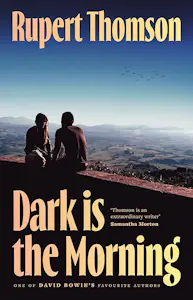
Gino is the son of a family from Caracciolo, to where he returns with some reluctance in his early twenties, after a decade of dead-end jobs, addiction, psychiatric care and — worst of all — backpacking. There are other hints of Gino’s dissatisfactions: his father, for example, “was always there when I fell. Not to catch me, though. No, never that.” His father has a reputation as a hero, for foiling a fascist plot in the 1970s — or so the family story goes.
Still, Gino makes the best of his return by catching up with a local girl Franca, recalling how in their teens she had boldly declared, “One day I’m going to marry you.” And as it turns out, she’s been waiting for him. They have something in common, Franca observes, in that they’re both living and working below their potential. “But maybe we could be something different — to each other.”
Gino reflects how wondrous this is, “to be able to open up a whole new world with one short sentence”. But he needn’t be surprised: that is his creator’s stock in trade, and Thomson goes on to deliver a series of brilliant set pieces: concise, telling, rich. Miniature scenes — Gino’s car strikes a shedding lorryload of model tigers from a funfair; Franca tells him about a former suitor who made vague threats when she ended their affair — provide food for characterisation as well as narrative drive.
Things go pretty frictionlessly for Gino and Franca — they move in together, she becomes pregnant, even Gino’s despised father dies. One in, one out. Even in his open coffin, Gino observes, “there was a disdainful curl to his nostrils, as if he could smell something he didn’t like”.
And yet our man remains on edge, particularly thinking of Franca’s ex, Pierozzi, and those veiled threats. It’s when we observe that Gino tends to gloss over his account of being sectioned that we wonder where all this is going to go — and how much we can rely on what he tells us.
And so, despite its surface sheen, this is a pretty dark story. When the baby is born, Pierozzi tells Gino, “There’s something I want you to remember. I was there first.” We also get the return of the uncanny elements from Thomson’s earlier books, but at heart this is a meticulously structured novel about concealed pasts and how we overcome them — or don’t. There’s a case that Thomson’s smooth skill may undercut the nastiness in the heart of the book (and of one character in particular), but overall this is a story where you can both stand back and admire the architecture and live vividly inside it like the characters themselves.

It’s the tenth year of the International Booker Prize, and, by the time you read this column, this year’s winner will be known. But your intrepid critic has read all of the shortlisted books, and, whichever novel triumphs, there can only be one people’s winner, which is Daniel Kehlmann’s The Director.
It’s a widescreen slab of traditional literary fiction that, after an initial framing device (those are very popular these days), gives us a rollicking account of the wartime life and work of the real-life Austrian film director G.W. Pabst. At the start of the book, in the 1930s, Pabst is in America, where his efforts to move cinema from “spectacle and eye-rolling” to something “like theatre, like a novel, like true art” aren’t helped by philistine but enthusiastic movie executives (“That’s just terrific!” “Really great!”). He rubs shoulders with great talents, even when they know they are. “Metropolis is the greatest film ever made,” he tells Fritz Lang, who replies, “I know.”
All this is academic when Pabst and his wife Trude in 1939 decide to return to Europe to look after his ill mother. The ship is empty. “Everyone wants to go to America,” a steward tells him. “No one wants to come back.” He buys and moves into Dreiturm Castle in southern Austria, where a sign of the times comes from their oleaginous retainer, Jerzabek, who assures Pabst that “I don’t want the master and mistress to end up like the scum in the concentration camp”.
When war is declared and leaving is impossible, things pick up — Nazis swarm in, their previously quiet presence now unhindered. But Pabst needn’t worry, surely, since the regime wants his skills. He is called to Berlin where, in a terrific scene, the Nazi minister threatens and cajoles him into agreeing to channel his desire to make “deep films for deep people!” to the service of the party.
So proceeds a chilling account of how the soul can be destroyed from within as Pabst tries to hamper his work to prevent it from seeing the light of day. It’s a novel with some similarities to Julian Barnes’s The Noise of Time, about Shostakovich’s compromises with the Soviet authorities, but Kehlmann’s approach is broader and more purely entertaining. Characters are big, including Leni Riefenstahl and her “skull-like smile”, and there’s even a cameo from prisoner of war P.G. Wodehouse, who narrates one chapter.
Here, no one is safe. “Critics? We have no critics!” one Nazi figure tells Wodehouse. “Criticism is a Jewish genre that no one needs. Instead we have art appreciation.” In a world where criticism is not permitted, a man who was “once a feared critic”, the Nazi says, is now “one of our subtlest describers”. I hereby, unsubtly, describe this book as very good and a sure fire hit irrespective of Booker success.

Having completed the run of Maigret novels in new translations, Penguin now turns to Georges Simenon’s romans durs, that is, his “hard novels” of psychological intrigue. The latest of these is Letter to My Judge, first published in 1947 and previously translated into English as Act of Passion. The letter is from a doctor on criminal trial to the examining magistrate who put him there. Our scribe, Charles Alavoine, cannot stomach his status as a criminal defendant, when he was previously on the same social level as the judge.
This is a book not just about desire, but the human need for desire: that we want to want more, always. Alavoine, as a stereotypical Frenchman — like Simenon himself, who claimed to have slept with 10,000 women — has an eye for the ladies. His first, in his youth, was Sylvie, whose presence was “the first time I’d wanted a life other than mine”.
He marries Jeanne, who was “gentle like my mother” (paging Dr Freud!) but cheats on her with 18-year-old Laurette, whose “thick thighs” lead him to “sprawl over her like an animal”. When his wife dies, “it strikes me as terrible that I never tried to find out what she thought or who she really was”.
But finding out who people really are is Simenon’s speciality. It was his focus in the Maigret books, and, with the romans durs, he casts his net wider. For Alavoine there is another wife, and another key lover, to come. And our narrator digs deep in working out the reasons for his infidelity, even if only to excuse it to himself.
None of this would matter if he weren’t on trial; for what crime, we find out only later. The gift of this book is to blend page-turning charm with a prising open of the darker corners of the psyche. Some of Alavoine’s motives are obvious: his second marriage, however comfortable, was the status quo, where with his later lover, Martine, “the world was changing by the hour”.
And when he moves her into the marital home, under guise as his prospective assistant, the friction is so great — they are always adjacent, but not truly together — that we know something terrible is coming. But we delight in it all the same. Simenon’s novels are short but weighty, and he wrote so many of them that we can find new pleasures from him for years to come. He was a man of great appetites in more than one field.


