

This article is taken from the May 2026 issue of The Critic. To get the full magazine why not subscribe? Get five issues for just £5.
How many people who casually invoke the Weimar Republic really know why it fell? The Bauhaus and the cabarets, the hyperinflation and the jackboots are familiar, but, if we are ignorant of what actually destroyed the first German democracy a century ago, we risk misunderstanding the threats to our own.
One historian who really does know the politics and culture of Germany from 1918 to 1933 is Victor Sebestyen. In a crowded field, Weimar Germany: Death of a Democracy towers above its competitors. From the shocking violence to the exhilarating culture of Weimar, Sebestyen is a master of his material.
His own Hungarian heritage has equipped him with a delicate sensitivity, what Germans call Fingerspitzengefühl, for the precarious balance between the individual and the state that is required to lend legitimacy to a liberal constitutional order. Germans took full advantage of their new civil liberties, but many were never prepared to concede legitimacy to the republic inaugurated in their name at Weimar in 1919. After the collapse of the Habsburgs, Hungary also ran the gamut from Béla Kun’s Bolshevism to the authoritarian régime of Admiral Horthy.
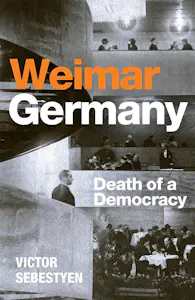
Sebestyen’s book has obvious contemporary significance. As I write, Viktor Orbán’s experiment in “illiberal democracy” seems to have run its course, despite frantic efforts by Russian and American allies to keep him in office. Yet we cannot know the destinies of nations and should beware of pretenders to prescience. The Federal Republic may yet suffer the fate of Weimar at the hands of mountebanks who boast of their “alternative for Germany”.
Sebestyen tries to chronicle events from the perspective of his subjects, who had no inkling that a demobbed demagogue from Austria would ultimately snuff out their future. “There was nothing inevitable about the failure of the Weimar Republic,” he insists.
Contingency, then, flickers throughout this narrative like the neon illuminations of the Berliner demimonde. What if Max Weber, polymathic pioneer of social science, had not browbeaten the other architects of the Weimar constitution into creating a directly-elected president with strong emergency powers — thereby turning the Republic into what he called a “plebiscitary” or even “Caesarist” system?
For all his omniscience, Weber did not foresee the danger of combining a British-style parliamentary system with an executive presidency — unlike Hugo Preuss, who actually drafted the constitution but was overborne by Weber.
If the foreign minister Walther Rathenau had not been assassinated outside his Grunewald villa in June 1922 by proto-Nazi thugs of the shadowy Organisation Consul, the French occupation of the Ruhr and the subsequent hyperinflation might have been averted.
Yet Rathenau had recklessly dismissed his security detail a few days earlier. The outpouring of grief after his death would have been an extraordinary display of republican loyalty even if he had not been murdered for the crime of being a Jew. Not that Rathenau was any less echt deutsch than his killers: his recessional was Siegfried’s funeral march from Wagner’s Götterdämmerung.

Or consider the case of Friedrich Ebert, the affable Social Democrat who served as president for the first seven years of the Republic. Had he not acquired an insatiable appetite for litigation — he sued for libel 173 times — he might not have died at 54, just after losing a case. So popular was Ebert that, in an improvised gesture of respect, during his funeral all traffic in Germany stopped for five minutes.
Ebert was succeeded by Field Marshal Paul von Hindenburg, then 78, whom Sebestyen holds chiefly responsible for the destruction of the Republic after just 14 years — “one of history’s guiltiest men”. He does not need to spell out the parallels with another septuagenarian leader whose vanity, malevolence and sheer stupidity may yet ruin a republic that has lasted 250 years.
But Hindenburg would not have been able to use his emergency powers to undermine parliamentary democracy and ultimately install Hitler as chancellor, had it not been for the many millions who voted for the enemies of the Republic. The Communists and Social Democrats hated each other more than the Nazis, whilst the polarised media enabled people to live in echo chambers. Sebestyen’s verdict is harsh but just: “It was the German people who killed their democracy through a form of mass political suicide.”
True enough: for all his lethal use of violence, lies and propaganda, Hitler knew he could not smash “the Weimar system”, as he contemptuously called it, by means of a putsch. He had tried that in 1923 and failed ignominiously. Power could only be obtained through the ballot box.
What made the Nazis different? They were younger and cooler than other parties, and they told bigger and more brazen lies. Many of those who voted for the Nazis had been too young to fight in the Great War. Apart from Hitler himself and Goering, this was also true of many Nazi leaders: Goebbels, Himmler, Bormann and Speer, for example, had never seen action. The Communist leader Ernst Thälmann, by contrast, was a decorated war veteran. At 43, Hitler, was Weimar’s second youngest chancellor when he took over in January 1933. The Nazis represented a younger generation than the leading figures of the Republic, several of whom died in their fifties, including Weber, Rathenau and Ebert.

Another premature death robbed Weimar of its greatest statesman, Gustav Stresemann. He had saved Germany from inflation, invasion and insurrection but died of heart disease in 1929, on the eve of the Wall Street Crash. Had he lived, could Stresemann have rescued the Republic? Improbable but not impossible: the last days of Adolf Hitler might have come in late 1932, when the Nazis lost votes and nearly disintegrated. “If the party falls to pieces,” Hitler said, “then in three minutes I will make an end [of myself] with a pistol.”
If the Chancellor at this point had been the courageous and energetic Stresemann, rather than the cynical and ineffectual General Kurt von Schleicher, the Republic might have risen Lazarus-like from its deathbed, as it had already done in 1923.
But Stresemann wasn’t cool: stout, bald and bull-necked, in frock coat and stiff collar, he resembled all the other Weimar politicians. Hitler and his paladins looked different: their stylish apparel, their use of branding and spectacle positioned them in the vanguard of image-building.
Along with modernity came mendacity. Not for the Nazis the “workaday small lies” of ordinary politicians, but the “big lie”: “In the greatness of the lie there is always a certain element of credibility,” Hitler wrote. Facts were irrelevant, “for the most impudent lie always leaves something lingering behind it — a fact that is known to all the great expert liars in the world.”

When Hitler wrote these words in 1924, one of those expert liars, four years younger than him, was getting his first lucky break. A mere assistant librarian, Mao Zedong was amongst the cadres of the then tiny Communist Party chosen by a Soviet emissary to join the executive committee of China’s dominant Nationalist Party. Just as Hitler butchered the Weimar Republic, so Mao would go on to infiltrate, hollow out and ultimately dismember the Republic of China, Asia’s first experiment in parliamentary democracy.
Frank Dikötter’s scholarly, readable and brilliant history of the rise of the Chinese Communist Party upends the self-serving narrative nurtured by Mao and perpetuated by his successors, including Xi Jinping. He demolishes the mythology of the “Long March” of 1934-5: it was actually a military disaster, and Mao did no marching but was carried in a sedan chair.
Dikötter shows how Mao’s ultimate triumph over his Nationalist rival Chiang Kai-shek was by no means inevitable. It would not have happened without serious support from Moscow, sustained over many years during which the Communists languished in obscurity. And it would never have happened without violence and cruelty on an industrial scale.
Nor is there an easy answer to the question posed in America after 1949: who lost China? Dikötter emphasises the influence of the American journalist Edgar Snow’s 1937 bestseller Red Star Over China, which put Mao on the map for the first time — the beginning of a process that persuaded the West to accept the Communist claim to be the party of the Chinese peasants. Snow was still acting as a secret conduit to Mao when President Nixon went to China in 1972. Dikötter shows how, once Japan had been defeated and China began to move towards elections, the Truman administration was deceived into believing that, as Mao said, “Chinese democracy must follow the American path”.
In the end, the US dumped Chiang and his Nationalists, who fled to Taiwan. It would hardly be surprising if, faced by an ultimatum from Xi backed by overwhelming mainland forces, Donald Trump were to abandon Taiwan, too.


