


This article is taken from the May 2026 issue of The Critic. To get the full magazine why not subscribe? Get five issues for just £5.
It is not hard to imagine the problems that arise when unusually gifted people occupy the same quarters. The kind of people who create things out of nothing: novels, poems and operas. Or simply dress up and show off on stage.
In 1940 a group of talented men and women did shack up in such a house. Middagh Street, Brooklyn Heights, was the location, over the East River from Manhattan. “The February House”, it was called, because they seemed to share birthdays in the second month.
Half a century later Sherill Tippins wrote a fine book about the lodgers who called it home for an eventful year.
Wystan Auden occupied the top floor of the three-storey brownstone with his boyfriend Chester Kallman, when the promiscuous Kallman wasn’t trying to attract other partners. On the floor below lived a very different homosexual couple, Benjamin Britten and Peter Pears.

The ground floor belonged to Carson McCullers, the alcoholic, mentally disturbed novelist, and Gypsy Rose Lee, who wrote the G-String Murders when she wasn’t shedding clothes on stage. Rodgers and Hart wrote a song about her in Pal Joey, produced on Broadway in 1940.
“Zip” it was called, with Larry Hart’s knock-out line: “I’m a broad with a broad, broad mind”. Hart supplied another zinger, which has gone down in the annals of musical theatre: “I was reading Schopenhauer last night — and I think that Schopenhauer was right”. Auden, who was collaborating with Britten at the time on Paul Bunyan, a musical entertainment, never revealed that level of wit. It must have stung.
Others came and went, as Gregory Woods described in a Sunday Feature for Radio 3. Christopher Isherwood, Kurt Weill, Lotte Lenya and members of the Thomas Mann clan popped in, and Paul Bowles lived there briefly with his wife Jane. Bowles, a composer, achieved a certain réclame later in life as a novelist, but he was a bit-part player in this tale.
Leonard Bernstein came across the river to see them. Lincoln Kirstein and George Balanchine, great figures from ballet, were other guests. Salvador Dalí, as Woods didn’t mention, made an appearance. What a bunch. Gifted and impossible to live with. The household fell apart at the end of 1941, when the Japanese strafed Pearl Harbor, and Americans realised there was a worldwide conflict they could no longer ignore.
Auden, a colossal bossy-boots, became an American citizen. Britten, the principal victim of the poet’s intellectual bullying, went to California with Pears and returned home in 1945 to compose Peter Grimes, his opera about a Suffolk fisherman.
The US premiere at Tanglewood in 1946 was conducted by Bernstein, who wrote a symphony, The Age of Anxiety, based on a poem by Auden, who in turn dedicated a poem to Kirstein. It was a round dance.
McCullers wrote The Ballad of the Sad Café, The Member of the Wedding and, best of all, The Heart is a Lonely Hunter. She was a troubled soul, from Georgia, and died in 1967 aged 50. Bowles decamped to Morocco, for the usual reasons, and wrote The Sheltering Sky, filmed by Bertolucci.
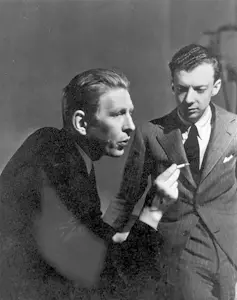
When Auden died in Vienna in 1973, Kallman said that life without him was “unimaginable, unmanageable”. He was the odd one out in Middagh Street, the lodger without discernible talent, though Auden gave him a joint credit on the libretto of The Rake’s Progress he wrote for Stravinsky.
Britten spent the rest of his days avoiding his former collaborator. Though he and Auden had attended the same school, Gresham’s in Norfolk, Britten was a cold man who required solitude. What he was doing in the February House is a mystery, though he did compose Sinfonia da Requiem, one of his finest works there.
Woods, who describes himself as a poet and “cultural historian”, overlooked that piece, which was probably the most impressive work any of these Bobby-dazzlers completed in Middagh Street. He was more interested in the “queer” aspects of the story, a word emphasised by his expert witnesses, of whom Tippins was the most reliable.
The homosexual element cannot be ignored. Equally it is not the most interesting part of this fascinating experiment in living. Neither Auden nor Britten was eager to parade their sexuality. They were what they were and didn’t draw attention to their sexuality. The idea of gay liberation would have left them cold. They liberated themselves through their genius.
There was a turning of the tables after the war. Auden, so original in Europe, waned in America, whilst Britten waxed in Suffolk. Both men left a body of remarkable work, and that is good enough.
A pity then that Paul Kildea, billed as a Britten expert, thought that Auden “had to educate him”, because the composer was “hopelessly middle-class”. So was Auden, actually, and so is Kildea. Seven out of 10, therefore, for this well-meaning programme — and the dunce’s cap for Kildea.


