

No ‘Sacrifice to Oblivion’: Studies on Monuments and Commemoration for Paul Cockerham
edited by David Lepine & Christian Steer
(Donington: Shaun Tyas, 2025)
ISBN: 978-1-915774-24-8 (hardback)
430 pp., many col. & b&w illus.
£40.00

This splendid Festschrift is stuffed full of marvellous information concerning commemoration and memorialisation in essays by several scholars, including Fr Jerome Bertram (who was a priest at the Oratory, Oxford) and other distinguished individuals connected with the Church Monuments Society, the Monumental Brass Society, the Society of Antiquaries of London, the Worshipful Company of Armourers of the City of London, and various Universities.
Paul Cockerham (born 1957), is a Cambridge man, and while an undergraduate became enthused by Gothic art and architecture while also studying to become a vet. Later, when running his veterinary practice in Cornwall, he began an MPhil, later developed into a PhD at the University of Exeter, on memorialisation and the Cornish funeral-monument industry 1497-1660. His interests then extended over a wider geographical area in England, Ireland, France, and north-west Germany, particularly with regard to work produced by Flemish craftsmen, and his learned publications on funerary monuments earned him both respect and kudos. During his stint as editor of Church Monuments: The Journal of the Church Monuments Society I had the pleasure of dealing with him, and his courtesy and kindness when helping to prepare my own modest offerings for publication earned my lasting gratitude.
Join Britain’s most civilised publication.

Challenge the consensus. Access rigorous analysis.

The book under review is (mostly) wonderfully illustrated with numerous glorious things, especially incised slabs, memorial “brasses”, and other commemorative artefacts. David Meara, formerly Rector of St Bride’s, Fleet Street, and Archdeacon of London, contributes a sensitive essay on the beautiful “brasses” designed by William Butterfield (1814-1900), including those for the Revd John Keble (1792-1866) in the church of All Saints, Hursley, Hampshire, and for William Henry Dawnay (1812-57), 7th Viscount Downe and his wife, Mary Isabel, in the great church at Baldersby St James, Yorkshire, also designed by Butterfield.
The late Clive Burgess (d. 2023), formerly Professor of Mediæval History at Royal Holloway, University of London, provided a fascinating piece on All Souls’ Day in the Charnel Chapel of Old St Paul’s cathedral, subtitled “Commemorating London’s Unnamed Dead”, mentioning the “Dance of Pauls”, where the skeletal dead depicted in murals in the Pardon churchyard pointedly admonished even the high and the mighty. Unfortunately, this erudite essay lacks illustrations, apart from a rather unhelpful and rudimentary map of the cathedral and its precincts, and some efforts should have been made to provide some visual aids to better understanding the piece.

Generally speaking, the illustrations in this tome are very most informative, but there are some horrible amateurish examples with converging verticals, including a vile snapshot of the east end of Albi cathedral, two very disappointing photographs of Lord Burghley’s magnificent funerary monument in St Martin’s church, Stamford (the colour is murky as well), two other images of the monument to Richard Cecil and his wife in the same church, and a poor shot of the Burghley/de Vere monument in the St Nicholas chapel, Westminster abbey. Other illustrations which should not have been reproduced include a detail from the Alington tomb in Bottisham, Cambridgeshire, and it is a puzzle as to why the two very dim blurs purporting to show the effigial slab of Bernard de Camiat in Albi cathedral were included at all, as they are so dark almost nothing in them can be seen.

But these are minor quibbles in a book full of delights, sound scholarship, and glorious things. The copper-alloy effigy of Bishop Heinrich Bocholt (d.1345) in Lübeck’s cathedral is a miraculous survival, as so much was destroyed in that fascinating Hanseatic city during World War II: it is wonderful and dignified, a masterpiece of Flemish-inspired sculpture of the time.
I have a particular love for what can still be enjoyed in northern Germany, and have known Lübeck in particular for many years, so it is pleasing to see reproduced here the noble “brass” of Johannes Lüneburg (d.1461) in the city’s Katharinenkirche, an exquisite and elaborate work, aptly described by Reinhard J. Lamp of Hamburg as “in a class of its own”. It is indeed, and Lamp does full justice to it, as he also does to the monumental brass to Thomas Pownder, his wife, and children (1525) in the redundant church of St Mary Keys (St Mary-at-the-Quay) in Ipswich, Suffolk: this is Flemish work, probably exported ready-made from Lübeck to Ipswich. I was also refreshed to see references to another lovely German city I have known well, even half a century ago: Schwerin, in the Dom of which are yet more superb things, including the brasses of Bishops Ludolf (d.1339) and Heinrich (d.1347) von Bülow.
Professor Robert Marcoux of Université Laval, Québec City, Canada, contributes an erudite and well illustrated account of the documentary evidence concerning the funerary monuments of Notre-Dame, Paris, given that any student of the tombs of mediæval and early modern France quickly learns to appreciate the great works of 17th– and 18th-century scholars who have provided the only visual or written descriptions of monuments that Revolutionary vandalism destroyed.

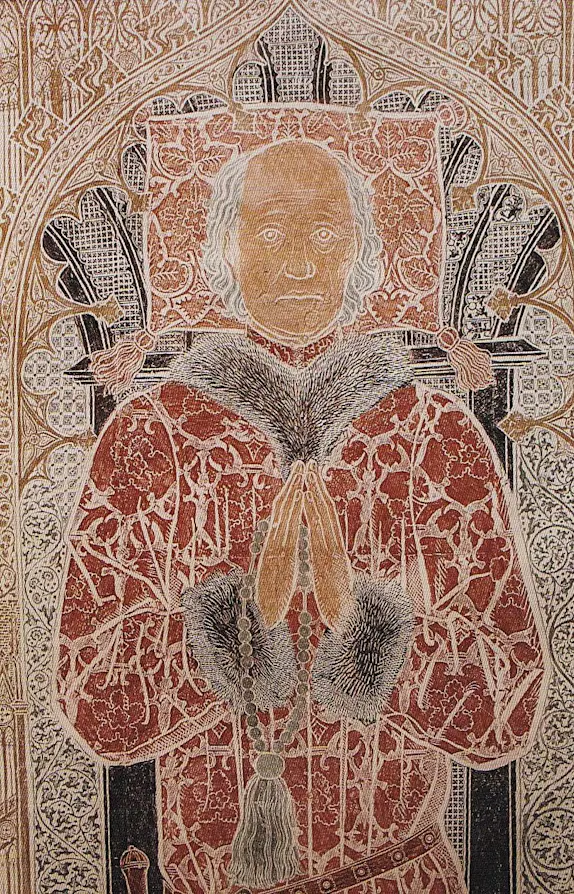
David Lepine gives us a detailed study of the brass of a former Rector, Henry de Codyngton (d.1404), in the church of St Mary at Bottesford, Leicestershire, with eight figures of Saints on the orphreys of his cope, a type deliciously described as inhabited orphreys. It is a splendid piece of work, “almost episcopal in its magnificence”, with microarchitecture in the form of triple canopies over the figure, a particular sign of high status. Lepine compares the Codyngton brass with others of similar design in various places, and illustrates these. However, the full-page photograph showing Codyngton’s brass surrounded by the showy and later Manners monuments, Earls of Rutland, is far too dark, and could have been lightened (or re-taken).

Other essays in this very interesting tome are by Tobias Capwell (representation of armour on a brass in Exeter cathedral); Nigel Saul (on commemoration and dynastic extinction, with reference to the brass of Margery Arundell in Antony, Cornwall); Christian Steer (on a palimpsest from mediæval London); Jerome Bertram (on the Bewforests of Dorchester, Oxfordshire, and their brasses); Joanna Mattingly (on bench-ends, a fascinating paper, with stunning illustrations); Nigel Llewellyn (on Lord Burghley’s monuments, unfortunately not helped by poor-quality photographs); Amy Louise Harris (on monumental transactions in early modern Ireland); Elizabeth Tingle (on memorialisation of cathedral canons in France during the 16th and 17 centuries, with particular reference to the Counter-Reformation); Nicholas Rogers (on the Fortescue brass in Huddington, Worcestershire); Jean Wilson (on the recording of overseas contacts on early modern English funerary monuments, although some of the photographs could have been better); Shaun Tyas (on tombs in ghost stories); a sympathetic recollection of Cockerham’s career by Christian Steer; a short and affectionate foreword by Sophie Oosterwijk; and a list of Cockerham’s published works, all of which are well worth a read.

Church-crawlers will be well aware of the treasures that can be found in our parish churches and cathedrals, though there are iconoclasts in the Church who would be ideologically delighted to cast out the lot, especially if the individuals commemorated do not conform to what is regarded as virtuous today. Self-righteous prigs are usually neo-puritans, of a casuistical and prying disposition, always keen to burn somebody and to smash something, often curiously preoccupied with the sexual activities of youth, and utterly devoid of any æsthetic sensibility whatsoever: such destroyers are obviously impervious to the splendours illustrated and described in this revealing tome, the contents of which should encourage conservationists although they will enrage thin-lipped, humourless wreckers.

Cockerham and the contributors to this volume have all played their parts in recording, interpreting, and appreciating the art and architecture of commemoration, and their efforts are to be applauded as a counter-balance to the forces of destruction that are so obviously in the ascendant within the Churches, and are especially virulent in the Anglican Communion.
I do, however, have a few reservations, even though I welcome this tribute to a great scholar. The paper used in the book is too thin, so the shadow of the next page shows through every sheet. I have mentioned illustrations that are too dark, or have ghastly converging verticals, or are too murky and unclear, so a rigorous editorial purge of poor illustrations should have prevailed, yet obviously did not. More’s the pity, as a book of this quality and type should not be marred by inferior images. Finally, the index is not quite good enough, as a tome of scholarly material, wide-ranging in its subject-matter, really does need a fully comprehensive index, and this one does not rise to the occasion, even omitting the Umlaut in Bülow.
Nevertheless, No ‘Sacrifice to Oblivion’ is a very welcome addition to the literature on a truly absorbing subject, and, considering its size, very reasonably priced too in these dispiriting times. Shaun Tyas is to be commended as publisher of this and other worthy volumes: many years I purchased from him Sabine Baring-Gould’s Lives of the Saints in the 1914 edition published by John Grant in Edinburgh, and its marvellous tales have been agreeable bedtime reading ever since, so I am grateful to him for that and for other fine publications which grace my own library.


