

This article is taken from the April 2026 issue of The Critic. To get the full magazine why not subscribe? Get five issues for just £5.
In Agatha Christie’s Murder on the Orient Express, 12 passengers come together to avenge the murder of three-year-old Daisy Armstrong. In the film adaptation featuring David Suchet (easily the best version, with apologies to Albert Finney and Kenneth Branagh), Poirot denounces this act of “kangaroo justice”: “You have no right to take the law into your own hands!” he tells the conspirators. “We looked to the law for justice,” says Daisy’s grandmother in their defence, “and the law let us down.” No, replies Poirot: “The rule of law, it must be held high, and if it falls, you pick it up and hold it even higher.”

As Jonathan Brown observes in this learned and engaging book, the film’s denouement brilliantly captures the perennial tension between substantive and procedural justice. This tension had already been recognised by Aristotle. Considering the relationship between legal justice and equity (epieikeia — the word used by Paul for the “gentleness” of Christ), Aristotle explains that difficulties arise because the law deals in general terms, whilst actual legal cases are specific. Equity, therefore, is a “rectification of law insofar as law is defective on account of its generality”.
The tension between equity and law, Brown points out, is felt particularly acutely in Islam, where law — the Sharia — is believed to be divine, perfect and comprehensive. When the divine law appears to clash with our sense of justice — as Islamic family law does in the view of Muslim feminists, for instance — can it truly be considered divine?
Though undoubtedly catalysed by the globalisation of liberal values in modern times, such concerns are nothing new. Muslim responses have taken several forms. Within the majority Sunni tradition, the dominant view has been that justice is simply what God says it is. “Lying,” says al-Ash’ari, the founder of the leading school of Sunni theology, “is only evil because God has declared it to be evil … And if He declared it to be good, it would be good.”
On this view, divine law and equity are synonymous. As the 19th century Yemeni jurist al-Shawkani wrote, “Justice is what accords with what God has legislated, and injustice is what contravenes it.”
Yet this theistic subjectivism has been counterbalanced by the idea that the Sharia works towards the achievement of certain ends. From the 11th century, many Islamic jurists came to hold that there were five essential “aims of the law” — the preservation of religion, life, reason, lineage and property — an idea which has often been used to adapt the law in line with changing needs and circumstances.
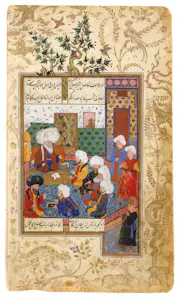
Abu Sa’ud Teaching Law, a 16th century illustrated manuscript depicting a prominent scholar discussing
law with theologians
A third solution is an institutional one. Whilst the Sharia has primarily been enforced through the court of the qadi (a judge trained in Islamic jurisprudence), in the mid-8th century there emerged a separate judicial forum called the mazalim, tasked with ensuring that justice was done when the qadi’s court was unable to provide an equitable resolution to a legal dispute.
From an Arabic word meaning “injustices”, the mazalim, in its ideal form, was to be administered by the sovereign or his representative, and so was a key mechanism for siyasa, the ruler’s duty to ensure that justice was upheld. Rooted, as Muslim theorists acknowledged, in the practice of the kings of Sasanian Persia, from its establishment at the beginning of the Abbasid period until the drastic restructuring of Middle Eastern and South Asian legal systems in the 19th century, the mazalim was a key plank of legal practice across the Muslim world.
Passing through Cairo in 1326, the Moroccan traveller Ibn Battuta found that the Mamluk sultan al-Malik al-Nasir would “hold sittings every Monday and Thursday to investigate complaints of injustice and receive the petitions of complainants”. Three centuries later, the Venetian Niccolao Manucci, reporting on several cases from the mazalim court of the Mughal emperor Shah Jahan, stressed how “anxious” the sovereign was that “justice should be administered in his realm”.
Brown’s reconstruction of the theory of the mazalim is based on three interrelated texts. At the centre of his account is a treatise written by the late-15th century Persian scholar Jalal al-Din Davani, one of the greatest Muslim theologians of the post-classical period. His treatise was based on a chapter from a famous work on political theory by the 11th century jurist al-Mawardi, and was itself the inspiration for a text by the 19th century Ottoman reformer Ahmet Cevdet Pasha.

For each of these authors, the mazalim was helpful for navigating a moment of crisis: al-Mawardi wrote in the wake of the collapse of the Abbasid caliphate as an effective temporal authority; Davani amidst political chaos in Southwestern Iran; Ahmet Cevdet to justify the Ottomans’ modernising Tanzimat reforms.
Particularly in times of chaos, they argue, the mazalim provides a means for safeguarding the interests and rights of the Muslims. It can do so because the magistrate overseeing it enjoys greater procedural flexibility than the qadi. Specifically, he can resort to the intimidation or judicial torture of suspects, can rely on circumstantial or written evidence (whereas the qadi has primarily to rely on confession, oral testimony or oaths), can pick and choose between the rulings of the different schools of Islamic law, and can order disputes to be resolved through mediation.
In drawing attention to these texts, Brown has two aims. First, he wants to show that the mazalim did not, as some scholars have suggested, administer a secular form of justice, but was in fact an essential part of the Sharia. “The judgment of the mazalim tribunal,” Davani insisted, “is the judgment of the Sacred Law.”
More ambitiously, he proposes that, as an expression of the state’s obligation to enforce justice, the mazalim is a resource that can help Muslims work through some of the tensions between the Sharia and contemporary morality.
In a previous book on Slavery and Islam, Brown introduced “the Slavery Conundrum”, the challenge of reconciling a commitment to a religious tradition that accepts the legitimacy of slavery with the view that slavery is always morally wrong. Here he presents the solution: the most compelling Islamic argument for abolitionism is rooted in siyasa — specifically, in the ruler’s ability to “restrict what is permitted” in the interest of public welfare.
In this way, Brown (who is himself Muslim) seems to be laying the ground for a kind of Islamic post-liberalism, where politics and law are shaped by Aristotelian-cum-Islamic notions of justice and the common good. Certainly, the history and theory of the mazalim underscore the widespread idea in Islamic thought that the Sharia is meant to be enforced here on earth, through the coercive power of the state.
Readers who would prefer the tension between law and equity to be resolved in the next life, by contrast, can appeal to the authority of Hercule Poirot. When one of the killers on the Orient Express appeals to the existence of “a higher justice”, the devoutly Catholic sleuth replies: “Then you let God administer it!”


