


This article is taken from the June 2026 issue of The Critic. To get the full magazine why not subscribe? Find our subscription offers here.
I do enjoy a well executed counterfactual or “alt” history television drama. Thus far, nothing has topped The Man in the High Castle, based on Philip K. Dick’s novel set in a post-war United States occupied by Japan and Nazi Germany. Apple TV’s Star City is definitely strong competition. The series unfolds in a smaller arena — the Soviet space programme — but is no less creatively ambitious.
It’s the early 1970s and the height of the Brezhnev epoch known as the “Period of Stagnation”. But not in Star City, which crackles with energy, ambition and intrigue. There a team of dedicated scientists, technicians and brave cosmonauts are preparing for journeys beyond the moon as far as Venus.
Star City is a spin-off of For All Mankind, Apple TV’s long-running series about space exploration. In both counterfactual dramas Russia has beaten America to the moon but Star City works perfectly as a stand-alone. Strong character development drives the story forward in an increasingly paranoid hothouse of fear, betrayal and adultery.
The Soviet Union’s dreary, vanished empire is brilliantly reconstructed, most of all in the corruption of human relations — a place where even husbands and wives cannot trust each other. All the cosmonauts’ homes are bugged. The dead, heavy weight of Soviet bureaucracy permeates every episode. Yet the team still shows courage, comradeship and determination to explore the final frontier.
Somewhere in Star City there is a mole, planting a device in the rocket and leaking information. Anna Maxwell Martin delivers a stand-out performance as the truly terrifying Lyudmilla Raskova, the space centre’s KGB security chief. Raskova boasts of her time liberating Berlin in a Soviet tank driving down roads littered with German corpses. When an apparent traitor is found, she swiftly delivers a bullet to the head.
Even if the victim was innocent, the system cannot make mistakes, she explains. First-class acting, superb attention to period costume and setting detail make Star City engrossing, chilling viewing.
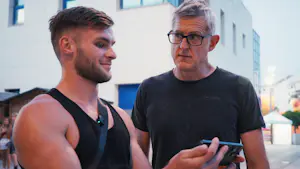
The very online world known as the “Manosphere” may be unfamiliar to most Critic readers. But it’s one that we should all know more about. The Manosphere is the thriving ecosystem of high profile influencers and social media feeds on platforms including TikTok, livestreaming platforms Twitch and Kick, Instagram, YouTube and more.
Inside the Manosphere, Louis Theroux’s Netflix documentary, takes us right inside this dark realm. It’s a pretty ghastly spectacle: a hyper-aggressive cluster of misogynistic, sexist online lynch mobs shot through with conspiracy theories.
Much of the programme revolves around Harrison Sullivan, known as HSTikkyTokky, and the American Amrou Fudl, known as Myron Gaines. Sullivan is the son of Victor Ubogu, a former England rugby star. Ubogu was a largely absent father, and Sullivan was mainly raised by his mother Elaine whilst he went to private school in Essex. Fudl once served as an agent for the US Department of Homeland Security.
Theroux guides the story along in his usual low-key curious style, unafraid of appearing the geeky boomer uncle, puzzled and concerned at what he is witnessing. His unobtrusive approach allows the manosphere influencers to unabashedly portray themselves as they wish.
A brief exploration of Sullivan’s fractured relationship with his father brings a flash of vulnerability and loss and could have been explored in more depth.
Some scenes seem ripped from a post-modern Ballardian nightmare: Theroux films and is simultaneously filmed and live-streamed, his utterances sliced and diced for insta-hits. Inside the Manosphere is not pleasant or enjoyable. But it is necessary viewing.
This is the world where legions of young men now live online. Shock and outrage are relentlessly monetised for vast profits. Complex human interactions and emotions are reduced to a stream of clicks and reposts. Women are there to be docile partners and service their men’s sexual needs. I don’t know what the answers are, or how to stem this tidal wave of fury and misogyny amongst young men. But something in post-industrial Western society has gone very wrong indeed.
Finally, a brief mention for Netflix’s Legends. Neil Forsyth’s smartly written six-part thriller unfolds in the early 1990s.
It’s the heyday of Thatcherism, and the ultimate free-marketeers — the drugs cartels — have taken control of Britain’s clubs and backstreets, doling out not just dope but heroin, sometimes with fatal consequences.
All this has to stop. The job is given to a handful of HMRC undercover operatives with a minimal back office operation, meagre funds and little political protection. The mismatch between the team and the cartels seems enormous, but the customs officers soon grow into their new roles, showing courage and determination.
They immerse themselves in their legends — the fake identity, backstopped as much as possible but still never foolproof. It’s a world of extreme danger and violence, where a single slip or absent-minded act could be a death sentence.

Tom Burke delivers a fine performance as Guy, charged with infiltrating a deadly Turkish cartel based in north London. Forsyth layers his character with complexity, showing him at home as a loving husband and father but fully in character when playing the part of a violent drug dealer.
Living a double life brings an emotional cost, both he and his family soon learn. Haley Squires plays Kate, a tough, courageous young Essex woman, with verve and grit.
It all makes for engrossing viewing — especially as Legends is based on a true story. “You think a few customs officers can take on the biggest drug gang in Britain?” asks a sceptical Home Secretary. Yes they can.


