


This article is taken from the June 2026 issue of The Critic. To get the full magazine why not subscribe? Find our subscription offers here.
Sometimes, especially when the world seems a harsh and bitter place, all you want from a night at the theatre is a jolly slice of escapism rather than something difficult or improving.
Thankfully, the world has provided. If you’re looking for a short, hilarious play that is soufflé-light and has no grander design other than to entertain, then Peter Shaffer’s Black Comedy, which has been revived at the Orange Tree Theatre, will fit the bill admirably.

It’s a century since Shaffer was born, and whilst his magna opera of Amadeus and Equus are often revived — the former coming next year with Michael Sheen and the latter currently at the Menier Chocolate Factory — his lesser-known plays do not always get the attention they deserve.
In the case of Black Comedy, this is a considerable oversight. Its brilliant comic conceit is that light and darkness are reversed. When we see pitch black, its characters cheerily proceed as normal, and when the stage lights are up, those on stage are reduced, hilariously, to hapless groping about.
And there is an awful lot of groping, hapless or otherwise, in the finely detailed miniature Shaffer serves up, which concerns the artist Brindsley Miller and his attempts to sell a piece of his work to the wealthy collector Bamberger.
This endeavour is bedevilled, variously, by the presence of his fiancée and former mistress, his fiancée’s splenetic military-man father, his vaguely louche neighbour — whose furniture Miller has borrowed without permission to impress the collector — and an unfortunate teetotal spinster, Miss Furnival, who is drawn into the mayhem.
Caroline Steinbeis’s briskly paced production marshals the comic chaos with brio and conviction, helped by a crack cast of farceurs who are adept at the split-second timing and moments of short-lived relief and panicked reversal that comedy of this kind demands, although the diverse casting on display might raise eyebrows with those who believe that a show like this should look like the National Theatre’s rep company c.1990.
There is nothing approaching heart or sincere emotion on stage, and perhaps Black Comedy is best viewed as a breathtakingly accomplished technical exercise, rather than a seriously brilliant piece of theatre.
Yet along with Michael Frayn’s Noises Off, this must be one of the 20th century’s greatest farces, which uses the potentially challenging in-the-round space of the Orange Tree to great effect. After a slow-ish start, the audience were howling with laughter for an hour and a quarter. I was proud to be amongst their number.
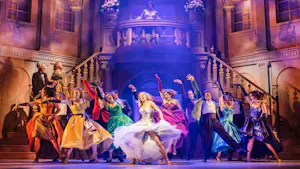
There was similar mirth in the Barbican’s handsome new staging of Cole Porter’s High Society, a nostalgic throwback to the days of big-budget musical theatre. Rachel Kavanaugh’s determinedly traditionalist production comes complete with a starry cast, including Felicity Kendal in a smallish part, a decent-sized band and talented ensemble of dancers.
All this makes for a jolly and tuneful evening, even if there is something faintly odd about the enterprise. Rather than being an original Porter show like Anything Goes or Kiss Me Kate, this is a cobbled-together adaptation of the 1956 Bing Crosby–Frank Sinatra–Grace Kelly film, which is itself a musical version of the screwball classic The Philadelphia Story.
High Society then brings in several well-known Porter classics such as “I’ve Got You Under My Skin” and “You Do Something To Me”, which are skilfully incorporated into Arthur Kopit’s book.
If this sounds like a recipe for incoherence, then the antics on stage are sufficiently entertaining to make up for it. The plot is thin to the point of nonsensical — society glamour girl Tracy Lord (Helen George) is about to marry the dullard George (David Seadon-Young), to the chagrin of her debonair ex Dexter (Julian Ovenden), with a couple of undercover reporters thrown into the mix in the forms of Freddie Fox’s Mike Connor and Carly Mercedes Dyer’s Liz. But no one will care too much about the storyline when the singing and dancing are this good.
The show is comprehensively stolen by the great Nigel Lindsay as Tracy’s lascivious and drunken Uncle Willie, whose big set-piece number at the end of the first act, “That’s Jazz”, brings the audience to their feet in giddy applause, but Ovenden’s regretful playboy has some good moments, especially a wistful second act solo, “Just One Of Those Things”, which introduces an element of sincere melancholy into proceedings.
And it’s beautifully paced: two-and-a-half hours fly by in the blink of an eye. The whole thing has the innocent jollity of a really good cocktail party, with a bar that never runs dry.
I often moan that London theatre isn’t much fun these days, and rightly so. But right now, you have two productions, of vastly different scope, that aim to do nothing than to put a smile on your face. Both succeed admirably and are well worth your time. If it’s escapism you want, then escapism, in its purest form, you shall have.


