


This article is taken from the April 2026 issue of The Critic. To get the full magazine why not subscribe? Get five issues for just £5.
One of the signs of reaching professional middle age is that you begin to consider your life’s work in quasi-historical terms. The juvenile artistic experiences which shaped your early career are coloured in the light of later events. It becomes easier to understand why some projects built with youthful energy have faded into insignificance. Many convictions of early adulthood have faltered, exposing some former certainties as dubious.
For me, an art critic who was once an art dealer and a faithful adherent of the cult of contemporary art, hindsight is a blessing. My experience helps me to make sense of what art has become today. But it is also a curse, because it lands me with some responsibility for not halting art’s catastrophic decline. This is my — and my generation’s — mea culpa.
Having come of age in the final years of the last millennium, I was primed to become embroiled in the irrational optimism of Britain’s rising creative economy. Despite my sixth-form careers advisor steering me away from art school, my creative urges got the better of me. After a degree in physics and stints in drama, publishing and photography, I headed in 2006 for Central Saint Martins.
My artistic aspirations aside, I remember the art school programme including patchy lectures on “professional practice”, some vain hope that Charles Saatchi might visit the degree show, and that the faculty’s insistence that building a “peer group” — were they Pulp’s “common people”? — was the course’s key outcome.
London was glorious in those times of plenty. Everyone I knew was an artist or a designer. Openings of exhibitions in pop-up galleries in the East End were a regular feature of our evenings. But the truth is that I was a decade too late to be a pioneer. The art scene was a maturing industry, and its opportunities were practical, not creative. I landed a job managing the studio of an established artist, a Norwegian, who — like many at the time — lived “between” London and another art world capital.
Europe was glorious, too. I travelled often and met some of the art world’s greatest minds. Everyone I knew was a citizen of nowhere. Altermodern, the final 2009 Tate Triennial, curated by the father of socially engaged art, Frenchman Nicolas Bourriaud, proclaimed artists the apex global nomads. By contrast, if not by that definition, England’s art felt parochially anti-intellectual.
❣
Inexperience spurred me on. I began organising exhibitions in a vacant Hackney warehouse, hoping to cultivate my peer group further. Responding to a question about that project’s public benefit in the first funding application I submitted to Arts Council England, I argued that we — artists, curators, my friends — were the deserving public. The bid was successful.
Public subsidy, along with the enthusiasm of the growing number of left-leaning artists I was meeting, helped me turn my project into a gallery that professed commercial goals under a peculiarly non-commercial ethos. The outfit’s programme, according to its website, brought “institutional-quality exhibitions to London art audiences and market” yet focused on artistic “practices that pertain to and stem from political periphery”. Despite having attended England’s most prestigious public school and universities, I somehow felt included in this latter designation.
❣
I would cringe at this description now, were it not that the intervention felt vital at the time. The inexhaustible supply of artistic labour in London created its own demand for intellectual debate. The institutions simply hadn’t kept up with the industry’s expansion, and spaces for ideas were sorely needed.
Besides, the idea of making political art marketable, thus turning the art market into a medium for artists, was genuinely innovative. It would not become obvious until the austerity of the 2010s set in that the cultural middle classes were bound to lose their standing. This downfall revealed only to some that the ostensibly radical Left politics which an increasing number of arts institutions foregrounded were only a self-serving version of liberalism. When its performance degenerated into “woke”, it happened without explanation.
Still, the art world’s growth was thrilling. Art biennials were popping up everywhere, undeterred even by the financial crash of 2008. The “periphery” was in. When my gallery was invited to show in its first-ever art fair, the booth fees were waived in recognition of my showing a bunch of Eastern European artists.
That was just as well because my London collectors could barely pronounce those foreign names. They did like the sound of them, though, and my ability to roll my Rs helped. Looking back on the work of, for example, the duo Anetta Mona Chişa and Lucia Tkáčová, a Romanian and a Slovak, which I brought to London, I wonder if I wasn’t more than a little complicit in fetishising the cultural geopolitics that emerged after the eastward expansion of the EU.

Chişa and Tkáčová’s 2006 video How to Make a Revolution lampooned the career trajectory of artists of their provenance who’d “make a controversial show”, “start exhibiting in the West”, then “marry a curator” and, eventually, “get divorced, start painting”. Was this satire lost on me, or did my childhood partly spent east of Berlin exempt me from becoming its target?
A growing interest in identity as a way to understand the world made such questions moot. Artists were speaking of “performed” lives, promoting “otherness” as a research method. This was a time before the prohibitions on “cultural appropriation”, and the line between voyeuristic instrumentalisation and liberation was hard to discern.
❣
The British artists whom I represented, amongst them the feisty duo Karen Mirza and Brad Butler, had their intellectual roots abroad. Mirza and Butler cut their teeth on production residencies, supported by British NGOs, in places such as Karachi. They brought their films and thoughts from the subcontinent to their studios in the already culturally-exclaved Tower Hamlets.
Unlike the bulk of the liberal art world, Mirza and Butler appeared genuinely anarchist. Their critiques of capitalism and state overreach were far sharper than many I’d heard. When, in 2014, they proposed staging The Unreliable Narrator, an exhibition that linked the legacy of British institutions with terrorism in India, I was eager to help.
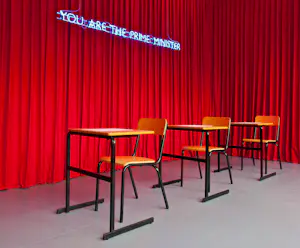
A blue neon sign stating “You are the Prime Minister” greeted visitors to the show. The line came from a scholarship exam at Eton. The essay question charged twelve-year-old boys with scripting a speech that justified the use of violence against the British people as “both necessary and moral” after shortages of oil in the Middle East resulted in deadly riots in London. The critical response was overwhelming.
Yet the unsustainable motives of my intellectual project began to show. In preparation for the exhibition, I invited Mirza and Butler to meet my former Eton housemaster, Robert Stephenson, then the school’s deputy head. My artists sank into deep chintz sofas as they asked why Eton didn’t admit girls, and whether the school should share its resources with the less privileged. This was hardly a challenge for Dr Bob, a working-class Yorkshireman who’d spent his life disciplining young men. As we left, Butler exclaimed “fascist!” just out of our host’s earshot.
I now see this dissonant moment as an indication that the era of institutional authority had given way to the age of distributed power without cultural activists noticing. Eton represented the old locus of dominion in The Unreliable Narrator, as if this formerly august institution still tightly ruled British society in the 21st century.
In fact, it had long turned to merely promoting students’ individualism. Decades after thinkers such as Michel Foucault described societal control as amorphous and power’s transmission as capillary, thus implicating even the most powerless agents as complicit, the political artists still fought their imagined enemies.
❣
In a world with no coherent understanding of power, this impulse is understandable. Some arts institutions did try to regain authority in this vacuum. An urgent public gathering of the London art world in the wake of the 2011 Arab Spring, for example, took place at Tate, rather than an independent space. The confusion of this public square, at once open and tightly controlled, would lay the ground for cancel culture. That Tate’s 2023 LGBTQ+ Pride month celebration was watched over by an army of “vibe checkers” who monitored visitors’ speech should have been no surprise.
Failing in direct political action, artists turned to aesthetic boycott. Libia Castro and Ólafur Ólafsson, another artist duo on my gallery roster, were amongst this form’s pioneers. In 2014, they withdrew from the Biennale of Sydney, to media fanfare. They did so to protest against the Biennale’s chair Luca Belgiorno-Nettis’s links to a business that operated a notorious refugee detention facility.
Belgiorno-Nettis resigned, but not before accusing the artists of “vicious ingratitude”. In London, I wondered how one might deal in artefacts produced under the conditions of a boycott. Numerous artists, erroneously concerned that their politically critical works would find demand from arms dealers, oil tycoons or human rights abusers, presented me with extensive do-not-sell-to lists.

One might have understood that the biennial boycott, which later became an art world staple, dovetailed with the left’s former anti-globalisation struggles. Far from it. A year after Sydney, I showed Castro and Ólafsson’s Your Country Doesn’t Exist cycle at a fair in Istanbul. These campaigning works included paintings, photographs and a sizeable neon sign with the slogan rendered in Turkish.
The pieces had been met with an enthusiastic reception in multicultural Berlin and at the Venice Biennale, where belief in a borderless world is the default. Yet no Turk was interested in denouncing his state and paying me for the privilege. Was I so blinded by my part in the art world’s jet-set that this ideological dissonance eluded me?
Indeed, jet lifestyles and global nomadism played the greatest trick on the Western art world. With the British state learning that its power relied no more on keeping artists on side than it did on Old Etonians, new opportunities to influence Britain’s financially ailing culture opened up to actors from the Middle East. A new set of difficult-to-pronounce names appeared on the boards of London’s art institutions. Curators stopped talking about Europe (now deemed parochial despite, if not because of the threat of Brexit) and began travelling to new biennials in the new art world capitals such as Sharjah.
To start, the art that emerged from such exchanges glibly misrepresented the politics and history of the Middle East in ways that were easy to incorporate into the West’s interpretative frameworks.
For example, I exhibited archival materials from Lebanon’s space rocket programme, assembled by Joana Hadjithomas and Khalil Joreige, alongside embroidered works by another duo, Slavs and Tatars, that lauded 20th century socialist workers’ movements in Polish and Arabic. Was I thinking about myself or the rest of the world when I called the show Long ago, and not true anyway? The project was another critical triumph.
What initially felt like a natural continuation of the art world’s globalist expansion eventually turned the tide. The sheer number of artists who took up residencies in the UAE or Saudi Arabia, and of Western museum directors who defected for the region’s tax-free salaries, means that Middle Eastern soft power influences Britain’s institutions far more than the other way around. It is no wonder, for example, that the art world today is virtually united on the question of Palestinian liberation.
❣
Do these anecdotes show me up as a pioneer of mostly bad ideas and thus discredit me as an art critic? It would be face-saving if my exit from the liberal art world were the result of some decisive political conversion. The truth is that this came slowly and antagonistically. Few of my old art world peers approve of what I think and do today.
Yet, now middle-aged, I regret little. The gallery’s parting shot was an installation of videos by the poet and musician Nástio Mosquito. At the time, the Angolan was fetishistically celebrated by arts institutions as a charismatic performer. On stage and screen, he lamented having to work in art’s “global context”, as if such a frame were accessible to anyone. He challenged his audiences, who were only then becoming steeped in the discourses of decoloniality, to outright “fuck Africa”.
I understood the significance of his words only later and read them as a caution against writing off the art produced by the art world I helped build on false foundations. What prevails of this corpus is not only its political dimension — that is the stuff of confession and gossip — but its forceful aesthetics. It could only have emerged from the corpse of contemporary art. If art, and any of its faithful, are to be redeemed, is this not the only way through?


