


This article is taken from the May 2026 issue of The Critic. To get the full magazine why not subscribe? Get five issues for just £5.
In the early days of the Israel-US war with Iran, galleries and museums in the Middle East closed and the art media reported a peculiar sense of solidarity amongst the migrant cultural labour force in Dubai and Abu Dhabi. Then, as missile near-misses became a social media spectacle and the Gulf States’ brand new cultural infrastructure appeared safe, the industry’s discussions turned to the Louvre franchise’s lost tourism income.
Such concerns are not trivial. And what use is art in a war? Not in the pacifist sense of works like Picasso’s Guernica. Not in defiance or promotion of confrontation that characterised Jacques-Louis David’s Napoleonic propaganda. But, rather, how does art, as art, coincide with conflict, in recognition and continuation of its reality?
Official war artists have grappled with this question since Willem van de Velde pioneered the profession in the seventeenth century. Today, the ongoing contradictions of art’s relationship with war are evident in the very title of Beauty and Destruction, the Imperial War Museum’s exhibition of nearly 50 paintings of London made during the Blitz for the War Artists’ Advisory Committee.
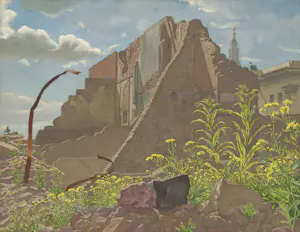
With works by Duncan Grant, Eliot Hodgkin and Graham Sutherland, Beauty and Destruction is a Who’s Who of London’s wartime art. Looking at the images, however, one might not immediately recognise that what unites them is war.
The exhibition is organised in sections such as “Thames”, “travel” and “street”. Together, they give a sense of wartime London as the milieu of a structural conflict akin to that manifesting in Dubai today.
It takes a moment in the gallery to notice that the pictures don’t foreground the human drama of Pathé newsreels and post-war cultural productions. This is unsettling, but the images are seductive.
John Platt’s oil panels of river traffic look like sci-fi. John Minton’s drawings of bombed houses in Poplar have a hint of Surrealism. Anthony Gross’ ink views of sandbagged Bethnal Green, meanwhile, read more like ghostly genre fiction than a narrative of a harrowing reality.

The Committee’s chair, Sir Kenneth Clark, who commissioned works from over 400 artists, suggested that art, unlike reportage photography, could represent the “peculiar feeling” of the War’s events. He insisted that “no amount of description or documentation” could transmit this sense to future generations. Without painting, no one would believe Britain’s story.
Despite comprising over 5,500 works, the war collection is eerily stylistically consonant. War Pictures by British Artists, a set of propagandistic booklets published by the committee, reveals the formalist restraint of the stiff upper lip. This may have been auspicious when flights of the imagination felt inappropriate.
Yet this explanation is too simple, as are Clark’s professed aesthetic preferences. How did a “magical essence of style”, in his words, emerge from the reality of war?
One answer might be that art allowed distance from the conflict. Clark admitted his desire to protect British artists from active military service, for example. But the more profound indication of Beauty and Destruction is that art — particularly painting — gave artists and their viewers a temporary way out of the grim wartime reality in which they were already living.

The Second World War, then, marks an instrumental division in the uses of media in war. In Clark’s regime, painting was for reserved contemplation, as if leaving the emotional charge of war’s brutality to photography. Insofar as this distinction has held, it is useful in understanding the Middle Eastern art world’s muted response to the videos of missiles in the sky.
Beauty and Destruction doesn’t know what to make of this. Whilst the show ostensibly foregrounds the experience of Londoners — including eyewitness accounts, for example — Londoners are hardly a feature of the works. Those that do include human subjects, such as Sleeping in a Shelter by Edward Ardizzone, hold them at a collective distance, as if to imagine that no one specifically suffered adverse fate.
One exception might be Evelyn Gibbss’ WVS Clothing Exchange, whose women and children are discernible as protagonists. The inclusion of this canvas in the exhibition is likely a curatorial knee-jerk intended to establish a female perspective. Yet, in how jarring it is — in no small measure owing to its mesmerising teals and purples — it does far more than that: it refocuses the titular beauty as contingent on destruction.

1941, 1941
The tragedy plays out in the architecture captured on the canvases. Hodgkin’s 1945 view of the remains of Haberdashers’ Hall surrounded by mounds of dirt and flowery “bomb weed” is perversely attractive.
Grant’s 1941 portrait of St Paul’s being wrapped for protection is outright radiant and forces one to imagine the cathedral’s form had it succumbed to Nazi bombing.
This is shocking because the concept of ruin value — the notion that buildings have an aesthetic function after their destruction — is associated with Hitler’s architect, Albert Speer. Beauty and Destruction opens with Clark’s suggestion that “bomb damage is in itself picturesque”. Inasmuch as it is possible to resist pictorial equivocation, it’s worth remembering that Van de Velde accepted commissions from both sides of the Anglo-Dutch Wars.
Beauty and Destruction: Wartime London in Art is at the IWM London until 1 November


