

The journalist Benjamin Ryan and the commentator Helen Pluckrose have recently posted thoughtful essays about the vexed issue of pronouns, with the titles “Why I Use Trans People’s Preferred Pronouns” and “The Counterproductiveness of Vitriolic Gender-Warring”. I have great respect for both Benjamin and Helen, and above all for their tireless work in defense of liberal principles and science; furthermore, Helen is a personal friend. Nevertheless, I disagree with some (not all) of what they have written in these essays, and I would like to explain why.
But first, let me mention some things with which I agree wholeheartedly. All of us should avoid being gratuitously nasty to anyone; we should refrain from prescribing to other people what beliefs they must hold or what terminology they must use (though we of course retain the right to present our arguments); we should accept that reasonable and fair-minded people may come to different conclusions about controversial issues; and consequently, we should not demonise those whose opinions or judgments differ from our own.
But Benjamin and Helen have missed, in my opinion, some important considerations when it comes to pronouns: namely, that we need not only to defend freedom of expression (on all sides) and to urge moderation in language (again on all sides), but also to promote the clarity of thought and debate. And for this latter reason it matters a lot what words we use.
Join Britain’s most civilised publication.

Challenge the consensus. Access rigorous analysis.
We are concerned here with two attributes that a person may have — biological sex and gender identity — and how to handle situations in which the two attributes do not coincide.
Biological sex has an unambiguous and objective meaning for at least 99.98 per cent of the human race; furthermore, there are two and only two sexes, female and male (because there are two and only two types of gametes, ova and sperm). Most readers of this article will not need, I imagine, to be convinced of this (though they may well have friends who do). But for what it’s worth, lucid and comprehensive explanations have recently been given by biologists Colin Wright, Emma Hilton, Richard Dawkins and Carole Hooven.
The meaning of “gender identity” is less clear; indeed, most of the commonly used definitions are ludicrously circular. For instance, WPATH defines “gender identity” as “a person’s deeply felt, internal, intrinsic sense of their own gender”, but then defines “gender” by saying vaguely that “Depending on the context, gender may reference gender identity, gender expression, and/or social gender role, including understandings and expectations culturally tied to people who were assigned male or female at birth”[1]. Along similar lines, the American Medical Association defines “gender” as “someone’s inner sense of being a woman, a man, another gender or genders, or no gender at all”, without resolving the circularity or explaining what it could mean to have an inner sense of being something that one is not. (I have addressed this latter question sympathetically in another essay.)
Serious attempts to elucidate the meaning of “gender identity” in a noncircular way have been made by philosophers Kathleen Stock and Alex Byrne, and I recommend those books to interested readers. But for present purposes I’m happy to circumvent the difficult philosophical issues by simply stipulating that whenever a person says that they have a particular gender identity, then they do have that gender identity — without inquiring into what, precisely, they might mean by that statement. In this essay, therefore, I am choosing to bend over backwards from the outset to maximize the case for the advocates of gender identity, by assuming for the sake of argument that gender identity indeed has some definite meaning, and by refraining here from challenging its advocates to explicate in a noncircular way that meaning[2].
Consider now a situation — perhaps women’s sports, or a single-sex changing room, or a rape trial — involving a person whose biological sex is male and whose self-declared gender identity (whatever precisely they may mean by that) is female. In such a situation, any use of a pronoun (which in English is necessarily sexed) inescapably implies that one of those two properties — biological sex and gender identity — is considered by the speaker or writer to be more important or fundamental than the other, or at least more important for the issue at hand as they see it. [The dilemma is even more acute in languages like Spanish or Italian, where adjectives are gendered: then even calling a person “tall”, “thin” or “American” requires labeling the person as female or male. Likewise in French, though there the gender of an adjective is in many cases not audible.]
It follows that those of us who believe that biological sex is more important than subjective gender identity in a particular situation should use the accurate sex pronoun in that situation; to do otherwise would be to muddle our argument and to concede what is in fact the heart of the matter.
Similarly — and just as importantly — those who believe that gender identity is more important than sex in a particular situation should do the reverse.
And last but not least, journalists who wish to be objective — if there are any such people still around — should avoid pronouns entirely: they should constantly refer to the person by their surname, even if that makes the prose awkward. (Using a first name would, in most cases, surreptitiously imply a sex.)
To illustrate what is at issue, let’s consider a specific example: the question of whether a particular transwoman athlete — that is, a biological male who considers himself a woman — should be allowed to participate in female competitive sports. Any use of a pronoun (or even a first name) to describe this athlete immediately and inescapably prejudices the question in one direction or the other: calling the person “she” (or using a female-sounding name) induces the reader to think, at least subconsciously, “Is it fair to discriminate against this woman simply because she is transgender?”; by contrast, calling the person “he” (or using a male-sounding name) induces the reader to think “Is it fair to let this male compete in the women’s category simply because he considers himself a woman?” (You’ll note that I gave away my own analysis of this issue when I used the pronoun “himself” in defining “transwoman”.)
It follows that each person arguing one side or the other of this case should use, for clarity, the pronoun that accords with their own position; to do otherwise would obscure and undermine the point they are trying to make. By contrast, those who are aiming to be neutral in this policy debate should avoid using any pronoun at all. (My heart goes out to journalists writing in languages more strongly gendered than English. Probably they will need to use hideous locutions such as “El/la nadador/a norteamericano/a Will/Lia Thomas es alto/a (185 cm) y delgado/a.” Or else Newspeak like “Le nadadore norteamericane Will/Lia Thomas es alte (185 cm) y delgade.” But journalists writing in English have no such excuse.)
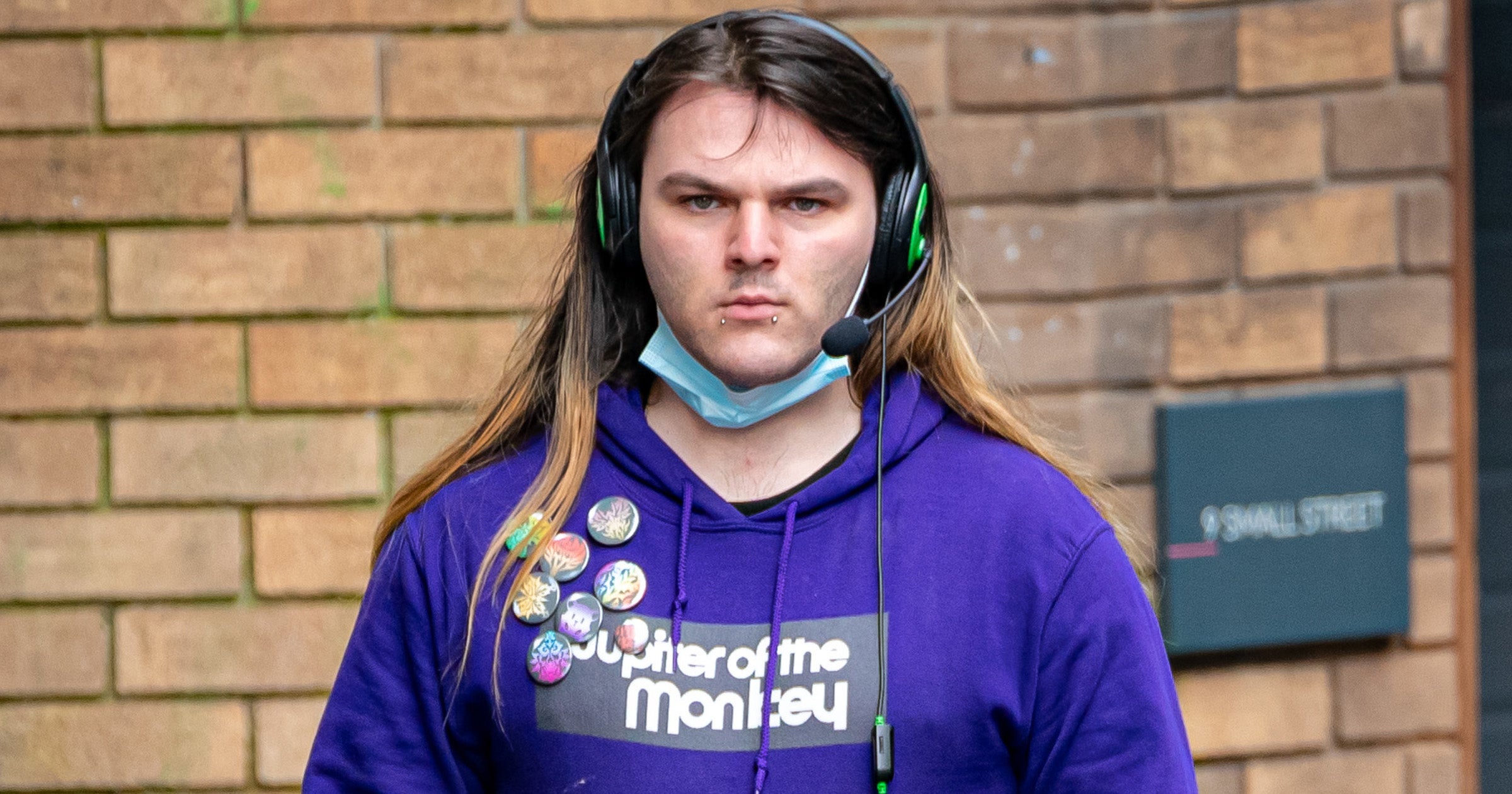
Some instances of this muddle are even more extreme, not to mention ludicrous. Two years ago, The Independent reported that:
Lexi-Rose Crawford [see photo here], 24, was jailed for nine years for one count of rape and one of assault by penetration …
Bristol Crown Court heard on Wednesday that Crawford had contacted the victim on Facebook and gone to her home to play video games. She sexually assaulted the woman, who repeatedly asked her to stop, before raping her.
Please note that rape is defined in English law as the intentional penetration of the vagina, anus or mouth of another person with the perpetrator’s penis, without consent; so only penis-havers (formerly known as “males”) can commit rape. The news article continues:
Prosecuting, Gregory Gordon told the court: “The defendant, Lexi-Rose Crawford, now identifies as female and she contacted the victim on Facebook to go to her address.
“When the defendant arrived at the victim’s address, she brought along a PlayStation. She sat on the sofa and moved to kiss the victim, who said no and stop.
“The defendant carried on setting up the PlayStation then sat on the floor next to her before pulling the victim down and pulling down her clothes and was not listening to the victim’s protests to stop.
“She began to sexually touch the victim, who pulled the defendant’s hand away. The victim was saying ‘stop, I don’t want this’.”
Mr Gordon told the court that Crawford then raped the victim with “her penis”.
He added: “She was told repeatedly to stop but she wouldn’t listen.”
A jury, after hearing the evidence, unanimously convicted the defendant.
Last year, a court in Southampton heard a case where, in the journalist’s words:
Samantha Norris, 56, … is accused of four counts of engaging in sexual activity in the presence of a child and two counts of exposure where she “intentionally exposed her penis intending someone would see it and cause alarm or distress”.
Judge Christopher Parker KC said: “Samantha Norris is in the course of gender transition and prefers to be referred to as she.”
Charles Gabb, prosecuting, told the jury that … “The defendant, Miss Norris, now transitioning, she has a penis, was standing there fully naked, on the first day almost glorifying in that nudity over quite a period of time knowing the girls were there and drawing attention to herself. And the next day when she saw them again and she was naked, glorying in her nudity, almost posturing, definitely manipulating her penis with these two young girls being able to see all this.”
He said that one of the girls described the defendant “throwing her penis around” and added “both children could see her playing with her penis and knowing the children were watching. It certainly caused alarm for these two children and an element of distress as well,” he said.
But the prosecutor was wrong in saying that one of the girls described the defendant “throwing her penis around”. The girls were completely clear-eyed about the alleged perpetrator’s sex, even if the journalist and prosecutor were confused. The news article recounts:
In a recorded police interview, one of the girls said that she and the other girl had seen the defendant through his [reality creeps back in!] window as she [reality now escapes!] pulled down her trousers and added that she was still naked two hours later. She said: “He looked naked from where he stood in the window. He was still looking out the window two hours later.”
The girl said that the defendant changed windows as she moved so she could “continue staring at us”. She said: “I felt like really anxious,” and added: “I felt a bit unsafe because he was trying to look at us at all times.”
The girl said that the defendant was naked again the following day and added: “I shouted out: ‘Can you please stop that? We are under-age,’ but he carried on which made us very uncomfortable.”
She added: “He had his penis in his hand and was throwing it around, I just walked away because I didn’t want to see it, to be honest. It was like he was trying to make us watch.”
(The defendant was acquitted by a jury after arguing that “she” was “a naturist who was ‘habitually naked’ in her own home and [that] the children could only have seen her naked if they had been ‘spying’ on her”. However, “Norris entered guilty pleas to three charges of making indecent images of children of categories A, B and C” and “one count of possessing prohibited images of children” — “16,000 images of children including about 2,000 still and 121 moving images of category A seriousness”, to be precise — as well as “a charge of possessing an extreme pornographic image depicting a person engaging in sexual activity with an animal”.)
My apologies for quoting these two gruesome cases at such length; the point is not to dwell on the depravity of a tiny number of people who call themselves trans — or more likely, the clever opportunism of some fraction of male sex offenders — or to doubt the defendant’s innocence on the indecent-exposure charge in the second case, but simply to show the knots into which the judges, prosecutors and journalists have tied themselves by a misguided emphasis on “kindness” (to some people, less so to others) and on the unrestricted primacy of self-declared gender identity over biological sex.
Indeed, until recently the Equal Treatment Bench Book instructed judges in England and Wales that they should “recognise a person’s gender identity and their present name for nearly all court and tribunal purposes, regardless of whether they have obtained legal recognition of their gender by way of a Gender Recognition Certificate”. That guidance has now been radically revised, thanks to protests by gender-critical feminists, sparked in part by the shocking case of Maria McLachlan, a 60-year-old feminist woman who was denied compensation as a victim of assault by a male trans-activist half her age (he was convicted of “assault by beating”) because, during her testimony recounting the attack, she had sometimes inadvertently referred to her assailant as “he”. The new guidance stresses that, particularly in cases of alleged domestic abuse or sexual assault:
The court should always put witnesses in the position of giving their best evidence. As in any case (eg a fraud where a defendant has used multiple identities), witnesses should give evidence referring to the defendant in the way they knew that person, including by the name, they knew them/how they perceive and understand them, as placing additional or artificial barriers on a witness is likely to detract from their ability to give best evidence. Accordingly, witnesses giving evidence in trials should not be required to call an accused “she”, particularly if they knew the accused as a male.
An even more shocking instance of gender identity taking precedence over biological sex is occurring in the prison systems of some jurisdictions, including the UK until recently; and the courts have sometimes gone so far as to forbid sex-realist language in addressing it.
In U.S. federal prisons, data from a Freedom of Information request by a feminist campaign group revealed that 47.94 per cent of male-to-female transgender prisoners had been convicted of sex offenses — vastly exceeding weapons/explosives (13.26 per cent), drugs (10.75 per cent) and other categories. (By contrast, female-to-male transgender prisoners were incarcerated primarily for drugs (55.03 per cent) and weapons/explosives (15.03 per cent); only 7.19 per cent were guilty of sex offenses.) Amongst all prisoners of both sexes (of whom 93.5 per cent are male), only 13.5 per cent are incarcerated for sex offenses.
The data from Canada are similar: 30.0 per cent of transwomen prisoners were incarcerated for a sex offence, and 44.3 per cent have a history of sexual offending. (By contrast, amongst transmen prisoners, none have a history of sexual offending.) Amongst all prisoners of both sexes (of whom 94 per cent are male), only 18.9 per cent are incarcerated for sex offences.
In the UK, Ministry of Justice statistics show that 57.4 per cent of legally male transgender prisoners were sentenced for one or more sexual offence[3]. By contrast, only 19 per cent of all male prisoners and four per cent of female prisoners had been convicted of a sexual offence.
The data for all three countries are thus similar: transwomen prisoners have a rate of sexual offending that is between one and a half (Canada) and more than three (USA, UK) times as high as that for male prisoners in general — and vastly higher than that for female prisoners.
Does this mean that males expressing a female gender identity are more prone to commit sex offences than males in general? Perhaps, but probably not. A more likely explanation is that, amongst incarcerated males, the sex offenders will be more likely than others to assert, opportunistically, a “transgender” status, at least in jurisdictions where this might help them get transferred to a women’s prison[4]. (Of course, even male prisoners who are not sex offenders might wish to be transferred to a women’s facility, simply because conditions are less harsh at women’s prisons than at men’s prisons.)
In the UK, a 2016 policy review — outsourced to the chief executive and co-founder of the trans-activist lobby group Gendered Intelligence — asserted that “allowing transgender offenders to experience the system in the gender in which they identify will, in the great majority of cases, represent the most humane and safest way to act”; the policy established Transgender Case Boards to evaluate prisoners’ requests to be transferred to a different prison estate. The exact number of male prisoners transferred to the women’s estate is unknown — the official records mention only (and inconsistently) “gender identity”, “legal gender” and “transgender status”, not biological sex — but data from 2018 show that of the 139 transgender prisoners, 111 reported their legal gender as male; and that of the 42 transgender prisoners in women’s estate, 22 identified themselves with a female gender identity, 17 with a male gender identity, and three did not provide a response. This suggests that roughly 20 per cent (= 22/111) of the biologically male transgender prisoners had been transferred to the women’s estate. Further details about the history of these policies can be found in an informative article by the Oxford sociologist Michael Biggs.
After much protest by gender-critical feminists — and cases such as that of Stephen Terence Wood/Karen White, a male convicted sex offender who was sent to a women’s prison on the basis of his “trans” status, and was later convicted of two counts of rape, one offence of wounding and two sexual assaults committed within the women’s prison — this policy was reversed in 2022 by the Sunak government: henceforth “transgender women with male genitalia, or those who have been convicted of a sexual offence, should no longer be held in the general women’s estate”, with exemptions allowed only in “truly exceptional cases”.
In California, by contrast, the Transgender Respect, Agency, and Dignity Act (SB-132), which has been effective since 1 January 2021, gives every “transgender, nonbinary, or intersex” prisoner, “regardless of anatomy”, the legal right to “be housed at a correctional facility designated for men or women based on the individual’s preference”. Data obtained by a feminist campaign group show that 33.8 per cent of transgender/intersex/non-binary prisoners seeking to transfer from male to female facilities are registered sex offenders. It’s unclear how many of these offenders were actually transferred to women’s prisons: a significant number of the requests were denied, but the exact per centages are unclear, as the official data do not add up[5].
In November 2021 the Women’s Liberation Front (WoLF) filed a lawsuit on behalf of four incarcerated women, alleging that they have “faced harm by being forced to live, work, and share private, intimate spaces with men who claim to be women”. That case is still pending.
One intervenor in that case was Tremaine Carroll, a male prisoner with a long history of violent felonies, who had been incarcerated for over two decades, with a sentence of 25-years-to-life. Carroll invoked a “transgender” identity for the first time in March 2021, shortly after the passage of SB-132, and in August of the same year he obtained a transfer to the Central California Women’s Facility. Two and a half years later, the Madera County District Attorney’s office charged Carroll with two counts of forcible rape and one count of intimidating a witness: one of the alleged victims, a female inmate housed in the same cell with Carroll, accused him of attacking her in the shower and raping her. The judge at the preliminary hearing, after hearing the two women and other witnesses, determined that the prosecution had met the burden of proof to proceed to trial.
And here is where pronouns come in. Carroll asked the judge to require the prosecutor to refer to him as “she/her”; and in December 2024 the judge, shockingly, granted the request, citing an appellate court decision in a previous case of “misgendering” (otherwise known as “accurately sexing”) a defendant where, however, sex and gender were completely irrelevant to the alleged crime (driving with a suspended license and recklessly evading a peace officer).
So henceforth the prosecutor in Carroll’s rape case will be required to say “the defendant’s penis” or “her penis”, and will be subject to sanctions if he inadvertently refers to Carroll — who is manifestly male and has a moustache and beard — as “he”. The judge has not yet determined whether the witnesses — including the two alleged victims — will also be required to refer to the defendant as “she”.
As WoLF points out in connection with its own lawsuit, the American Civil Liberties Union, an intervenor in this case on behalf of four incarcerated men:
has successfully persuaded judges to compel preferred pronoun usage in at least two other cases that relate to sex discrimination. … [I]t is reasonable to believe that they will similarly seek to compel WoLF in this case if it proceeds. Our attorneys and the women we represent could be forced to refer to male inmates who transferred into the women’s prisons under SB132 as “she/her,” even when these men have assaulted them.
So let’s go back to Benjamin Ryan’s essay, which was the starting point for this exchange.
Ryan mischaracterizes gender-critical feminists (or at least the most uncompromising ones amongst us) as the “woke right” — whereas nearly all of us would situate ourselves on the left — but that is a minor point, so let’s put it aside. The crux of Ryan’s argument is:
I may write critically about pediatric gender medicine and the evidence base behind it. But that effort is distinct from my steadfast belief in treating people with basic human dignity.
That is why I call transgender women “she.” It is simply the kind thing to do.
Kindness: that is the bottom line for Ryan.
There’s nothing wrong with kindness, of course — indeed, it is admirable — but the trouble is that sometimes kindness to one person unavoidably entails unkindness to another. Kindness to Vladimir Putin entails unkindness to Ukrainians. Kindness to Benjamin Netanyahu entails unkindness to Palestinians. Kindness to Lia/Will Thomas entails unkindness to his female competitors. And kindness to Lexi-Rose Crawford (né Dominic Risden) entails unkindness to his traumatized victim, who “repeatedly attempted suicide following the attack”.
When kindness is at issue, therefore, it will often be crucial to determine to whom kindness is most strongly due, when kindnesses conflict; furthermore, that choice of priorities needs to be reasoned, not imposed by fiat or by default or by one-sided consideration of some people’s interests to the exclusion of others’. Sometimes moral considerations will make this choice obvious, provided that the question is posed: between a convicted rapist and his victims there is no contest as to who is more deserving of kindness. (The situation is more delicate prior to conviction, since everyone accused of a crime is to be presumed innocent until proven guilty, and complainants are at this stage only alleged victims: see further below.)
But in other situations it will most often be one’s evaluation of the underlying substantive issue that determines one’s priorities for kindness. For example, between Lia/Will Thomas and his female competitors, I choose to prioritize kindness to the latter, because in my opinion he has intruded into a space where he does not belong (abetted, to be sure, by the sporting authorities) and has stolen medals that rightly belong to those women. Other people may come to a different judgment of this case; that is their right. But this example shows that kindness, properly considered, is not a free-standing criterion that automatically weighs in one direction or the other; rather, it will most often simply reinforce one’s judgment of the underlying substantive issue: which property matters more in the given situation, biological sex or gender identity? Furthermore, kindness is only one criterion amongst many that can play a role in the choice of pronouns.
Ryan stresses his understanding that:
… it is important to listen to women and other feminists who are concerned about women’s safety in single-sex spaces and fairness in sports. Unlike with same-sex marriage, which posed no true imposition on heterosexuals, trans women’s needs in particular can indeed conflict with those of cisgender women in the context of bathrooms, locker rooms, prisons, domestic violence shelters and competitive athletics.
That recognition is to his credit, though his use of the terms “trans women” and “cisgender women” already somewhat prejudices the discussion (possibly, in fact, in a direction that is opposite to his own view). Ryan continues:
I believe these conflicts should be subjected to civil debate. But I disagree that my calling a trans woman “she” means I am foreclosing upon such debate, that I am dismissing the needs of women, or that I am any less of a feminist myself.
Accusing people of misogyny who refer to a trans woman as “she” is as counterproductive as smearing anyone who raises concerns about pediatric gender medicine as a transphobe. Such invective doesn’t help anyone’s cause. It doesn’t help anyone reach consensus. It just causes a reactionary effect, driving people to dig in their heels, and can even radicalize people.
All this calls for compromise. It calls for dialogue and not invective. And it calls for choosing words carefully and conscientiously in an effort to turn down the heat in this woefully combustible debate.
I agree completely that we need dialogue and not invective, and that we need to choose our words carefully (that is, in fact, my main point); and I agree that is wrong to accuse people of misogyny merely because they choose to refer to some, or even all, transwomen as “she”. Ryan is neither a misogynist nor a transphobe.
Ryan is also right to say that calling a transwoman “she” does not foreclose debate. But that terminology does, it seems to me, prejudice the debate, and muddle it in ways that constitute an impediment to careful analysis.
Just as it would be wrong, in my opinion, to insist on always referring to people — even in private one-on-one contexts — with sex-realist pronouns, so Ryan commits the same error in the opposite direction by saying, without qualification, that he (always?) calls transwomen “she”, even in the context of public debate.
Ryan did allow, in response to commenters on his article, that there might be “some edge-case exceptions” — presumably like rape cases — although he averred they are “frequently blown out of proportion”. (What about transgender athletes?) But even when challenged specifically on the reporting of crimes, Ryan began by acknowledging that “that is a very difficult scenario” but then evaded the question by referring to the presumption of innocence. Even if that presumption were to mandate the use of gender identity over biological sex during the trial — and I don’t agree that it should, because I don’t agree that accurately stating a defendant’s sex would, in and of itself, undermine in any way the fairness of the trial — why should journalists continue to refer to Lexi-Rose Crawford/Dominic Risden as “she” after he has been convicted?
Helen Pluckrose’s contentions are much more modest and nuanced than Ryan’s, and I can agree with most of them. She acknowledges up-front that:
… exhortations to “be kind” … are really a demand that people say things that are untrue and also contrary to their principles
and that gender-critical feminists were right to object to this; she only points out that some people calling themselves “gender-critical” have taken things:
… to a new level of revelling in unkindness [and] trying to bully everyone else into doing the same
She cites some appalling comments (on X, where else?) denigrating trans-identified people, disparagingly called “troons”.
She also observes that some self-described gender-criticals have launched “vicious personal attacks” against:
… people, like Benjamin, who have been staunch supporters of women’s sex-based rights and children’s rights to evidence-based medical care [but] who dissent in the slightest way from the hardest line gender critical approach, particularly when it comes to the use of pronouns or the rights of men to wear dresses. (The latter is not very gender critical at all). … Contrary to the beliefs of a radical fringe of the gender critical movement, it is quite possible and, indeed, admirable to counter untrue claims about biological reality, oppose the authoritarian trans activists and reject the notion that it is unkind to do either without being genuinely viciously unkind to people with whom one disagrees in the slightest.
I agree completely.
Pluckrose stresses “the central liberal principle” that we should “Let people believe, speak, live as they see fit, provided this causes no material harm to others nor denies them the same freedoms”. In particular:
Nobody should be compelled to affirm a belief in gender identity or to use pronouns that relate to gender identity rather than biological sex. We must protect the right of gender critical feminists, gender critical people more broadly and everybody else who believes that an individual’s biological sex should be clearly referenced in every aspect of language to decline to speak in ways that indicate otherwise. We should also recognise that very many people (including me) absolutely support the protection of women’s sex-based rights and children’s bodies and do not believe that this requires never addressing a trans person as they wish to be addressed, being abusive to them or denying their right to present as they choose. We must also accept that authoritarian trans activists who do not respect women’s sex-based rights and who endanger children’s health exist and still have a significant degree of institutional power. Anybody who wishes to address that effectively cannot afford to descend into vicious purity spirals over word choices and character assassinations against those who decline to be unkind to trans people. We need to focus on what matters and engage with substantive issues that threaten women, children and freedom of speech and we need to work together.
That is well said; I couldn’t agree more.
The trouble, in the end, is not in what Pluckrose says, but in what she fails to say. Whilst correctly defending people’s right to use either sex-realist language or gender-identity language as they see fit, she fails to address the question of what one should urge people to do in different contexts, and why.
Now maybe it’s unfair to criticize an author, whose stated goal is to do X, for failing to do Y. Helen herself has addressed this point in an eloquent (and admittedly somewhat exasperated) essay “How Not to Critique Someone Else’s Writing”. Helen’s title in the present essay is “The Counterproductiveness of Vitriolic Gender-Warring”; her goal, quite clearly, is to defend the liberal principle of freedom of expression whilst urging people to avoid intemperate language — not to take a substantive position on the correct use of pronouns. Fair enough: she has a right to limit the purview of her essay as she sees fit. My goal in the present essay, by contrast, is to defend liberal principles and moderation in language and also to promote the clarity of thought and debate — and that last goal requires taking a stand on the situations in which sex-realist or gender-identity language is more appropriate, or at least on the criteria that people should use in making those judgments.
The bottom line is that neither Ryan nor Pluckrose really engages with the main point being made here (and which was also made, I should acknowledge, by several commenters on Ryan’s article): namely, that choices of pronouns can seriously prejudice the substantive question under discussion (as the cases of transgender athletes and prisoners make clear). Maybe Pluckrose didn’t need to engage with this point, because it was beyond the scope of her essay, but Ryan should have. Instead, he stressed merely that in some situations gender identity may be more important than biological sex, and that in those situations it makes sense to use the pronouns that correspond to a person’s declared gender identity. With that modest contention I can agree: as I have already said, in those situations where you consider gender identity to be more important than biological sex, you should use gender-identity pronouns rather than sex-realist pronouns. But that is a far cry from Ryan’s blanket position of always (or almost always?) using gender-identity pronouns.
Furthermore, although I am happy to acknowledge that there are some situations — particularly in private one-on-one contexts — in which gender-identity pronouns are appropriate, it is important to recognize that reasonable people may have different opinions about which situations those are; that needs to be debated case-by-case. We should have respect for fair-minded people whose judgments in particular cases differ from our own.
There is, nevertheless, one excellent reason why Ryan might choose to use gender-identity pronouns as a matter of course in his writing, though he did not mention this reason in his own article; it is a reason that is tactical rather than principled. Ryan, a freelance health journalist, is doing heroic work in defending the principles of evidence-based science and in holding pediatric gender medicine to scientific scrutiny. Indeed, he is one of a mere handful of journalists who are bothering (or daring) to do this crucial work (Jesse Singal, Lisa Selin Davis and Abigail Shrier are others). Ryan clearly wants his commentaries to be read and taken seriously by left-liberal people, or at least by those left-liberal people who might be open to hearing reasoned criticism of some “progressive” dogmas; and he wants to avoid doing anything that might undermine that paramount goal. So in this context it could well be prudent for him to concede to “progressive” sensibilities on the subsidiary issue of pronouns. I am not saying that this is in fact Ryan’s reasoning — I can’t read his mind — but I do think that this would be a perfectly legitimate reason for him (and for others in a similar situation) to use gender-identity pronouns.
Indeed, I must confess that I myself have done a similar thing, though under far less duress than Ryan’s work must put him. Two years ago I wrote an article entitled “The implicit epistemology of White Fragility”, critically analyzing some of the ideas of Robin DiAngelo; and another article, “‘White empiricism’ and ‘the racialization of epistemology’ in physics”, critically analyzing some contentions of Chanda Prescod-Weinstein. In both instances I wanted to display my left-liberal bona fides before embarking on a critique of the ideas of two “progressive” superstars; so I decided to use the capitalized adjective “Black” to refer to African-Americans, even though I am conflicted about this usage (compare John McWhorter’s qualms to Kwame Anthony Appiah’s arguments in favor). In the end, I figured that a tactical concession would gain more than quibbling about spelling. Perhaps Ryan feels the same about gender-identity pronouns; or even if he doesn’t, it seems to me that he would have some justification for taking that stance.
Some justification, I stress — justification, perhaps, for using gender-identity pronouns as the default whenever there are no compelling considerations to the contrary; but not justification for blanket use in all circumstances. Furthermore, what goes for Ryan does not necessarily go for the rest of us, who do not have such a valuable and delicate enterprise to protect.
Last but not least, it is worth pointing out a curious asymmetry. Many defenders of science and biological reality nevertheless choose, like Ryan, to use gender-identity pronouns — whether sometimes or always — in referring to trans people, out of kindness. (I myself do so routinely, in those situations where the person’s biological sex is either not relevant at all or is anyway not important.) By contrast — and here readers should correct me if I am wrong — I am not aware of any adherents to gender-identity ideology who have used sex-realist pronouns in referring to convicted rapists like Dominic Risden/Lexi-Rose Crawford and Stephen Terence Wood/Karen White. Why the asymmetry? What about kindness to those rapists’ female victims?
The bottom line is that the use of gender-identity pronouns can in some contexts seriously obfuscate and mislead. “Her penis” is the most extreme example, but it is perhaps the least dangerous precisely because it is so absurd: no juror will be misled. But referring to a male athlete as “she” can seriously prejudice the discussion of whether he should be allowed to compete in the female category. Even worse is referring to a male sex offender as “she” when considering his request to be moved to the female prison estate.
So the choice of which pronoun to use in a given situation is not a trivial issue, nor is it a matter of mere “kindness”. Rather, it goes to the heart of which property — biological sex or gender identity — one thinks is more important in the particular circumstances at hand. Clarity requires that, if one must use a pronoun at all, one should always choose the pronoun that fits one’s judgment about whether biological sex or gender identity is more important in the given context. And one should always do this calmly, without apology, and without being vicious or nasty.
[1] This latter definition does, at least, have the virtue of hinting at the reactionary nature of the concept of “gender identity”: your gender identity is the traditional stereotype with which you identify — Barbie for women, GI Joe for men, and somewhere in-between for “non-binaries”, according to the trans-activist organization Mermaids. Readers are referred to the brilliant book by the Swedish feminist Kajsa Ekis Ekman, On the Meaning of Sex, for a detailed elaboration of this analysis, based on extensive quotations from gender-identity advocates.
[2] Alert readers will have noted my use in the preceding paragraph of the colloquial gender-neutral singular “they”, in order to avoid any implication that the person in question is male or is female. I certainly don’t mean to imply by this word that the person is “non-binary”, whatever that may mean.
[3] See Table 2 of the spreadsheet: 74/129 = 57.4 per cent.
[4] In order to evaluate the relative importance of these two explanations, it could be useful to obtain statistical evidence on when the incarcerated male first expressed a “transgender” status: Was it before his first sex offence, or only while on trial, or only while in prison? And if the latter, was this before or after the rules were changed to allow a “transgender” prisoner to request a transfer to the other prison estate?
[5] A total of 871 prisoners requested to transfer from a male to a female facility. Of these, 45 were approved, 107 were denied, 123 changed their mind, 206 were pending, nine transferred back voluntarily, and two transferred back involuntarily. That adds up to 492, which is considerably less than 871.
The author is Professor of Mathematics at University College London and Professor Emeritus of Physics at New York University. He is co-author (with Jean Bricmont) of Intellectual Impostures: Postmodern Philosophers’ Abuse of Science and author of Beyond the Hoax: Science, Philosophy and Culture.


.png)