

This article is taken from the June 2026 issue of The Critic. To get the full magazine why not subscribe? Find our subscription offers here.
One of my favourite quiz questions was set by Lord Lisvane, the magnificently whiskered former Clerk of the Commons. Nine Test cricketers have sat in the House of Lords, he observed. Which one had the highest batting average?
Not Ian Botham, who has so far played only two cameo innings as a peer. He averaged 33.54. Nor Colin Cowdrey (a bit over 44). Some may suggest David Sheppard, who entered the Lords twice, first as a bishop, then a life peer, but it is not him. And it isn’t Learie Constantine, the Trinidadian cricketer, barrister and Britain’s first black lord.
None of the ancient hereditaries — Lords Hawke, Harris, Darnley and Tennyson, grandson of the poet — come close, though Darnley did regain the Ashes as captain under his pleb name of Ivo Bligh. No, the greatest peer to wield a cricket bat is the only one who did so in a skirt.
Rachael Heyhoe Flint averaged 45.54 in 22 Tests and made three hundreds, including an unbeaten 179 against Australia in 1976. That summer she was the first woman to captain England in a one-day match at Lord’s, so it feels long overdue that it is only now, 50 years later, that the ground will host its first women’s Test. England play India from 10 July.
Heyhoe Flint had a gate named after her at Lord’s in 2022, and it was a nice touch at the 2019 men’s World Cup that Eoin Morgan’s side walked out to play their final below a portrait of someone who had already led England to victory in a World Cup, as she did in 1973. Until now, however, women had not merited a Test there.
In part, this is because they play fewer of them. The recent men’s Test was the 150th at Lord’s. There have been only 152 for women around the world since the first in 1934. England have had nine Tests on the county ground at Worcester and six at the Oval, but they have also gone to some low-key venues: Guildford, Blackpool, Wetherby.
This reflected the public interest and even though ticket sales for Lord’s are higher than for any previous women’s Test in England, it was only 24,000 over four days. The public seems sceptical about women and cricket. Administrators think they will tolerate it only in small doses of 20 overs or 100 balls.
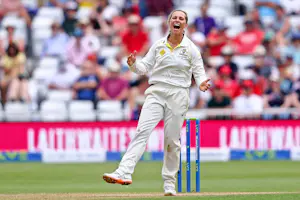
Yet women are clearly capable of playing a long innings at a good strike rate. Their most recent Ashes Test in this country, at Trent Bridge in 2023, had both teams making more than 450 in their first innings at 3.8 runs per over before Ashleigh Gardner took eight wickets with off spin to win the match for Australia on the last day. That sounds like a good formula for a Test match to me, winners aside. England’s men, by the way, have averaged 330 in the first innings of their past ten Tests at 4.1 an over.
If administrators mean it when they say Test cricket is the pinnacle, women should have more opportunities to play it and make it count. Having been given the grandest stage, a repeat of their most recent win over India, by two runs at Jamshedpur, would do nicely.
Some will say that Lord’s has a women problem. There is the story about an MCC member waking from a post-prandial doze, seeing a blurred vision and spluttering: “Good heavens, there’s a woman in the committee room! And she’s talking to Swanton!” He need not have feared for the grand old man of the Daily Telegraph. E.W. Swanton was only being introduced to the Queen, or perhaps it was the other way round.
Elizabeth II made 36 visits to Lord’s. Until 1999, she was the only woman allowed in the Pavilion, save staff. Heyhoe Flint was one of the first ten women members and Tony Lewis, MCC president at the time, admitted that getting change had been like turning an ocean liner. Since then, Clare Connor has served as president and two members of the ground staff, responsible for tending the wicket, are women, which is unique in English cricket. The first women’s Test is another welcome step forward.
It would be wrong, though, to effect change unfairly. MCC is concerned that only 3.2 per cent of its full membership are women. It would like to reach 20 per cent in ten years. With the current 29-year waiting list, it should take until the 2060s. But only 12 per cent of those seeking to be members are women, so it is not a target matched by interest.
The club is consulting about how to speed it up. Having more women qualify as playing members is a good option — the number of women’s MCC matches went up by a third in 2024. More concerning is the proposal that women be allowed to skip the queue and enter on a 50-50 basis. The club’s modelling shows it would add three years to the waiting list for men.
This is what happens with bishops in Parliament: a spot amongst the Lords Spiritual used to be given on longevity-in-see, but women bishops are now fast-tracked. Jumping the queue for the Lords is one thing; doing it at the apostrophised Lord’s another. The Home of Cricket must be a place where women feel welcome as players and as members, but as equals not by preferential treatment. That would simply not be cricket.


