

Freddie’s finest over
Five balls, four minutes, three untouchable deliveries, two lbw appeals and one priceless wicket
This article is taken from the February 2025 issue of The Critic. To get the full magazine why not subscribe? Right now we’re offering five issues for just £10.
Even in this brave new world of T20, Big Bashes, IPL and the Hundred, Test matches are still the most exalted form of cricket, and at their best arguably the most sublime of any sport. A proper Test match is like a novel: it ebbs and flows, it reveals character for good and bad, it intrigues and suspends, it grips and moves, it runs multiple plots at once, and by the end you’re breathless and wrung out, wanting to stay in it so much longer but knowing that its finitude and rarity are what make it so special.
This year marks the twentieth anniversary of the greatest Test series ever played. The 2005 Ashes had it all: the two best teams in the world going without quarter at each other, and on free-to-air Channel 4, letting the entire nation get involved. So many moments still spring unbidden to mind — Simon Jones castling Michael Clarke with reverse swing, Andrew Strauss doing his best Superman impression to catch Adam Gilchrist, Gary Pratt with an eagle swoop and laser throw to run out Ricky Ponting. When it was over, England had come back from losing the first Test to win 2-1, and the Ashes were home for the first time in 18 years.
With hindsight it may all look to have been inevitable, but it was anything but. Everything hinged on the second Test at Edgbaston, a contest so epic that Shakespeare would have got a play out of it, Wagner an opera, Picasso another Guernica. It’s easy to imagine a parallel universe in which Australia find the three extra runs they need to win, go 2-0 up and proceed to secure the series easily. England would never have recovered from going two down with three to play, not against this Australian team. It was England’s Edgbaston victory, and the way they did it, which set the tone for the rest of the summer.
From Sliding Doors to matryoshka dolls: for if the series hinged on one Test, then the Test in question hinged on one particular over. It’s the penultimate afternoon: Australia 47 without loss chasing 282 to win. England need a breakthrough, and they need it fast. Enter Andrew “Freddie” Flintoff: zinc on his nose, stud in his ear, undaunted by a damaged shoulder. His first ball is fast and full. Justin Langer plays it away to point. No run. The second ball is quicker and jumps on Langer, cannoning off his glove and onto his stumps.
In comes Ponting, perhaps the best Australian batsman since and apart from the immortal Don Bradman. Get him early, get him cheap, and England are in business.
Langer and Ponting pass each other on the outfield. Langer neither looks at nor speaks to his skipper. Perhaps he has an inkling of what’s coming.
Ponting takes guard and surveys the field. The England players are bouncing from foot to foot, geeing each other up. Flintoff charges in, the gathering tsunami of the crowd’s roar at his back and all around. The delivery seams viciously in at Ponting and raps his pads. 25,000 spectators and 11 England players scream for lbw. Not out, says umpire Billy Bowden. The crowd “oooooh” their disappointment.
But this is on. This is very much on.
Fourth ball of the over. 93 mph. Ponting jabs hurriedly at it, sending it on one bounce to Ashley Giles in the gully. Flintoff gives Ponting a look — plenty more where that came from, sunshine. The pain in his shoulder is gone, submerged beneath the swirling adrenalin. It’s the rawest of contests: strike bowler against talisman batsman, irresistible force against immovable object.
This is why they call it Test cricket.
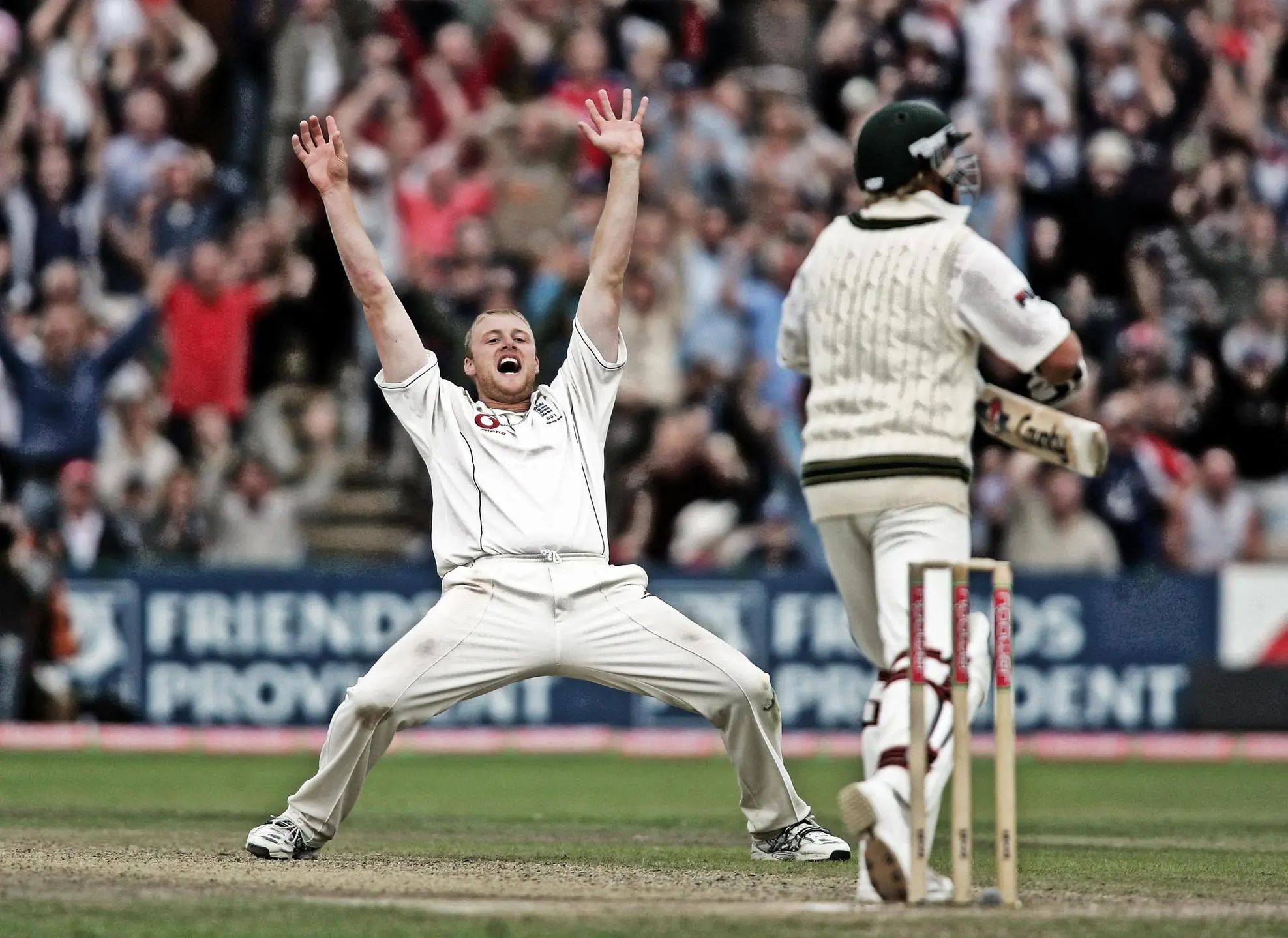
Fifth ball. Another delivery which comes back way too fast for Ponting to get a bat on. Again thousands shout for leg before, and again Bowden shakes his head. The crowd noise pulses eager and insistent, spectators feeding their energy to the gladiators in the middle and getting it back from them: an endless loop of crescendo and fade, crescendo and fade, sound and fury renewing themselves with every delivery.
The sixth ball goes away from Ponting, and he follows it for a split second before twirling his bat clear. It’s the briefest glimpse of his exquisite talent: few batsmen would have got near that ball, and even fewer got away from it again. Bowden calls no-ball, meaning there’ll be one more delivery. “That won’t be a problem as far as Flintoff’s concerned,” says commentator Mark Nicholas percipiently.
One more delivery, one more chance, one more bite at the cherry. Flintoff walks back to his mark with a single thought in his mind: get Ponting. Get him. Finish him. Finish him now.
Seventh ball. Faster and furiouser and jagging away late. Not a batsman on earth who’d survive it. Ponting gets a thick edge and wicketkeeper Geraint Jones catches it baseball-style up by his ear.
Bedlam. BEDLAM. Flintoff plants his feet, arches his back and thrusts his arms aloft whilst his team-mates engulf him. The Eric Hollies Stand looks like the mosh pit at Rock am Ring. The innings, the match and the series are suddenly aflame. And none of it happens without this: five balls, four minutes, three deliveries the batsman couldn’t even touch, two lbw appeals, and one priceless wicket. Twenty years on, and it’s still just as thrilling in memory as it was the moment it happened. Sport, in excelsis.


