


This article is taken from the June 2026 issue of The Critic. To get the full magazine why not subscribe? Find our subscription offers here.
At last, we can stop the pretence that art appeals in some ethereal, unique way that is different to reproducible luxury objects. When Christie’s released a promotional video of Nicole Kidman cavorting around Constantin Brâncuşi’s beautiful gilded bronze sculpture Danaïde of 1913, there were mutterings and chunterings.
Here was a Hollywood star, commissioned to promote a great work of art! A great sculpture, the chunterers complained, had been reduced to the status of a bottle of expensive perfume.
The art market and auction houses have been selling handbags, fashion, sportswear, dinosaurs, Hermès ashtrays, sports cars, expensive watches for decades, and the fashion world has long collaborated with artists. The apparent offence is not only the debasement of a work of art in such a video, but the egregious sin of selling these great works of art for gigantic prices.

Danaïde sold for $107.5m; in the same sale Jackson Pollock’s Number 7A, 1948 sold for $181m — both from the collection of the Condé Nast billionaire S.I. Newhouse, which was auctioned at Christie’s in New York in May. One commentator was disgusted: art, he said, had been reduced to a casino chip, a financial instrument, a placeholder trophy destined for a free port.
The auction house, apparently, has stripped art bare of meaning and placed it “naked on the block with only a price to define it”. The sale was a “séance in which capital applauds itself”, whilst the rest of us “pretend to witness culture”.
But this is precisely backwards. The perfume advertisement vibe borrowed the language of art; the Christie’s film was clever in acknowledging that the Brâncuşi and the perfume bottle occupy the same economy of desire. Both are beautiful things. Both are expensive. Both are coveted.
The auction house was being honest about what a sculpture at that level of the market actually is: a luxury object of the highest order, available to a handful of people on earth, marketed accordingly. The pretence that something more elevated was being traded — some sort of scholarly transaction rather than a commercial one — would have been the real dishonesty.
The art market has rarely been only a scholarly endeavour. Properly, the scholarly function belongs to the compiler of the catalogue raisonné, or the museum, perhaps even the theoreticians at the university. The top end of the market is, and has always been, about commerce, luxury and what sells.
This is not a recent development. The pictures Titian painted for Philip II of Spain in the 1550s, the poesie, including Diana and Actaeon and Diana and Callisto (which are now in London’s National Gallery and the National Galleries of Scotland in Edinburgh) were luxury commissions on a royal scale, painted to hang in private apartments for the pleasure of one man.
The great collections that eventually became public museums: the Wallace, the Frick, the Burrell, the Gardner, the multifarious Rothschild collections, were assembled by very rich people buying beautiful things for their houses, motivated by desire, status and the pleasure of ownership in roughly equal measure. Nobody at the time felt obliged to dress this up as something else.
The dressing-up came later, following the invention of the institutions that inherited these collections and needed to justify their authority over them. The museum sacralised the art and ordained the curator — who promoted the intellectual status of some art (mainly pictures). The art market has no such need, and it is precisely that honesty that so discomforts the high-minded commentariat.
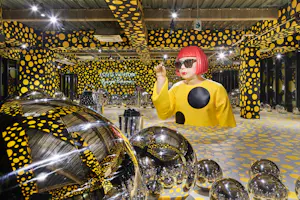
Louis Vuitton understood this when it collaborated with Yayoi Kusama, one of the most significant artists alive, to produce a fashion collection, a suite of global installations and a hardback book by Rizzoli (£290), with essays by Hans Ulrich Obrist and other curators who have organised major retrospectives of her work.
The collaboration was an acknowledgement that Kusama’s art and Louis Vuitton’s bags occupy the same space: the world of beautiful, costly, coveted things. The mock horror about the exorbitant prices, in the end, is not really about whether these artworks “deserve” such elevated valuations. It is about authority; about who gets to say what art means and under what conditions it may be sold.
The auction house’s great offence is to look beyond the museological and curatorial art world constraints of quasi-academic apparatus, and instead to treat a work of art as what it is: a beautiful, costly and desirable object.
As it happens, the inspiration for the Kidman–Danaïde face-off was a film shot in 1930 by Man Ray, of the Surrealist and photographer Lee Miller unveiling Brâncuşi’s phallic sculpture Princess X.
The eroticism and the smile are present in both films.


