

This article is taken from the May 2026 issue of The Critic. To get the full magazine why not subscribe? Get five issues for just £5.
Why hasn’t Quinlan Terry been knighted? Next summer he will be 90, but age cannot wither him and he is still at his drawing board, designing rich classical detail for his many projects. In the enlightened 21st century, Classicism is not the architectural curiosity it seemed to be a generation ago, during the hegemony of modernism.
There are many architects who practise the style, with varying degrees of brio and erudition; Craig Hamilton, John Simpson, Hugh Petter — they and their ilk give would-be clients plenty to choose from. The University of Cambridge not only boasts the Ax:son Johnson Centre for the Study of Classical Architecture at Downing College but offers a masters in traditional architecture, leading to a professional accreditation.

The future therefore looks rosy. How different it was, though, in the 1960s, when Terry attempted to start his career. The bleakness with which he viewed the professional world as a student at the Architectural Association in 1958 was summed up by a linocut he made of a ruined house, covered in Biblical quotations about decay and desolation. “Everyone that passeth by shall hiss and wag his head.” The new classical Jerusalem was far off.
That’s why Terry, in addition to his CBE, deserves the knighthood: whatever you think of his buildings, he kept the flame of classicism alive at a time when it burnt very low and was threatening to go out. This wasn’t easy. He was vilified by modernist opponents such as the late Richard Rogers who was elevated not just to a knighthood but a seat in the House of Lords. As late as 2009, Rogers fumed at the “architectural plagiarism” of Terry’s Margaret Thatcher Infirmary for the Royal Hospital, Chelsea — doubly tormenting to him since it could be seen from his London home.
Rather than engaging with Terry’s architecture, critics condemned it as “pastiche”, a damning adjective to architects who claimed to invent everything from scratch (whilst ignoring their own borrowings from Le Corbusier and Mies van der Rohe).
The extent of the loathing was out of all proportion to the scale of Terry’s practice. It was as though critics feared that, offered the choice, a misguided public would prefer traditional architecture over concrete-and-glass. Even the contrarian Gavin Stamp, who hated modernism, pursued a vitriolic campaign against Terry through his Piloti column in Private Eye.
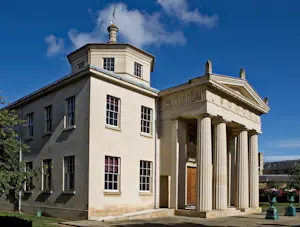
Perversely, he gave the Maitland Robinson library at Downing College, Cambridge an elegant stone-built rotonda that evokes both Palladio and the Tower of the Winds, the Sir Hugh Casson Award as the worst building of the year in 1993 — which was, by any standards, extreme.
But Terry stuck to his guns. This took determination, patience and self-belief, buoyed by a warm family life and a profound religious faith — the latter steering everything that he does. (Terry believes that the classical orders, being descended from those described in the Bible as decorating Solomon’s Temple in Jerusalem, are divinely inspired. He’s out on a limb on that one.)
Added to all of which is the deep, practical knowledge that he has of building, as well as the scholarly knowledge of classicism that comes from measuring countless ancient structures — qualities for which he is revered amongst classical architects in the United States. Work by Terry is beautifully detailed and will stand for centuries. These may sound like prerequisites for architecture of any type, but it is surprising how rarely they are met, in a world that accepts ugliness and does not expect a new building to last for more than 30 years.
Son of left-wing, Moscow-visiting parents who had met the guru of modernism, Walter Gropius, in America, Terry’s first love had been sculpture — fortunately it was taught at Bryanston where he went to school. It gave him a first-hand knowledge of stone.
By contrast, the Architectural Association was a disappointment, given that architecture was not regarded as a method of building so much as a religion. Whatever the obvious faults of high-rise buildings, you were expected to believe they were better than the terraces they replaced. For a time, he worked in the office of James Stirling — a starchitect before the term had been invented — and his more accessible partner James Gowan.

In the end, Terry rejected not just the architectural establishment but London. In the early 1960s he moved to Constable Country, on the border of Essex and Suffolk, to work for Raymond Erith, a classicist who had trained in the 1920s. His aesthetic had some affinity with that of modernist contemporaries. In the shadow of the Second World War, when budgets were tight, Erith pared his architecture to the bone. It was learned but spare, relying on proportions and sound construction rather than ornament.
He was, however, swimming against the tide — hence his withdrawal from London to Dedham, where he worked in a converted house of circa 1600 which had previously been a telephone exchange. He papered the walls with pages of The Times and consigned himself to a practice largely devoted to modest rural commissions, made possible by a private income.
When Terry arrived, Erith was in the midst of refashioning one of the most famous buildings in Britain, Nos.10-12 Downing Street (not least because the interiors included work by his hero Sir John Soane) as well as remodelling a country house for scandal-hit Jack Profumo.

Erith and Terry, as the firm became, would go on to design what they expected to be one of the last great country houses in Britain, King’s Walden Bury: Terry kept a beautiful notebook of elegantly lettered text and drawings to detail the work because of what seemed to be its historic significance.
Such opportunities were few. Terry had so much time on his hands that he could devote many hours to decorating his home at Higham — a Regency country house of Suffolk white brick — in an elaborate scheme of trompe-l’oeil. After Erith’s sudden death in 1973, the firm was only kept going by what appeared a near-miraculous commission from elders of the Baha’i religion for a spectacular temple in Tehran. To have been only slightly smaller than St Paul’s cathedral, it absorbed the office for five years. The fall of the Peacock Throne doomed the project.
Britain’s mood changed in the buoyant 1980s. It was a noisy decade of Lawson boom and Big Bangs in the City. Taxes tumbled and confidence surged. Entrepreneurs and City traders wanted to show the world that Brideshead, which, in Evelyn Waugh’s novel and its popular TV adaptation of 1981, symbolised decline, was back. Historic country houses that had seemed unaffordable after the oil crisis of 1973 were being restored. Shooting was the new golf.
A handful of plucky owners wanted to make their mark by commissioning a new country house, and generally they went to Terry. Few people understood traditional building methods better than him, reflecting an early devotion to the Arts and Crafts movement. Unlike Erith, he was not reticent about ornament. His clients then were not as rich as some are today; the word billionaire had barely entered the lexicon. Often, cautious of the expense, they built on a scale slightly smaller than Terry recommended and regretted it afterwards.

But even a relatively compact country house can be enriched with doorcases, Corinthian capitals and carving. Michael Heseltine wanted no more than a summer house overlooking his swimming pool at Thenford House. In stone of two colours, the end bays rusticated, the roofline crowned with finials, it exudes panache. The classical tradition, whose life had been hanging by a thread, was out of bed and on its feet again.
In 1986 I wrote a book on Terry, subtitled The Revival of Architecture. It was intended to counter the doomsters and gloomsters who said that the craft skills known to our Georgian ancestors no longer existed. Terry’s work showed that was nonsense. Perhaps few clients could afford a Solomonic column shaped like a corkscrew or a spirally fluted urn (very difficult to draw out before the dawn of computers) but such things could be made at a price. The Tory eminence grise Alistair McAlpine showed that some folk — he, at least — still wanted to commission elaborate follies, not least because the money, as was explained in an inscription to an unexecuted triumphal arch to Margaret Thatcher, would otherwise have gone in tax.
My book showed that classicism did not have to be confined to country houses. Terry had recently been asked to take over the design of an office scheme near Richmond Bridge that had got snagged in planning. He produced a kind of capriccio, in which units of different styles are joined together in a terrace. From the moment Richmond Riverside was opened by the Queen in 1988, it proved a hit with the public. Crowds throng the lawns in front of the buildings during the summer. When guidebooks now describe it as a survival from Richmond’s 18th-century heyday, Terry takes it as a compliment.
By 1990 the course was set. The rise of the super-rich in the 21st century provided an even better client base. For a time helped by his son Francis, a superb draughtsman who set up his own firm in 2016, Quinlan Terry Architects has been busy with an ever-increasing number of projects, often on an ever-increasing scale. Colleges (notably Downing, Cambridge), churches, a cathedral for Brentwood, town houses, cottages, offices, retirement homes, mansions overseas — all have their place in the oeuvre, although the mainstay remains the English country house.

Sadly, Richmond Riverside did not herald a slew of similar place-making commissions, although plans to replace Oxford’s Clarendon Shopping Centre, opened in 1983, with a Terry-designed Georgian square could give it a close run for its money. But as the country houses have got bigger, they have generally got better. The early houses may have seemed overloaded with ornament but the frame on which the decoration is hung has now expanded to the necessary scale.
On the other side of the Atlantic, and wherever people care about classical architecture, Terry is accorded almost the status of a divinity. At home, having survived decades of invective, he has shown that traditional construction and the classical style are viable options for this pluralistic age, particularly in the vicinity of old buildings. The Battle of the Styles is over; we live in more tolerant times.
There may be people, in the 300th anniversary of Sir John Vanbrugh’s death, who wish that Terry’s country houses were more spatially exciting: all the energy has gone, it sometimes seems, into the facades, leaving plans that are formulaic and dull. I doubt that the criticism would disconcert Terry. His buildings work for their purpose. An architect, he believes, is more like a solicitor than a pop star: his duty is to build well whilst not making too much of it. To Terry, architecture isn’t the most important thing in the world: that’s God.
Ultimately Terry’s reward may be in heaven. Before that time, couldn’t an architect who is so admired by His Majesty the King be given recognition of a different kind, here below? Arise, Sir Quinlan. It has a ring to it.


