

Can London never change?
Peter Ackroyd treated the city as a semi-living entity resistant to human intervention
There is an alleyway in the City of London where, if one goes very early on a summer morning, when the air is still and not yet disturbed by the morning’s traffic, one can smell the aroma of spices encased in the walls, left by centuries of East India Company workers carrying cargo from the docks to its warehouses near Leadenhall Street. Today, the Company is gone, leaving curiously little trace in the City, save for a pub which still bears its name and that faint aroma.
Such moments of ghostly persistence form the foundation of many of Peter Ackroyd’s novels, which suppose that different periods of London’s history have the ability to bleed into each other, like a palimpsest or a phantom echo. His most famous, Hawksmoor, is named after the seventeenth century architect Nicholas Hawksmoor. Since the real-life Hawksmoor was an occultist, Ackroyd has his fictional equivalent, Nicholas Dyer, commune with devilish spirits. Dyer’s black magic is responsible for the East End’s darkness, from the Ripper murders and to a fictional set of twentieth-century killings. The result is erudite and playful, similar to the novels of Anthony Burgess.
Needless to say, the Ripper murders were not really caused by daemonic blood pacts or sinister ley lines emanating from Spitalfields; this is a literary conceit, not to be taken seriously as a real history. However, the same mysticism re-appears in his non-fiction works about London, especially in London: the Biography, his near 800-page history of the city.
Join Britain’s most civilised publication.

Challenge the consensus. Access rigorous analysis.
The subtitle is revealing. For Ackroyd, London is half-alive, with its own moods and secrets. In the introduction, we are told that “we must regard it as a human shape with its own laws of life and growth”. Later on, he proposes that “London is a labyrinth, half of stone and half of flesh … a wilderness of alleys and passages, courts and thoroughfares in which even the most experienced citizen may lose the way”. Ackroyd’s London is no longer the open, understandable city praised by Addison and depicted by Canaletto, but one whose eternal nature can be glimpsed only by a select few “Cockney visionaries”. Blake, Dickens, and, presumably, Ackroyd himself.
Ackroyd’s mysticism means that he fails to make sense of the Docklands, the area of London which has changed the most in the last fifty years
Each neighbourhood is populated by a genius loci, defining the spirit and the temper of its residents. He speculates that “certain activities seem to belong to certain areas, or neighbourhoods, as if time itself were moved or swayed by some unknown source of power”, explaining the associations between Clerkenwell and radicalism and Bloomsbury and occultism via this unknown power source.
Ackroyd is, of course, right to say that there are places in London long associated with specific functions or identities, like Harley Street or the Temple. He is also right to say that there are still more places where one can experience moments of eerie “thinness” and feel the closeness of centuries gone.
However, by supposing a perennial identity to the city, Ackroyd is forced to deny much historical transformation. In his telling, the city’s many manifestations, from Roman to Victorian to the present, are merely varying expressions of the same underlying type, ignoring real discontinuities.
Ackroyd’s mysticism has another flaw: at times, he seems to imply that it is futile to try to change the city’s nature, that there are urban forces that humans cannot fully understand or oppose. London, we are told, is “a mysterious, chaotic and irrational place which can be organised and controlled only by means of private ritual or public superstition”, like the blood magic of Nicholas Dyer.
These forces have supposedly repeatedly thwarted man’s attempts to redesign the city. After the Great Fire, Wren and Evelyn proposed to rebuild the City with Continental boulevards and a grid-like pattern of streets, but the City Corporation chose to retain the medieval warren of alleyways. Ackroyd contends that they failed because “the very nature of the city defeated them, its ancient foundation lie deeper than the level at which any fire might touch, and the spirit of the place remained unscathed”.
London’s hostility to planning has been noted by other, more sober, commentators. The Danish urban planner Steen Eiler Rasmussen famously contrasted London’s organic growth to the planned and despotic Continental city, but attributed this difference to London’s historic lack of municipal government rather than otherworldly forces.
Above all, Ackroyd’s mysticism means that he fails to make sense of the Docklands, the area of London which has changed the most in the last fifty years. After decades of neglect, the Docklands Development Corporation built a new financial district in the historic East End in the 1980s, clearing out vacant and derelict warehouses in the process.
In Canary Wharf, there are no alleys where one might encounter the ghost of a nineteenth-century dock worker, or pretend to still hear the cries of long-dead porters. There is no material evidence of the old warehouses of the West India Docks which once inhabited the site. These have been demolished without trace. In the face of such rupture, Ackroyd simply meekly suggests that the construction of Canary Wharf was both an act of change and continuity.
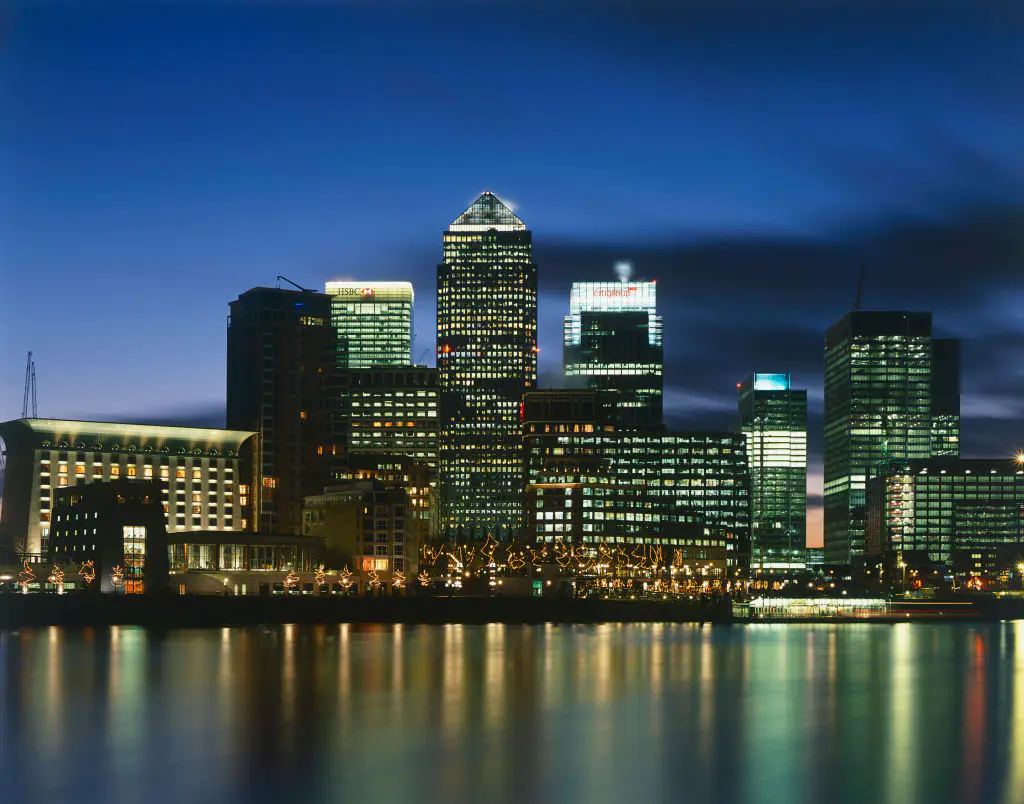
Most lovers of cities, from Aristotle to Johnson, characterise the city as a testament to man’s capability of practical reason and invention. Its critics would agree, holding the city as a symbol of Babel-like pretensions and artifice. Unlike Ackroyd, they recognise that cities are made by man and can be shaped and altered according to his needs and desires, as Baron Hausmann did in Paris and Robert Moses did in New York. The construction of Canary Wharf by the Docklands Development Corporation is yet another witness to man’s ability to shape the urban environment.
Shorn of its mystical baggage, Ackroyd’s attitude has a different name: historic preservation above all. If we take seriously the contention that places have immutable spirits, that London is unknowable and untameable, and that the city cannot be altered by human intervention alone, then its residents must become mere guardians of their local genius loci. Urban design becomes quietist and apologetic, unable to dare to change a place. The city becomes a museum: entombed in its past, unable to awaken from its nightmare.
In a revealing chapter, Ackroyd describes London’s post-war development as “vandalism” and bemoans the pulling down of the Euston Arch in 1963. This is the shrill language of Amery and Cruickshank in The Rape of Britain, a polemic that chided post-war reconstruction and catalysed the modern heritage sector.
Similarly, in a Times article written just before the book’s publication, Ackroyd proposed that “[n]o building over eight years old should be demolished without a special licence” and warns that, although “the history of London has been the history of vandalism and rebuilding … it is [now] necessary to preserve rather than rebuild”. Of course, prohibiting demolition in a crammed city entails restriction on new building. Calls for the “preservation” of a set of otherwise unremarkable Victorian office buildings scuppered Mies van der Rohe’s proposed Mansion House Square project.
In Ackroyd’s London, there is no conception that a city is fundamentally a place where people live and work, where neighbourhoods can be made and re-made based on present desires. If we are to take Ackroyd’s recommendations seriously, London will become a city defined by its past: an Antwerp or, worse yet, a Salzburg, where busloads of Chinese tourists can tick off yet another European destination. Before London usurped her in the Eighty Years’ War, Antwerp was Europe’s main entrepôt. Its quays and docks are sublime examples of Flemish Renaissance architecture: one can still visit its silted-up and perfectly preserved port today.


