Spectres of folk
Can the gallery embrace unofficial culture?

Cultural institutions love to flirt with the eccentric as much as they love to rediscover ideas they only recently abandoned. In art galleries, which have tended to side with the rational, periodic reappraisals of concepts like witchcraft or the occult, such as the 2020 touring exhibition Not Without My Ghosts, narrate incremental shifts in culture’s relationship with Enlightenment logic. The recurring celebratory incorporation of outsider art into the mainstream, like in the 2013 Venice Biennale The Encycopedic Palace, marks even contemporary art’s reliance on ideas cultivated outside the establishment. Elsewhere, one might expect the recent resurgence in religious interest to spark speculation about future aesthetic forms that break with the cold cult of organised reason.
For folk, a culture that by definition emerges without coordination, stimulated revivalism has been the default state since the late nineteenth century. Phantasmagoria, a group exhibition of “folkloric sculpture for the digital age” at the Henry Moore Institute in Leeds, pursues multiple such renewals at once. Bringing together video born out of internet horror, post-human sculpture, and AI-induced hallucination, the show catalogues and institutionalises the unsettling influence of unregulated social and media technologies on unsanctioned culture.
In the exhibition, Amsterdam filmmaker Rustan Söderling’s 2022 Virus Meadow, which animates the Green Man and a skeleton ghost engulfed in flames promenading through a frozen forest, serves as a symbolic link to pre-twenty-first-century conceptions of folk. This is spectralism for the CGI generation, haunted by climate change as much as it is by spirit tales. It is hard to imagine that such ideas could carry on today in the “real world”; they rely instead on the infrastructure of art institutions and cloud servers.
Steph Linn and Philip Speakman’s 2026 video installation, After the Vale, shown in frames spun with sheep’s wool, narrates the failed sixteenth-century Kett’s rebellion against the enclosures in Norwich. The peasants’ accounts ventriloquised in the triptych are compelling even if they end tragically. Yet this artefact miscasts craft as a quaintly rural, rather than primarily utilitarian aesthetic, and arbitrarily relegates an aspect of history to legend. Its talking heads sound like fictional characters in an online role-playing game. They could, conversely, have been extracted from today’s social media, where their veracity would be subject to different tests.
This is the limit of contemporary art’s embrace of folk truth; it is no longer quite the “living” culture valorised by ethnographic revivalists. Folk’s people and their legends are a historicist hangup to be recast in today’s narratives as mere content. How does this formulation, in turn, shape the folk? Joey Holder, whose 2025 The Woosphere resembles a retro gaming arcade designed ostensibly for human eyes, suggests that future cultural production need not be human at all. The installation and corresponding website woowoo.land are the home for interconnected AI chatbots who discuss their lot in cryptic terms incomprehensible to the exhibition’s visitors.
It is inevitable that the output of large language models, whose training data includes unofficial tales and whose contribution to the corpus is often phantasmic, will permeate human consciousness like folk songs once did. Reality has already overtaken Holder’s satirical prognosis: Moltbook, a social network for quasi-autonomous AI agents, launched in January. While that forum maintains a human-electronic frontier for now, the 2025 video Image Syncers by the Canadian-British artist Nina Davies suggests that new forms of human culture need not have directly human origins. In a podcast-like narrative, Davis accounts for the emergence of peculiar behaviours, such as robotic movement or distortion of gestures, prompted by the circulation of uncanny AI-generated images and video. Syncers are young people who wear prosthetic fingers, grimace unnaturally for the cameras, and wear clothing that twists their body shapes.
While Davies’s video is not a documentary — she exhibits her props and costumes — the phenomenon she highlights is far from fictional. If humans are memetic, some will emulate the hallucinations of machines. TikTok, for example, has contributed to the emergence of modern-day choreomania, an algorithmic epidemic inducing millions of users to reproduce intricate dance routines for the camera. Cosmetic surgeons, meanwhile, have reported receiving requests for permanently altering their clients’ appearances to match those of AI creations.
All this is happening in a youth culture that ostensibly values authenticity above anything else: despite embracing the copy, Syncers signal pride in their images not being “generated”. Such authenticity is also one of the characteristics associated, perhaps unfairly, with unwary folk cultural production. The uneasy implication of Davies’s work is that the spontaneous emergence that once defined folk may now be entirely railroaded by technological paradigms. Such a culture does not belong to any particular authentic people.
Phantasmagoria’s curator Sean Ketteringham casts this negation of folkishness as spectral, following Karl Marx’s and Walter Benjamin’s characterisations of capital’s perniciously seductive qualities. Cyberspace is, indeed, everywhere and nowhere, and the binary is as rational as it is spiritual. Yet this revival knowingly severs folk culture from any place or time, associations with which the “contemporary” of contemporary art is deeply suspicious of. It’s hard to see this as a win for anyone involved.
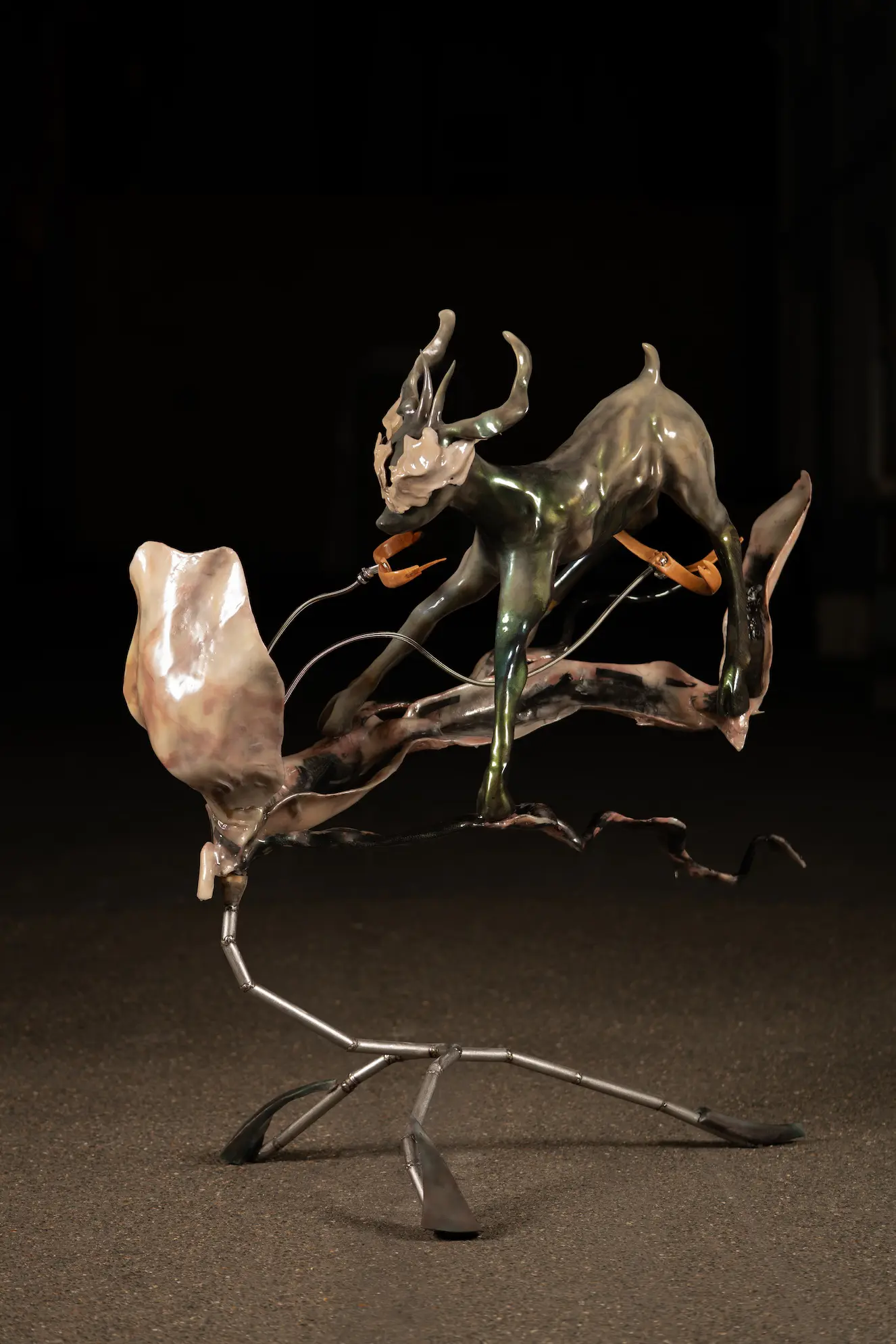
A handful of works in the exhibition bypass this extractivist rootlessness in favour of pure phantasm. Isaac Luthgoe’s bizarre sculptures, composed of materials such as cow stomach, resin, carbon fibre, and stainless steel, mix humanoid and animistic forms. His fantastical cats, fawns, and birds are the stuff of both nightmares and twee Victoriana. With titles such as When everything is new the pleasures are skin deep (2023), they also lampoon their own dominant paradigms. Despite this clash, the works are at home in the contemporary sculptural vernacular. It is precisely their unoriginality — one may imagine the works being made in any suburban garage — that brings Lythgoe’s sculptures into the embrace of folk when many other objects in the exhibition evade it.
Joe Moss’s performance Infinite Customisation V, which involved an official “meet” of modified car owners who showed off their pimped-out vehicles outside the exhibition’s opening, extends this logic. The aesthetic reality of such objects — at once imported and proximate, borne out of the global supply chain but intimately held — may well be what defines a controlled, folkish spontaneity today. But the confusion of Phantasmagoria won’t revive, let alone reinvent anything. Folk, if it still exists, had better stay away from the institution.