

The ends of Pan-Africanism
An exhibition devoted to Pan-Africanism avoids important political and aesthetic questions

There are concepts so fantastical that the only way to disprove them is in their wholesale, unencumbered acceptance. Pan-Africanism, the idea that a tacit solidarity binds the 1.5 billion inhabitants of the African continent with a worldwide diaspora and that this unity will one day lead to the emancipation of the globe, is one such runaway project.
Pan-Africanism has spread primarily through the efforts of the intellectual circles in Europe and the Americas. Project a Black Planet, an exhibition and series of events at London’s Barbican, tests the notion’s enduring influence and the convictions of the artists who continue to animate it in over 300 artworks.
Unlike today’s realpolitik formations, such as the African Union charged with protecting the integrity of the continent’s nations, Pan-Africanism specifically transcends geography. The Barbican’s exhibition begins with the French Moroccan Yto Barrada’s 2010 wooden puzzle Tectonic Plate, which rearranges the world map, Pangea-style, with only Africa central and immovable. Nearby is the Belgian Edith Dekyndt’s video Native Shadow (2014), which shows a flag made up of black hair flying in the sky of Martinique. The “Pan” of Pan-Africanism is thus the white man’s making.
The project is also transhistorical. Dekyndt’s work refers to events of the transatlantic slave trade that took place after its abolition and draws on theoretical developments that came even later. Throughout the exhibition, contemporary and twentieth-century works contend with archival materials. The first vitrine includes an invitation card to the 1900 Pan-African Conference, held in Westminster Town Hall and co-organised by the civil rights activist W.E.B. Du Bois. Next to it is a poster for a 1970 New York event with the Jamaican activist Marcus Garvey, whose political doctrine promoted black ethnic nationalism and his installation as a provisional president of Africa.
Project a Black Planet calls this “world-making”. This term has been in vogue in the art world of late, and its ubiquity conceals the bravado and unrestrained imagination necessary for Pan-Africanism to have got anywhere at all. It is extraordinary to consider today, after decades of the concept’s dominance in cultural institutions, that the construction of black identity needed to be offshored to the West.
At the Barbican, works of the Cuban Chinese painter Wifredo Lam highlight this complexity. Lam, a Cubist and Surrealist, rubbed shoulders with the likes of Matisse and Picasso during his time in Europe. His 1944 Altar for Elegua, a deity of a Cuban and Yoruba blend of Spiritism and Catholicism, is a luminous assembly of natural motifs, sculptural elements that dwell somewhere between life and representation. Above all, this loosely painted oil on paper is a work of Western Modernism that makes a claim on Modernity as an African phenomenon.
The intellectual consequences of this paradigm are easy to miss in today’s culture wars that leverage post-colonial reflexes in their basest forms. Yet the question remains unresolved decades after Lam and a cast of thinkers, such as Franz Fanon and Édouard Glissant, depicted in the exhibition in the South African William Kentridge’s 2023 ink and charcoal drawing Six Heads, made their world-building pitches.
African Modernity is not entirely ungraspable (think, for example, of Tate’s 2025 show Nigerian Modernism, which wasn’t entirely aesthetically incoherent). But this temporal claim makes more sense in art or poetry than in material reality. The Yoruba philosopher Olúfẹ́mi Táíwò is just one proponent of finally bridging the two. His 2022 book, Against Decolonisation, argues on the basis of his country’s current cultural output that African culture must free itself from neocolonial desires so that it can embrace (or reject, or fail at) modernity on its own terms.
When the Pan-Africanist movement turned to material reality in the second half of the twentieth century, that reality again focused on the diasporic. Project a Black Planet has a somewhat perfunctory display of British “Black Power” publications from the 1960s and Biafra pamphlets, but it is works such as the American artist and philosopher Adrian Piper’s 1975 photograph and crayon drawing I Embody Everything You Most Hate, that are capable of lastingly narrating, if not outright altering, the conditions of their production.
126 years into the Pan-Africanist project and at this stage of the exhibition, a visitor may legitimately wonder about the purpose of both. There have been plenty of other survey exhibitions (Hayward Gallery’s 2022 In the Black Fantastic, for example) that have failed to ascribe the African project in art or politics conclusively. Project a Black Planet takes plenty of art historical liberties without quite being able to root them in the underlying intellectual tradition or recent exhibition developments. This makes for some confusing assemblies, such as the white South African painter Marlene Dumas’s 1986 oil portrait of a black Albino hanging next to the Pakistani British writer and curator Rasheed Areen’s 1970 Five Blues, a wooden lattice that resembles the contents of a Meccano set. Does the notion of a “Global South”, so invoked, supplement or compete with Pan-Africa?
Such indecipherability and mission drift are both the intended feature and fault in Pan-Africanism. Or are they the idea’s natural evolution? Project a Black Planet evades the question by being economical even with aesthetic truth. The most prominent space in the show is granted to the American Hale Aspacio Woodruff’s 1952 mural series Art of the Negro. These propagandistic images, made for a university in Atlanta, extol African art from prehistory to colonialism and emancipation, in an illustrative style that blends European antiquity and comic book Americana. Woodruff’s narrative wouldn’t fare too well under the scrutiny of a fact-checker, but that’s hardly the display’s greatest problem: the Barbican puzzlingly shows six of these giant paintings in embarrassing inkjet-on-canvas copies.
This inattention to a crisis in credibility is the result of self-referential projection sustained by the institution without regard for its effect. It mirrors Pan-Africanism’s history itself. The gestures this process involves are staggeringly naïve at times. The American artist and film-maker Cauleen Smith’s 2015-16 Human-3.0 Reading List is a series of ink and watercolour reproductions of books by the likes of Angela Davis, establishing a library of “colour and consciousness”. This project doubles down on elite self-dealing. Its aim is to remake the world in the image of the African struggle without, alas, much attention to Africa.
Attempts to constitute a people of Pan-Africanism are not necessarily more intuitive than those that tie the project to time or place. The Egyptian painter Abd al-Hadi el-Gazzar’s early 1960s portrait of Two People in Space Outfits projects a future African diaspora that may not be rooted on Earth at all. Such work contrasts with the “back to Africa movement”, reanimated by Garvey, and is a precursor to the optimistic aesthetic of Afrofuturism theorised in the 1990s. All the feasible readings of el-Gazzar’s painting, however, involve a commitment to ahistorical, speculative realism capable of radically redefining the African subject.
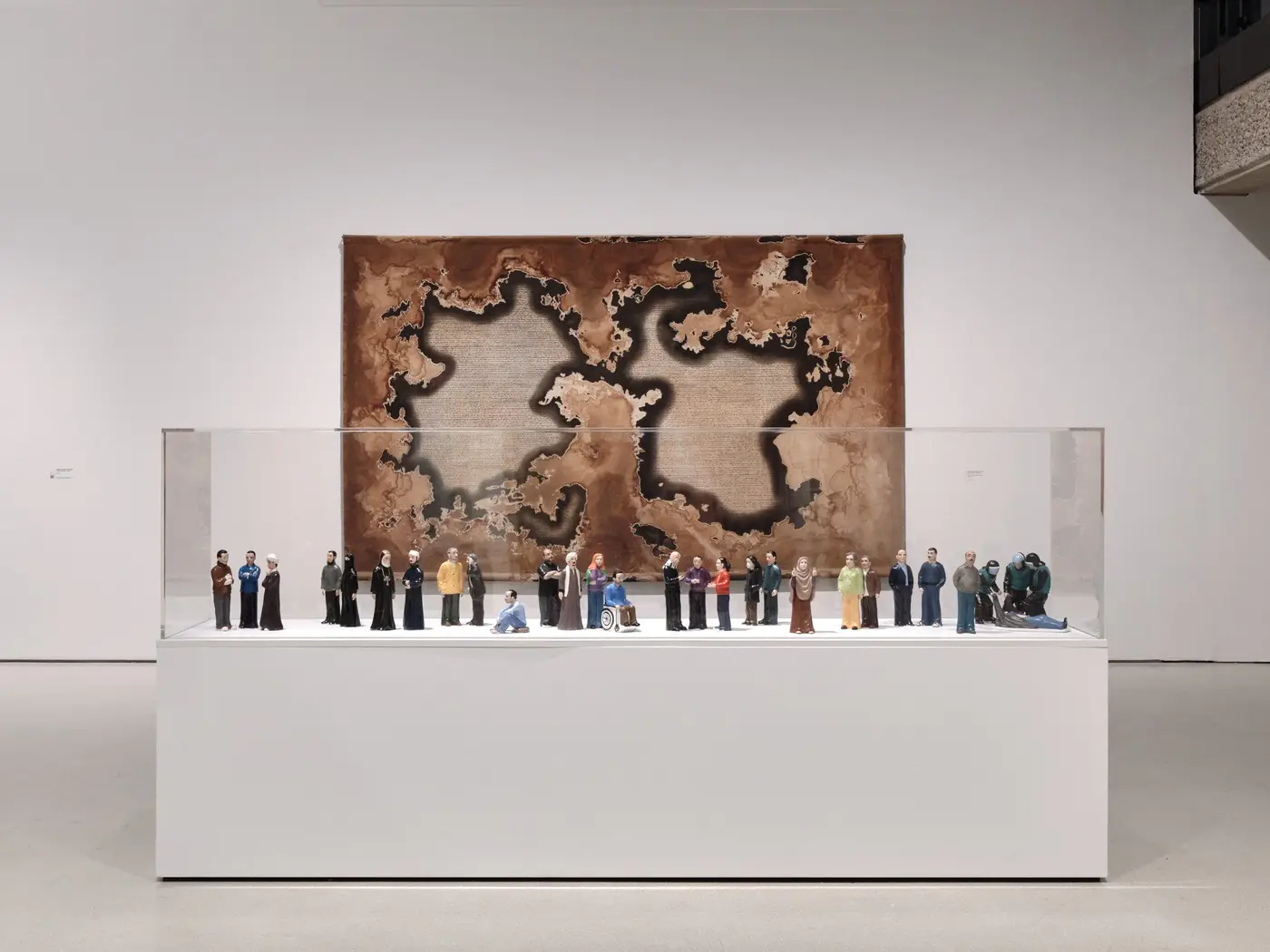
By aesthetic, but not ideological contrast, the Egyptian painter and sculptor Moataz Nasr’s 2012 assembly of clay figurines, Elshaab (The People), is prosaically modest. It shows the “diverse” (in that overfamiliar sense) participants of the 2011-13 Egyptian revolution. The drab simplicity of this work, in turn, recasts some of the contemporary projects of subjectivity creation. At the show’s end, when a visitor expects a digestibly optimistic takeaway or a set of instructions for the future, Project a Black Planet fills a room with new portraits by Lynette Yiadom-Boakye. The London painter is celebrated, including in a 2022 Tate survey, for her images of black people. The only snag is that her subjects are always entirely fictional.
How can the movement foster solidarity between people who do not exist? Yiadom-Boakye’s work is either Pan-Africanism’s greatest obstacle or its successful terminus. As the commitment to the revolutionary potential of Pan-African solidarity has become a mainstream artefact of Liberal thought, the black identity it has constructed has rendered itself open, once again, to totalisation. It is, to finally attend to the idea’s dissolution, these non-existent people who will be Pan-Africanism’s keenest adherents.
Project a Black Planet, The Art and Culture of Panafrica continues at Barbican Art Gallery until 6 September.


