

Stalin’s umbilical cord
Did the Arctic convoys actually do any good?
At this time of year, as a military historian I am frequently asked about wartime winters. They are the most difficult time for service personnel, far from the families and battling with the elements as well as their enemies. In days gone by, this was when troops withdrew into winter quarters, the front lines moved little, routine and boredom lay heavy on soldiers’ hands, the novelty and excitement of combat long since gone.
This year, those in Syria are celebrating the unexpected present of the departure of the Putin-supported murderous Assad regime, though we have yet to discover whether its replacement will be more tolerant. Brave Georgians, out on their freezing streets each night in Tbilsi, frequently pummelled by riot police, are hoping winter brings the downfall of the pro-Moscow Georgian Dream government, and its anti-Western leader Mikheil Kavelashvili, whom the outgoing pro-EU and NATO president, Salome Zourabichvili, refuses to recognise. Romanians pray for a better result after the annulment of their recent presidential elections, which the Constitutional Court deemed were dominated by Russian cyber activities. Stoic Ukrainians soldier on, under fire in their trenches and streets from Kremlin drone, missile and rocket attacks, wishing the season will bring better news than of late and that outside interference will not force them into a peace deal they do not want. I salute them all. Each will re-emerge in the spring to battle anew with the long arm of the Kremlin, and it is easy to see linguistically how Martius, god of conflict, seen by the Romans as the first month of the year, and marking the time of a return to farming and military campaigning, soon became Mars, Marzo, Maart, Marts, or our own March.
However, when the barometer plummets and the ground hardens and glistens, my mind often dwells on an immature nineteen-year-old from Inverness who had just received his call up papers and was drafted into the Royal Navy. Qualifying as a wireless operator and torpedoman, he spent his next eighteen months protecting Britain’s east coast convoys. In 1943 his pace of life changed dramatically when he transferred to Royalist, a 7,000-ton Dido-class light cruiser. Immediately, with 530 others, he was pitched into the fear, turmoil and exhaustion of escorting two Murmansk-bound Arctic convoys. Ten years later, after winning a short story competition in a local newspaper, to lift himself out of poverty he penned HMS Ulysses, the once-read, never-forgotten novel of a light cruiser on the Murmansk run. The youngster, who had grown up speaking only Gaelic at home, was Able Seaman Alistair MacLean.
Join Britain’s most civilised publication.

Challenge the consensus. Access rigorous analysis.
Hostile warships, submarines and aircraft were doing their best to kill them around the clock
He depicted seafaring life in the Arctic convoys in the way Nicholas Monsarrat had for the Atlantic in The Cruel Sea. Just as Monsarrat’s war service in anti-submarine escort ships informed his writing, MacLean’s dramatic hinterland provided HMS Ulysses (modelled on the Royalist) with authenticity on every page. Every paragraph, every exchange of dialogue suggested closely studied veracity. The way in the permanent gloom of winter, when the elements were at their most mischievous, the temperature never rose above minus 30. The ionospheric conditions that caused signals interference and tired wireless operators, such as MacLean himself, to misinterpret garbled orders or never receive them, and when weather forecasting amounted to guesswork. Then there were the constant companions of snow and ice, thick enough to capsize a ship if not quickly chiselled away by axe; and occasional discoveries of those on watch who had frozen to death. He remembered mugs of cocoa that frosted solid in seconds; ungloved hands which glued themselves immediately to cold metal; the impossibility of preparing and serving warm food; and how for each twelve-day voyage, clothes were never dry. And the cold, always the cold, which robbed all mariners of sleep, and sapped every remaining ounce of mental and physical strength.
MacLean recalled the mountainous winter seas which buckled funnels, tore away lifeboats and bent bridge superstructures out of shape; fierce storms that scattered convoys, leaving their escorts to grope blindly for their charges. There was the permanent exhaustion and constant nausea from being thrown around violently by the waves. The memory of rushing from port to starboard to try and stabilise the ship, then giving up, thinking each roll would be the last. Breakdowns of machinery were common, but human breakdowns were almost as frequent, brought on by the sense of isolation caused by darkened horizons and reduced visibility, which tested the hardiest of souls. Ever present, too, was the constant fear of being swept overboard, meaning instant death in the foamy maelstrom, any cries for help defeated by the furies.
Most of the vessels in the Merchant Navy that MacLean escorted were old and slow, dating from the First World War. Their crews, including cabin boys as young as fourteen and old hands into their sixties, thirty per cent of whom were non-Britons, were equipped for Arctic vindictiveness with little more than a duffle coat, heavy rubber sea boots and a balaclava. They were paid as little as £10 a month, which until May 1941 had ceased the moment the waves closed over their ship. Against these elements, where good leadership was vital, misjudgements by a nervous or poor commander could endanger the lives of his crew and mean the death of his ship. And if they made it to Russia, there was always the return journey, still at the mercy of the Arctic weather.
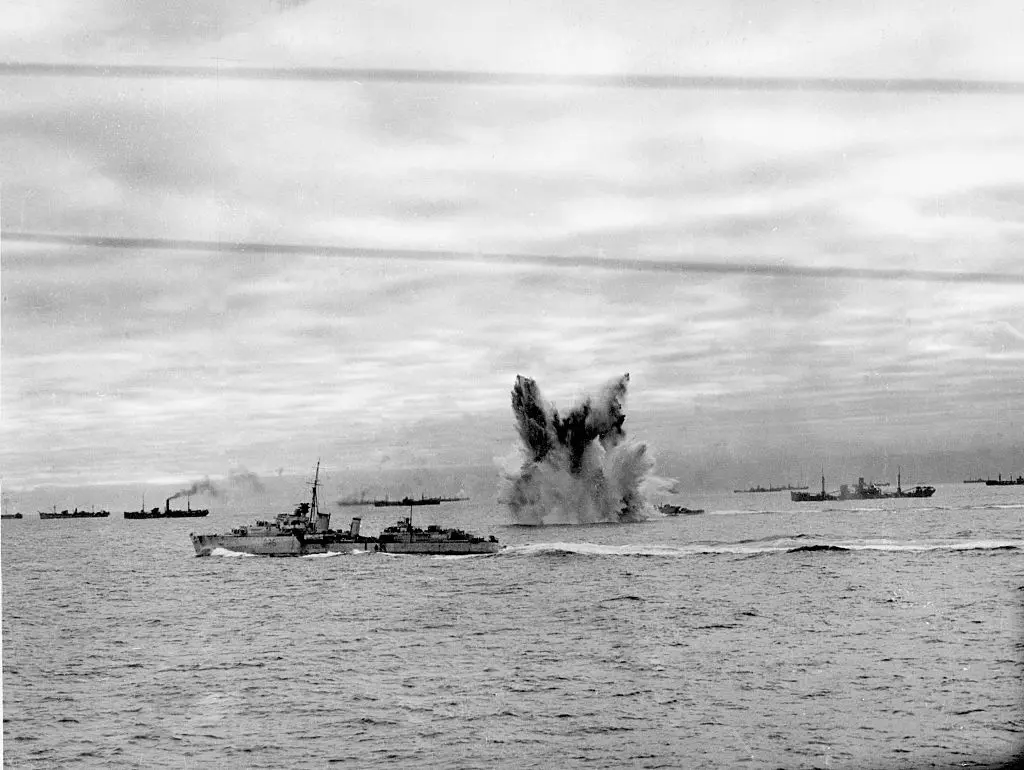
On top of which, hostile warships, submarines and aircraft were doing their best to kill them around the clock, usually in the long daylit hours of an Arctic summer. Although the winter conditions were more punishing, the extended Polar nights and atrocious weather offered better chances of survival. Then, it was pointless for U-boats to surface, and Luftwaffe reconnaissance flights were grounded, unable to prowl the shipping routes. In the summer months the floating caravans were relentlessly attacked from above and below the water, from U-boat and Luftwaffe bases in Norway. In all, the Germans would sink 85 merchantmen and 16 Royal Navy vessels, including two cruisers, six destroyers and eight corvettes. MacLean knew most of them. The fictional warship of his title, HMS Ulysses, suffered a mutiny; in real life, Churchill described these convoys as “the worst journey in the world”. There were endless factors why seamen might be unhappy on those desperate, bleak, and Homericly-testing voyages, and the young Alistair MacLean had experienced them all.
The reason for these ships slicing their way through spiteful seas was Operation Barbarossa, launched against the Soviet Union in the flash of a thousand cannon early in the morning of 22 June 1941. Within weeks Hitler’s panzers had raced halfway to Moscow; in a month the Germans had snatched an area double the size of their own country. With the USSR rapidly buckling, and many war factories overrun, Churchill and Roosevelt concluded they had to act fast to prevent a terminal haemorrhage of Stalin’s Russia. Throwing aside his longstanding antipathy for Communism, Churchill pledged to provide military and economic aid, the prime minister stating, “This is of course an alliance and the Russian people are now our allies”. From Washington DC, President Roosevelt dispatched Harry Hopkins to offer an extension of the Lend-Lease Act to include Moscow as well as London.
With wolf packs beginning to prowl beyond their usual lairs in the North Atlantic, in February 1942 the time-consuming business of taking on provisions, fuel and water, assembling convoys, issuing orders and shepherding merchant ships was established at a site originally chosen as the Royal Navy’s alternative to Scapa Flow, the well-sheltered anchorage and refuelling base of Loch Ewe in the remote Scottish Highlands, 80 miles west of Inverness. A large fjord with a narrow mouth, north-facing, and therefore shielded from the prevailing westerly winds, it is surrounded by gently sloping hills, where oystercatchers call, porpoises play and waves scrape across the shingle, and was at the very limit of Luftwaffe eyes.
The locals spoke Gaelic for preference though one German pilot, shot down in the mountains, found he could communicate with a surprised crofter in their mutual tongue of Latin. After June 1941 when the facility was commissioned as HMS Helicon, the few residents were swamped by thousands of new arrivals in many uniforms and none. Army gunners in khaki rubbed shoulders with the naval staff of a dozen nations, air force personnel in light blue, and merchant seamen from all over the globe. Helicon soon grew into a profusion of Nissen huts, concrete structures and bell tents, in effect a miniature town, incorporating accommodation, kitchens, a gymnasium, chapel, cinema, canteen and medical centre, oil tanks, anti-submarine nets, minefields, anti-aircraft guns, cement roadways and coastal artillery.
Today, if you look closely, you can see the crumbling gun-emplacements jutting out from the hillside, and if you drive past the Russian Arctic Convoy Museum in Aultbea, through Cove to the end of the road at Rubha nan Sasan, you will find an obelisk commemorating those who never returned from the hundreds of merchantmen and escort vessels that once rode at anchor in the now-empty loch. Shipping routes changed between the summer and winter months, where during the warmer seasons, the merchant fleets would operate as far north as possible, away from Luftwaffe air bases in Norway. However, during the almost 24 hours of daylight in northern latitudes from June to August, with fewer storms and less fog and sleet, convoys were more easily spotted. Cargo ships and their guardians headed first to Iceland, collected others and proceeded to Murmansk or Archangel.
Neither destination appealed. Murmansk was bombed daily, being close to German lines, whilst Archangel further east was ice-bound for part of the year. The young Lieutenant and future Admiral of the Fleet Henry Leach (1923-2011), aboard the battleship Duke of York, recollected Murmansk as “one of the gloomiest towns in the northern hemisphere, where conditions for the reception of merchant ships were hopelessly disorganised, muddled and inefficient. Far from being grateful for vital war stocks, the Soviets seemed to go out of their way to be difficult and obstructive. In winter the uncaring inhabitants shuffled around like ghosts, in summer the whole town stank with a stench so vile as to be hardly bearable. The surrounding Kola Inlet felt like being in a trap, the effect on the morale of our seamen was deep, and everyone was glad to be able to put to sea again.”
Amongst the casualties was the cruiser Edinburgh, a sister to HMS Belfast moored in the Thames. Telegraphist Alan Higgins recalled a festive “Christmas lunch of half a tin of cold steak and kidney pie with rice” aboard her on an Arctic run in December 1941. Of her 1942 demise, he recalled, “It was just after four o’clock in the afternoon and we were having tea. There was a bloody big bang and a flash. The whole ship felt as though clasped in a trembling hand”. Edinburgh’s loss was witnessed by the Soviet gunboat Rubin, concerned that Edinburgh had been carrying 465 Soviet gold ingots in part payment for war materials. It was not until the 1980s that divers recovered most of her stash from the wreck, 800 feet down. Five remain, if you’re interested.
At a time when every extra tank, aircraft or blanket counted, the flow of Western aid through the Arctic convoys made a crucial difference
Using a convoy as bait, the Admiralty twice, in December 1942 and again over Christmas 1943, managed to lure the German surface fleet out of port, and damage or sink them. On the first occasion a fifteen-ship collection of merchantmen, carrying a mix of valuable tanks, vehicles, fighter and bomber aircraft, aviation fuel and over 50,000 tons of other war supplies, protected by a few escorting warships, was attacked on the last day of 1942 by eight German ships. Two battlegroups comprising the heavy cruiser Hipper plus three destroyers, and the pocket battleship Lützow, with three more, engaged a Murmansk-bound flotilla. In an excellent display of naval pluck, the attackers were held at bay by the far inferior defenders, with Captain Robert Sherbrooke, commander of the close escort, in Nelsonian fashion losing an eye in the encounter, receiving a Victoria Cross for his leadership against overwhelming odds. Meanwhile, a distant covering squadron, based on the cruisers Sheffield and Jamaica, rushed to the rescue and managed to seriously damage Hipper and sink one of her accompanying destroyers with all hands, retiring without loss to themselves. The fifteen merchantmen, meanwhile, slipped past and reached Murmansk intact. Hitler demanded his war fleet be scrapped, which resulted in the resignation of its chief, Admiral Erich Raeder.
The second deciding moment arrived in late 1943, when a nineteen-ship convoy set sail on 20 December from their haven of Loch Ewe, protected from afar by a three-strong cruiser force and, further off, a Home Fleet squadron led by the battleship Duke of York. Michael G. Walling notes in Forgotten Sacrifice: the Arctic Convoys of World War II (2012) how on 22 December, a rare Luftwaffe reconnaissance plane sighted the convoy. Orders were relayed to the German battlecruiser Scharnhorst, lurking in a fjord at the very tip of North Norway, to intercept. With five destroyers she sailed in a Force Eight gale late on Christmas Day. The British Fleet commander, Admiral Sir Bruce Fraser, was in possession of timely Bletchley Enigma intelligence, which by then was remarkably slick. It brought him insights into Luftwaffe, U-boat and Scharnhorst’s wireless transmissions, giving him a better picture of German movements than they had themselves, though this aspect of the ensuing clash was only available to historians after the secret of Bletchley was declassified in 1974.
In the early hours of Boxing Day 1943, Scharnhorst managed to lose her destroyers, labouring in the heavy seas, but using her own speed and stability, started to follow the scent of U-boat reports in pursuit of the convoy. The Allied merchantmen, for their own part had no idea they were being offered up as live bait. Unbeknownst to Scharnhorst, she was already being tracked by British cruisers via radar. Soon, a star shell from Belfast suddenly illuminated the German ship, and within moments Norfolk’s eight-inch guns opened fire. Scharnhorst reacted quickly, made smoke, increased speed and within twenty minutes had escaped. Another star shell exploded three hours later, but this time Scharnhorst responded decisively, with hits scored on all three pursuers, Norfolk, Belfast and Sheffield, but again twenty minutes after it had begun, this second action ended with the battlecruiser veering off, though still shadowed by over-the-horizon radar contact by the cruisers, licking their wounds.
However, four hours later, another star shell burst overhead. This time, it had not been fired from an eight-inch cruiser, but Jamaica, accompanying the 42,000-ton battleship Duke of York, equipped with ten 14-inch guns, which were lying in ambush. Lieutenant Henry Leach remembered his first view through his turret’s periscope after Jamaica’s star shell. “Scharnhorst’s turrets were clearly trained fore and aft. Astonishingly, after being trailed by our cruisers for the whole of that day, she was caught completely by surprise.” Salvos rained down, but she fought back bravely, and used her 32-knot speed to draw away from her pursuers.
It seemed Scharnhorst had escaped, but then a chance shot, from the last of fifty-two broadsides, fired at extreme range from Duke of York punctured her armour and exploded below decks in her starboard engine room and the ship’s speed dropped. Leach observed, “Suddenly the range steadied, then started to close. We gained rapidly; our own secondary armament of 5.25-inch illuminated with star shell and fire was re-opened with 14-inch. We closed right into point-blank. Scharnhorst was ablaze from stem to stern. Men could be seen leaping over the side into the icy sea, and death within minutes, to escape the inferno. It was a terrible sight.” Scharnhorst went down after ten-and-a-half hours of battle, taking with her around 1,700 men.
Did the Arctic convoys, which cost the lives of over 3,000 mariners, do any good? Russians saw them in the wider context of Britain’s first trading mission of 1553, also to Murmansk, when an expedition led by Richard Chancellor (1521-1556) was sent by Edward VI to find a north-east passage and a market for English wool. Meeting Tsar Ivan Grozny (the Terrible) in Moscow, Chancellor returned with a Russian ambassador, furs and Baltic timber. Thus began the joint-stock Muscovy Trading Company, which Soviet textbooks alleged underwrote the creation of the Royal Navy, English oak being utilised only later. In 1697-8, that wily tsar, Peter the Great, visited Britain for three months, improved relations, learned the latest maritime and navigation technologies, and invited British merchants and engineers to establish a community in Saint Petersburg, which lasted over 200 years, survived the Napoleonic and Crimean wars, until snuffed out by the Bolsheviks in 1921.
By the Second World War, remembrances of the depression years had caused the British population to drift to the political left. In the days before Stalin’s excesses were widely known, fellow-feeling and solidarity with Russia, and pressure for a Second Front, reflected a popular mood. This was represented by an enthusiasm in manufacturing war materials for the USSR, which Churchill exploited to sweeten his dealings with the Kremlin. However, under the post-war Stalin regime, Western aid was dismissed as “worth about four per cent of the total of materials used on the Eastern Front, and of inferior quality to comparable Soviet models.” Later under Khrushchev, Marshal Zhukov secretly admitted, “Now they say that the Allies never helped us, but it can’t be denied that they gave us so many goods without which we wouldn’t have been able to form our reserves and continue the war. We didn’t have explosives, gunpowder. And how much sheet steel they gave us! How could we have produced our tanks without that steel? Without their trucks we wouldn’t have had anything with which to pull our artillery.”
Under glasnost, examination of Russian Federation Archives (again closed to Westerners) has further developed this “alternative history”. Often under-reported, machine tools and raw materials, such as aluminium and rubber, were shipped in Arctic convoys to get Soviet industry quickly back on its feet. When domestic Russian production was still very low, this meant their arrival had a disproportionate impact. According to the latest research, because the USSR had lost a staggering 20,500 tanks between 22 June and 31 December 1941, only 670 were available to defend Moscow. These were quickly supplemented by 487 British-made Matilda IIs and Valentines, plus the first of an eventual 3,000 Hurricane fighters, which reached the front with extraordinary speed.
Russian geopolitics today means Moscow’s historical pendulum has again swung against wartime aid, belittling it as irrelevant and of poor quality. Though Russian diplomats still honour Britain’s sacrifices, an irate Vladimir Putin draws uncomfortable parallels with Washington and London sending significant, war-winning assistance eastwards, this time thankfully by land, to Ukraine. Those same fast-melting waters of the Arctic have also become a new zone of confrontation for Canada, Denmark, Norway, the UK, the USA, versus Russia, where NATO has doubled its military activities as Moscow seeks to open up a permanent north-east passage to China and the Pacific. Guarded by the Kremlin’s warships and aircraft, and escorted for a fee by Russian icebreakers, journey time for shipping would be cheaper and quicker by at least ten days than across the Pacific.
In March 2021, America published its new strategy, Regaining Arctic Dominance, in response to Mr Putin’s determination to plant his flag on supposedly neutral subsea sections of the far north bearing precious metals, including lithium, cobalt, rare earths and graphite, which explains President Trump’s current obsession with Greenland. For him it is not just an exercise in sweeping the board in a real-life game of Monopoly, but a key asset in protecting North America’s trading routes.
Back in 1941-2, we now know that British-supplied armour comprised 42 per cent of the heavy tank strength of Soviet forces on the Moscow front, transcripts of German signals indicating the Wehrmacht first came into contact with British tanks on 26 November 1941. Bernard Edwards reminds us in Road to Russia: Arctic Convoys (2015) that by the end of 1942 out of 13,500 Red Army tanks in service, nearly ten per cent were of British and Canadian origin, with another ten per cent American. Eventually, one third of all Russian wheeled vehicles came from abroad and were considered of higher quality and durability than their own or the Wehrmacht’s. This enabled the Soviets to concentrate on what they did best — the mass manufacture of artillery, of which only two per cent came from the West.
To Russia by sea (there was a longer land route through Persia and an American west coast one for grain) were despatched four million tons of goods, including 18 per cent of the USSR’s canned meat needs, and 57 per cent of all rails used during the war, 1,900 locomotives to supplement their meagre output of just 92, and 11,075 railway wagons to add to the 1,087 produced domestically. America sent over 6,000 aircraft, including 4,719 P-39 Aircobras, with 12,700 tanks, including 4,000 Shermans, 44,000 Jeeps, 375,883 Studebaker and other trucks, 8,071 tractors, 5,000 wireless radios, 380,000 field telephones with 956,000 miles of telephone cable, 1,541,590 blankets, plus 15,417,000 pairs of army boots. This is not to say the Soviet Union would have lost without Western aid, but historians such as David Wragg in Sacrifice for Stalin: the Cost and Value of the Arctic Convoys Re-assessed (2005) argue that Stalin and his commanders “might have taken twelve to eighteen months longer to finish off the Wehrmacht.”
Thus, at a time when every extra tank, aircraft, machine tool or blanket in the USSR counted, the flow of Western aid through the Arctic convoys, mostly sailing each November to March, made a crucial difference. Hitler’s High Seas Fleet, designed to dominate the North Sea and sink ships in the North Atlantic, ended its days hiding in Norwegian waters, sniping at the Russia-bound convoys. Harried by aircraft, submarines and Royal Navy warships, most of it, like the damaged Hipper, either fled back to Germany or, as with the battlecruiser Scharnhorst and battleship Tirpitz (sunk by Lancasters in Tromsø fjord on 12 November 1944), was destroyed as a threat to the umbilical cord of aid to Stalin.
In total, 78 convoys sailed to or returned from Soviet ports, but it was only on 19 December 2012, after lobbying for sixteen years, that David Cameron’s government finally awarded convoy veterans their own official Arctic Campaign Star, by which time an estimated 400 were still alive. In 2015, the Kremlin subsequently awarded these ancient mariners their Ushakov Medal (named after the patron saint of the Russian Navy), and until recently they appeared as honoured guests at May Day parades in Red Square. Alas, too late for Able Seaman MacLean who died in 1987, but he would have heartily approved. So it is each winter, that I picture and honour the crews who took part in those Arctic runs, a job I would not have wished for all the lottery wins on earth.


