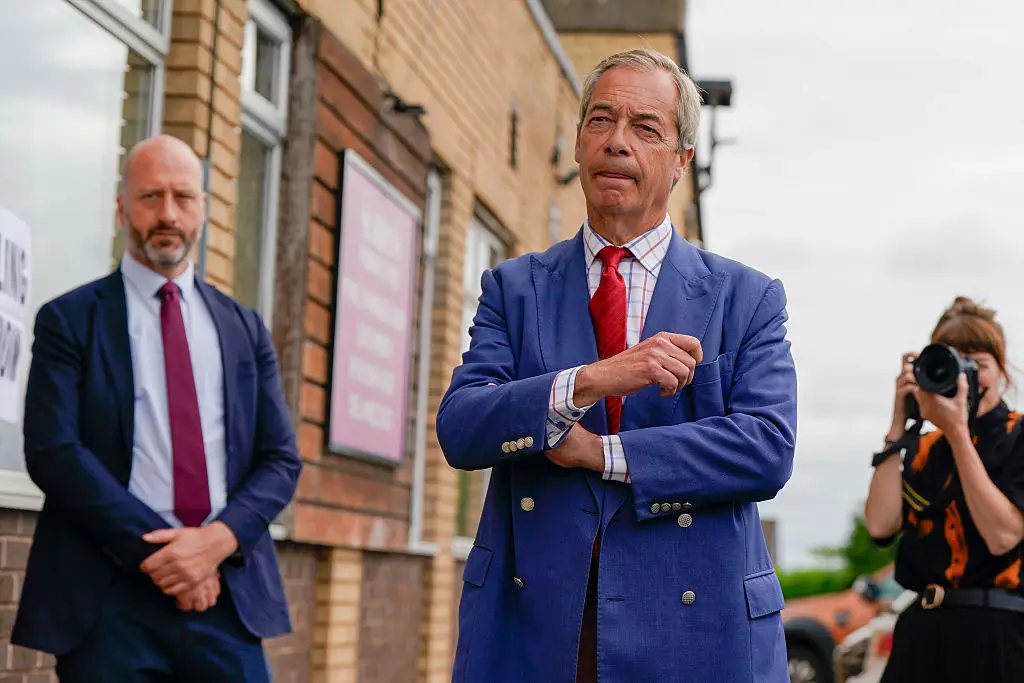
Farage the fumbler
Nigel Farage is not built for the highest positions of responsibility
I’m not entirely sure what to make of Nigel Farage’s decision to precipitate a by-election in his Clacton constituency. It does, as he put it yesterday, put his fate in his constituents’ hands, at least for now. But what else does it achieve? It doesn’t seem likely that it will deter his critics, nor would it prevent them having a chance to force another by-election in the event that he is suspended from the House of Commons.
As ever, a lot will depend on how we journalists end up framing it. Was this move decisive? Or desperate? We get to report whether something is a triumph or disaster and, in so doing, play a major role in deciding which it is. (Always worth bearing that in mind when you read us.)
Parts of Farage’s address to the nation, specifically his anger about alleged media intrusion into his family’s private life, seemed perfectly genuine. But the overall package was unconvincing, at least to anyone who has been following the stories about his finances over the past few weeks.
For example, he argued today that the £5m donation from Christopher Harborne — which he failed to declare on the Commons’ register of interests — was for security purposes, and spoke evocatively of the sort of treatment he gets that warrants private security. Fair enough, on the face of it, and this was the line he took when the story first broke.
Except that in the intervening period he de-emphasised that. In an interview with Julia Hartley-Brewer a couple of weeks ago, he insisted that he could “spend it on Ferraris” if he so chose. Initially asked for receipts to prove he had spent it on security, he couldn’t produce any, and claimed he hadn’t yet spent any of the money, which would at least seem to suggest that the security issue wasn’t terribly urgent.
The immediate problem here is that Farage didn’t declare the donation, which he ought to have done as it was given within a year of his being elected to Parliament. Whilst it was given before he seems to have had any intention of returning to the Commons, Farage’s claim that he didn’t need to declare it is nonetheless absurd. The rule on declarations covers all donations received up to a year before election and for good and obvious reasons.
But the deeper problem, I think, is that once again Farage is proving unwilling or unable to adapt to his new and much more public political circumstances. There has often been plenty of money sloshing around the Faragist ecosystem — UKIP’s EU funding, Arron Banks’ fortune, etc. — usually lavishly spent and seldom diligently tracked.
The extent to which the establishment is out to get Farage is often overstated: the Times investigative team that broke the latest story about his finances also exposed Lord Ali’s various embarrassing donations to Labour politicians a couple of years ago.
There is no doubt, however, that Farage is now subject to far more scrutiny than he is accustomed to and much of that is hostile. It seems entirely plausible that he himself believes that he is being persecuted. In which case, I suggest a useful little rule for outsider politicians: if you believe the establishment is out to get you, act like it.
It might not be fair, but if you’re up against a ruthless and powerful conspiracy of vested interests (even if only in your own head) then you simply need to be better, cleaner, and more careful than other people. Offered a tasty pot of cash or a favour from a convicted fraudster, you need to think “What will my powerful enemies do with this?”. Not bleat about it afterwards.
This isn’t just a Farage thing. One is put in mind of Liz Truss, whining about how the economic establishment supposedly conspired to bring her down. Now that is by no means the universally accepted version of events, but she certainly believes it — in which case she ought, surely, to have not been so extraordinarily reckless in taking them on?
I remain about as bearish as anyone I know about Reform UK’s long-term prospects
In the real world, however, one never encounters the tendency towards conspiracy theory and a bold willingness to criticise oneself in the same head, because the conspiracies are ultimately an excuse not to admit fault. It is thus hardly surprising that Farage’s are being reinforced by Dominic Cummings, a man equipped with a formidable analytical intellect but utterly unwilling to turn it on his own failings.
All this is why I remain about as bearish as anyone I know about Reform UK’s long-term prospects: not just because there is always a non-zero chance that the whole operation is engulfed by some scandal or other, but because Farage has time and again proven incapable of building proper institutions and accepting the constraints they impose. He clearly takes that same attitude towards his personal conduct in his private life.
And that will prove, in the end, cosmically self-defeating. Because I don’t think Farage took Harborne’s money for any illegal purpose, nor that there is anything remotely puzzling about borrowing a Westminster residence when he doesn’t have one himself. Nor does the British public care about politicians’ private wealth nearly as much as the Left wishes it did. Had Farage simply declared the donation in 2024, I think there would have been a bit of spluttering from the usual suspects and the whole thing would be long forgotten.
Instead, we now face at least one by-election and a world which seems increasingly to hold few good outcomes for Farage. Losing would be a bathetic end to one of the most consequential careers in modern British politics. But winning? That would keep him on a path which might yet end with Farage as prime minister — a role to which he seems more profoundly ill-suited by the day.