Spellbound by uncompromising weirdness
I loved Elektra’s sulky Riot Grrrl energy and Oedipus’s extraordinary choreography
Look out James Graham; move over Jack Thorne; London’s theatreland has a new darling. Sophocles, a hotshot writer out of Attica, currently has not one but two major productions of his cheery family sagas in prestigious playhouses in the heart of the capital.
In Elektra, at the Duke of York’s Theatre, things are going about as well as they ever do for the House of Atreus, the royal family of Argos. The title character, played by Brie Larson as a rebellious, sarky, shaven-headed teenager, is having a major strop over the fact that her mother, Clytemnestra (Stockard Channing), and her mother’s lover, Aegisthus (Greg Hicks), murdered her father Agamemnon. Admittedly Agamemnon had killed Elektra’s older sister but that’s a whole other story and, hey, bygones.
A livewire bundle of spiky rage in jeans and a punk band t-shirt, Elektra has another sister, Chrysothemis (Marième Diouf), but she’s not currently getting on with her. She’s waiting for the return of her brother, Orestes (Patrick Vaill), in the hope that he will avenge dear old dad by killing their mother and mum’s new squeeze. It’s complicated. Complex, even.
Join Britain’s most civilised publication.

Challenge the consensus. Access rigorous analysis.

The six-strong all-female chorus, dressed in toga-style gowns, sing-chant their commentary on the action while sounding like a lost prog rock album of the 1970s and the score — by composer Ted Hearne — is haunting. There’s another musical interlude when Beyoncé’s Daddy Lessons is blasted out while Elektra is arguing with Chrysothemis but, frankly, I’d take the chorus every time.
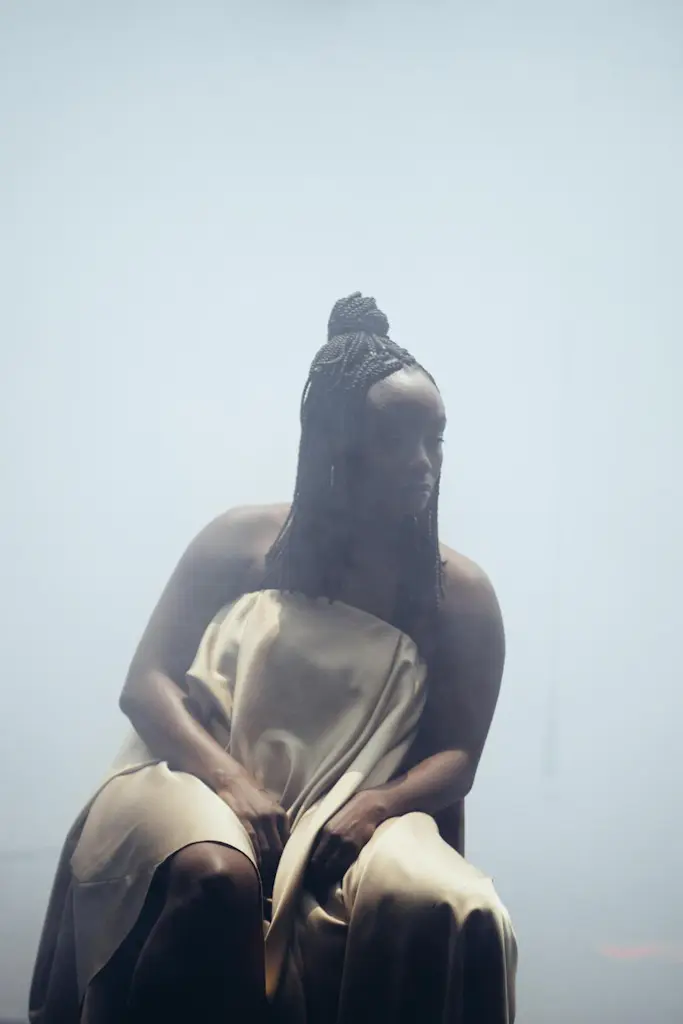
The show is directed by Daniel Fish from a translation of Sophocles’s play by the Canadian poet Anne Carson. Fish’s radical rethink of the musical Oklahoma! a couple of years ago was much admired but his Elektra has been divisive. Directors are often keen to show us how relevant ancient Greek drama still is — hey, look, those dudes were just like us! Fish’s concern seems to be to do the exact opposite. How much can we really identify with the Athenians who first watched this play performed 2,500 years ago? The past is a foreign country — they do things very differently there.
Again and again, they seem to fuse together into a seething organic unity and then fall apart
Larson’s mannered performance underlines this strangeness. She always sings the word “No”. She spits every time she mentions Aegisthus. Whenever anyone mentions Orestes, they beat their chest.
What does it all mean? What is the symbolism of the inflatable zeppelin that hangs over the stage, has a downward arrow on its side and changes from blue to white as it slowly turns round during the show? I have no idea. Is there any significance in Elektra wearing a Bikini Kill t-shirt as opposed to, say, a Hole t-shirt or a Slits t-shirt? Who knows? Why does she sometimes speak into a microphone that distorts her voice? Your guess is as good as mine. Why is she “Elektra” rather than “Electra”? Nope, I got nothing.
But was I entertained? I was riveted, spellbound by the production’s uncompromising weirdness. I loved Elektra’s sulky Riot Grrrl energy, I loved Orestes — disguised and wearing a Formula 1 driver bodysuit — delivering at approximately 200mph the tale of his own supposed demise in a chariot race. I loved the absolutely mesmerising chorus. This is drama as a 75-minute religious ritual — alien and impenetrable. And — a bonus — the short running time allows for a libation afterwards.
Not everything worked. There were some problems with the sound. Chrysothemis was barely audible at points. The inclusion towards the end of a recording of a journalist describing finding the bodies of torture victims felt out of place. And I could have done without the bright theatrical light placed on the revolve that, before the play started, periodically shone out into the audience dazzling everyone.
But look, Larson is an Oscar-winning star better known for playing a different sort of Avenger — Captain Marvel in the Marvel Cinematic Universe blockbusters. She chose to take a chance and a 99.99 per cent pay cut in order to perform in an experimental, avant-garde show that she clearly deeply believes in. I’m thrilled that she did.
Meanwhile, in another corner of the Sophoclean Dramatic Universe, namely Thebes, Oedipus (Rami Malek), the king is trying to work out why the city is in the grip of a terrible, murderous drought. Apollo lets it be known through his oracle that it is a curse and it can only be lifted by discovering who killed the old king and punishing him. Oedipus begins to investigate.
Malek — like Larson, an Oscar-winning Hollywood star — plays the ill-fated Oedipus as a politician, his speech cadences reminiscent of a JFK or an Obama. He’s trying to reassure a populace on the verge of an uprising that he’s on the case and sorting things out. There’s not much chemistry between the king and his older wife, Jocasta (Indira Varma), which does rob the play’s later revelations of some of their power but, nevertheless, the Old Vic’s show as a whole makes for intriguing entertainment.
This adaptation of Oedipus, by Ella Hickson, has been co-directed by Matthew Warchus and the choreographer Hofesh Shechter. The chorus has been replaced by 10 dancers from the Hofesh Shechter Company, performing to a hypnotic, pulsing score. The play opens with a long choreographed sequence and then each scene is followed by a passage of contemporary dance. The seemingly frenzied but actually very precise movement of the dancers is quite extraordinary. Again and again, they seem to fuse together into a seething organic unity and then fall apart. They bring an elemental, visceral dimension to the production and, as with the chorus in Elektra, will likely be what lingers longest in the memory for most who see it.

However, the lighting design is also spectacular, conjuring up by turn the scorching blast of the fierce sun and the shadowy recesses of the palace. Aristotle maintained that spectacle was the least important component of tragedy but then he’d never seen the work of lighting designer Tom Visser. And another visually striking stand-out is Cecilia Noble as Tiresias, the otherworldly blind seer, stumping grumpily across the stage.
In an interview printed in the Oedipus programme, Matthew Warchus says of this production “you won’t think it, you’ll feel it”. I felt it. And Elektra too.
Elektra at the www.thedukeofyorks.com runs until 12 April. Oedipus at the www.oldvictheatre.com runs until 29 March.