Holy wars and unlikely alliances
The Crusades were not a straightforward clash of civilisations: both sides were too internally divided
This article is taken from the February 2025 issue of The Critic. To get the full magazine why not subscribe? Right now we’re offering five issues for just £10.
“There was a man sent from God, whose name was John.” The Gospel verse was sung in grateful prayer after the Battle of Lepanto and again, more than a century later, after the breaking of the Siege of Vienna. On the first occasion, it honoured Don John of Austria, the illegitimate half-brother of the King of Spain, who as commander of the Holy League’s fleet had stopped the Ottomans at sea; on the second, King John III Sobieski of Poland, whose victory outside the Austrian capital had stopped them on land.
The combatants never doubted theirs were sacred struggles. They lived in a time of saints and miracles, an age illuminated only by fire, when the interventions of angels were more immediate to most people than human deeds in distant lands.
Today their battles tend to be pressed into arguments about Islamisation. People who bang on about Lepanto often turn out to support Pegida or the English Defence League; Gates of Vienna is an American anti-Muslim blog. Yet contemporary anti-Islamism, which takes its stand on the defence of secularism, would be incomprehensible to civilisations that believed in the regular manifestation of the divine in human affairs. Hence the timeliness of these books.
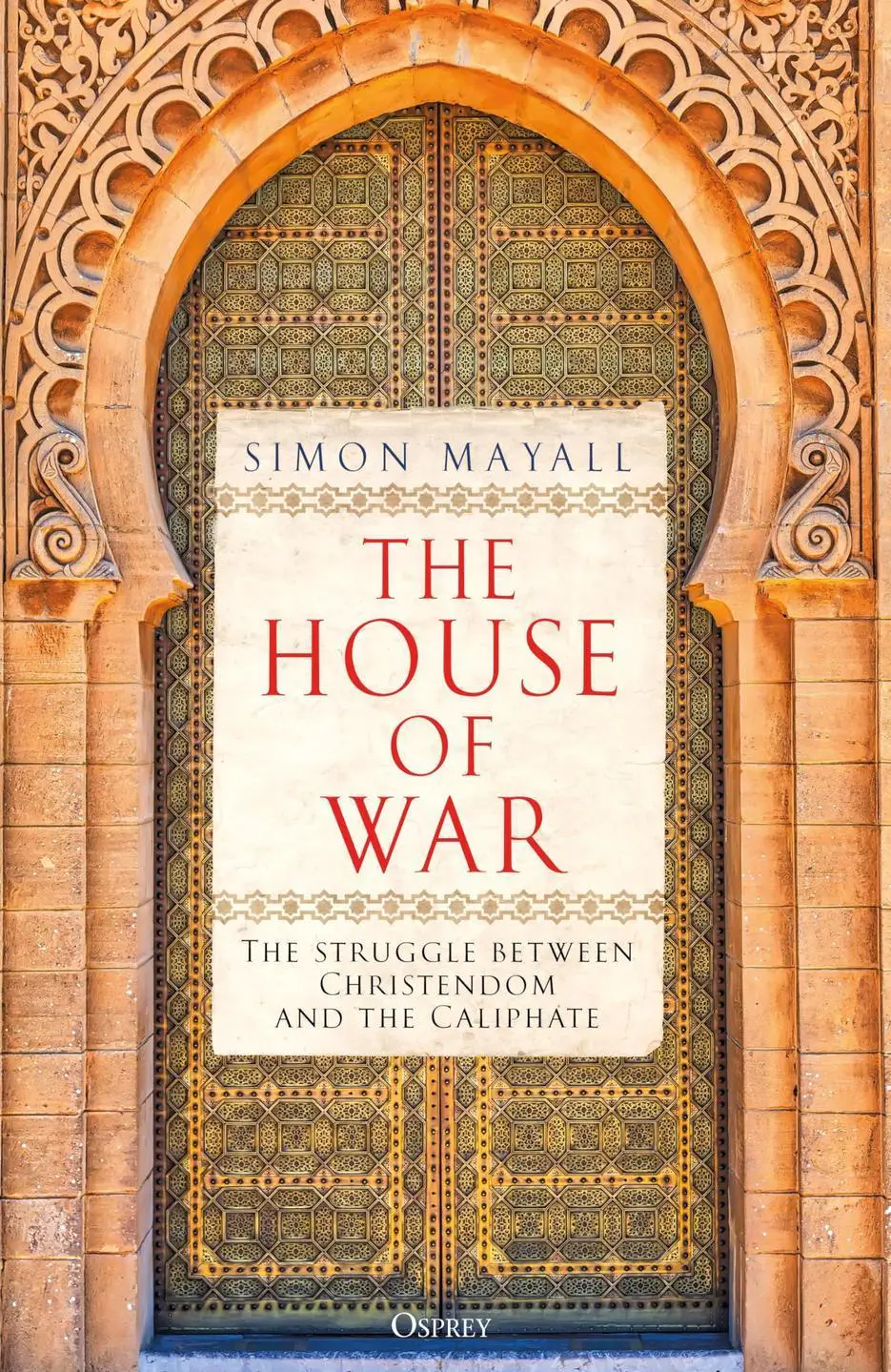
Lt Gen Sir Simon Mayall is not just another soldier with a sideline in military history. He is a serious scholar, a Balliol historian whose 40 years in the Army have given him a deep understanding of the Middle East. His House of War is a great narrative history, timed like one of those slow-motion videos you take on your phone. It begins at normal speed with the Byzantine-Persian wars that left both empires exhausted at the dawn of the Islamic epoch, slows down to take us in hi-res through the Crusades and the wars between the Ottomans and the Holy Roman Empire and speeds up again from the Siege of Vienna to the present.
Mayall homes in on seven key battles: Jerusalem (1099), whose capture led to monstrous atrocities by the victorious Crusaders; Hattin (1187), when the True Cross was lost; Acre (1291), which marked the expulsion of the Franks from the Holy Land; Constantinople (1453), the final fall of the Roman Empire; Rhodes (1522), when the Knights Hospitaller were driven from their island home by the Turks; Malta (1565), when they managed to cling on; Lepanto (1571), which saw 40,000 men killed in four hours of intense galley warfare and Vienna (1683), which began the melancholy, long, withdrawing roar of the Ottomans from the Balkans.
Plus an epilogue: Allenby’s triumphant entry into Jerusalem (1917), which Lloyd George declared was “never again to be restored to those who so successfully held it against the embattled hosts of Christendom”.
Mayall is, unsurprisingly, very good at battles. He starts each chapter with vivid descriptions of the key combatants, rather like a Bernard Cornwell novel. Yet amidst the flashing scimitars, glittering breastplates and colourful turbans, there are deeper currents. This was not a straightforward clash of civilisations: both sides were too internally divided for that.
After the Sack of Constantinople in 1204, some Orthodox Christians understandably saw the Latins as a greater menace than the Turks. Conversely, there were moments when the Fatimid Caliphate (which was Shi’a) offered to join the Crusaders against their Sunni rivals.
For 250 years there was an alliance between France and Turkey, “the sacrilegious union of the lily and the crescent”. The Ottomans generally approved of Protestants, whom they saw as fellow opponents of priestcraft, idolatry and indulgences. Elizabeth I pursued a flirtatious correspondence with the Ottoman Sultan, stressing their shared dislike of religious icons and clerical hierarchy.
She even joined the Moroccans in raiding Spain, scandalising Catholic Europe. That alliance, which allowed Shakespeare to draw the sympathetic characters of the Prince of Morocco and Othello, opened the door to a fruitful traffic in ideas, explored by academic Zulfiqar Ali Shah in Islam and the English Enlightenment (2022).

Many seventeenth-century English religious radicals were fascinated by Islam. They admired its denial of Original Sin; implicit republicanism; elevation of property over poverty; emphasis on reason over blind faith and (relative) tolerance of religious dissent. Above all, they were drawn to Islam’s simple monotheism, its rejection of the Hellenistic and pagan excrescences grafted on to Jesus’s teachings by St Paul and later by the fourth-century Roman authorities.
Several English radicals were Socinians, Unitarians or Deists who rejected the doctrine of the Trinity, seeing Jesus as a divinely-inspired human prophet. To more orthodox Anglican contemporaries, this made them “Turks’ or “Mahometans’ — a view shared by many Muslims, then and since. “When we read Paradise Lost, we feel that Milton is a devout Muslim,” wrote the Egyptian scholar Louis Awad, noting the poet’s rejection of ritual and of priestly authority.
Did any of the English freethinkers see themselves this way? Yes, in some cases. Henry Stubbe’s Account of the Rise and Progress of Mahometanism and a Vindication of him and his Religion from the Calumnies of the Christians (1671) went as far as any contemporary tract could in making the case for Islam. John Toland’s Christianity not Mysterious (1696) likewise made a case for religious rationalism that drew on Islamic theology.
Both saw Mohammed as going back to the original message preached by Moses and Jesus before popes and prelates overlaid it with mumbo-jumbo. In his emphasis on free will and rejection of caste, the Prophet seemed a radical of their own stripe. Both admired the religion itself rather than contemporary Muslim rulers, who they felt fell short of its standards.
Stubbe was a contemporary of John Locke’s at Westminster, where boys learned Arabic alongside Latin and Hebrew, and at Christ Church, Oxford. Locke, who was circumspect about his more controversial opinions, corresponded with his school friend and apparently warmed over time to his anti-Trinitarian views.
Given that Locke has a good claim to have invented our modern understanding of the relationship between individual and state, pioneering the idea that politics is about rights and consent rather than divine or monarchical authority, this strikes me as a remarkably under-explored theme. Although the Enlightenment was a Western — notably English and Scottish — phenomenon, Locke and his contemporaries were not writing in a vacuum. They were drawing on current thinking, including Islamic ideas on religious toleration, rationalism and proto-capitalism.
Here, then, are two very different books, one written by a British soldier and aimed at the general reader, the other by a thoughtful, meticulous Islamic scholar. Yet both serve to remind us that, from a Muslim point of view, the religious wars were at least partly inspired by a desire to liberate Europeans from the perceived backwardness, obscurantism and intolerance of the Roman church. Funny how we remember them now.